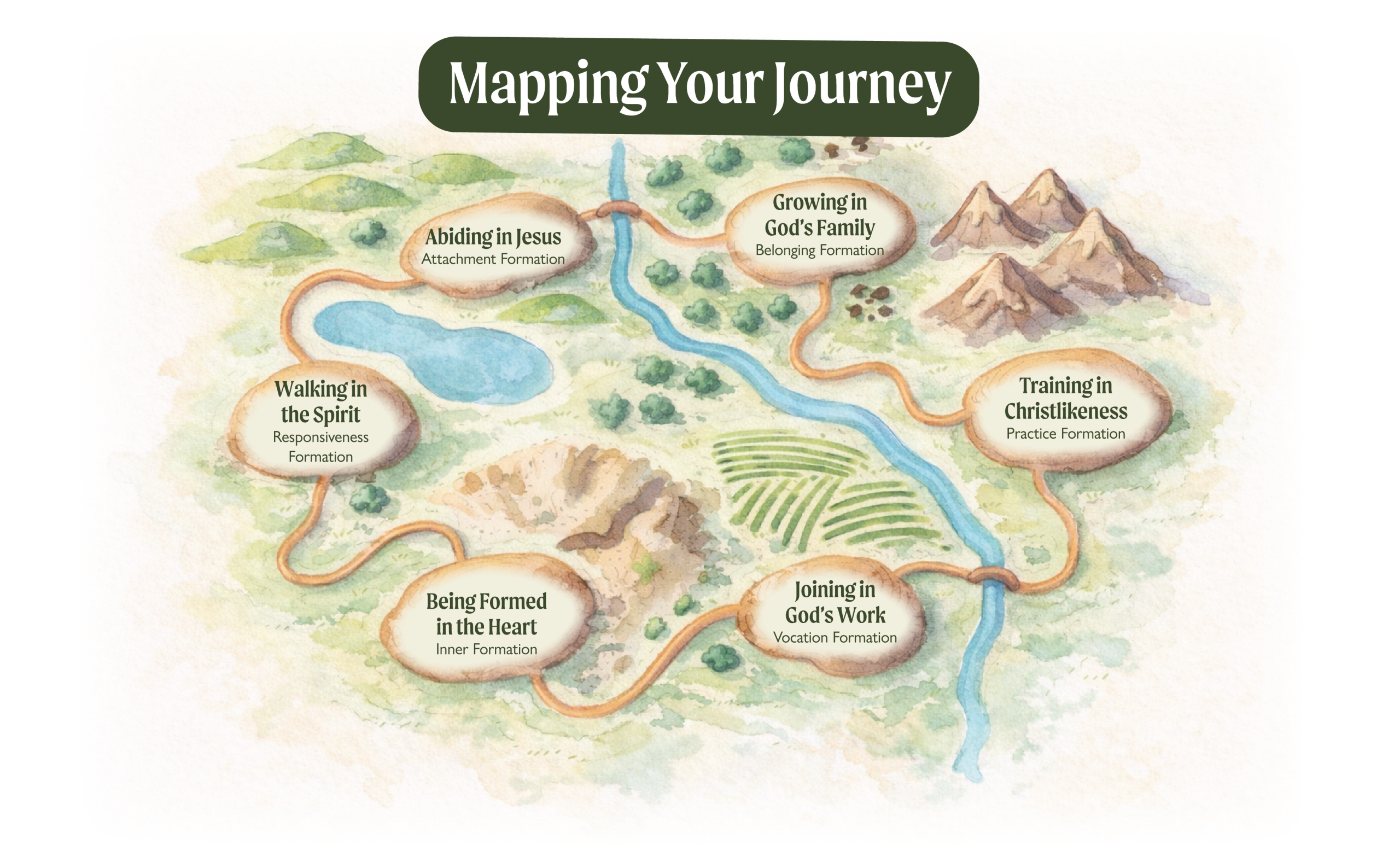
Maps can be helpful in seeing a larger landscape. They help answer relevant questions such as “Where are we?”, “Where am I going?”, “What might I expect along the journey?”. In this episode of Breaking Bread, Isaac Funk and Arlan Miller have a conversation about six movements along the path of spiritual growth. They give us a map to help us understand what growth in Christ looks like.
Part 1
View Full Transcript
I remember when I was younger in faith, and maybe you guys have had similar experiences, where you anticipated your journey looking different than it did. Everybody has this winding, turning road, this journey experience. The journey itself is where Christ is going to do some of the most important work in us this side of eternity.
Welcome everyone to Breaking Bread, the podcast brought to you by Apostolic Christian Counseling and Family Services. Excellent, as always, to have you along. Arlan Miller and Isaac Funk are with me today. Great to see you guys. Good to be here again, Matt. Yeah, glad to be here. We’re going to be talking a little bit about mapping.
I loved maps as a kid. The atlas. Dad would get an updated atlas every year. So, when we were on family trips, I’d just follow with the finger where we were. It’s a bit of a lost art. I’m not sure my kids would do very well with that. Yeah, Google Maps has made it a very different game these days.
Yeah. But the idea of a map on your lap has some real advantages, and I think one of the advantages is you really have a really good understanding of where you’re at. Yeah, it gives us some context for what’s around us, helps us locate ourselves. Somehow, I still find myself incredibly directionally challenged, and I think that’s because I see just the arrow in front of me on the Apple Maps or Google Maps right now or whatever, right?
And so yeah, it would help us just to zoom out and to take a look at the whole landscape around us. I think it’s that perspective of where we are in the scheme of things, and that’s what a map helps provide. As much as we could probably fill an hour on pontificating and reminiscing about map reading, as we think about the journey of growing in Christ likeness, the journey of spiritual formation, the journey of the Christian life is one for which a map could sure be helpful.
Absolutely. Yeah, I think that this concept of a map for our spiritual journeys is immensely helpful, and it’s something that Christians throughout time have tried to put their finger on because we’ve experienced life with Christ and that it’s not always turning out the way that we anticipated it.
I remember when I was younger in faith, and maybe you guys have had similar experiences, where you anticipated your life looking different than it you’re your journey looking different than it did. And to understand that everybody has this winding, turning road, this journey experience is just helpful to me to know that I’m not alone in that.
And that it is the journey itself where Christ is going to do some of the most important work in me this side of eternity. So yes, the idea of a map for my spiritual life is a real aid to my ability to live today. You mentioned expectations and things being different than what you expected, but certainly having some expectations is really helpful, right?
Even the expectation that it’s going to look different or the expectation that, “You know what? I’m probably going to have to take some turns and the journey’s not going to look exactly the way I thought.” But that’s partly the blessing of mapping, is that you have some sort of shape that you can expect your life to take.
This idea of mapping growth and having expectations and knowing benchmarks is good. Why is it that sometimes we feel like we’re blind and nobody knows? Yeah, so this is the thing to point out here that the map we’ve been given for our spiritual lives is not, “Here’s point A to point B.” It’s not a straight line.
It’s not a straight shot of growth. It’s an organic picture of growth, and it’s slow, and it takes time. The pathway is winding, and I think part of the reason for that is how we define discipleship. Here is the journey of learning to live our entire lives in the way of Christ and helping others to do that, too.
Jesus is reaching into every aspect of our life, our thoughts, our reactions, our habits, our relationships, our work, our hurts, our deepest wounds, our desires. All of that stuff, Jesus is reaching into and wanting to change into his image. And that’s what spiritual growth looks like. All of those parts of us being more and more formed or conformed to his image to look more like love.
And so, that journey is not a straight line. Here’s point A, here’s point B. But you’ll start off where you are, and then you’ll go on this winding journey with God and with each other and with other people, too. And we’re going to step through six different movements of spiritual growth.
Arlan, maybe give us a little bit of a preview, and then we will step into them one at a time. Sure. And you use that word movements intentionally, Matt, and I think that’s important. Sometimes you’ll hear the word stages or sometimes you’ll hear something a little bit more defined.
As we see so often in life it’s maybe not quite as exact. There’s a uniqueness. There’s a winding-ness to it. And sometimes you come in one or you go out of another one quickly. Sometimes they happen fast. Sometimes they happen for years. Sometimes you can get stuck in a stage. But there’s often just progression through the six movements.
We start with this idea of abiding in Jesus. Then you often see growth in God’s family where others come into the picture. Training in Christlikeness would be another movement that we identify where you’re building up practices. Then often there’s joining into God’s work, where might he have you engaging in a place where you see your gifts, your talents being used for his kingdom.
Being formed in the heart is the fifth movement we identify, where there’s the inner formation, the inner change. And then the final movement is this vision of walking in the Spirit. It’s almost full circle because it’s another depth of abiding but at this much deeper level of where you see that union with the Spirit, the Holy Spirit, and his work within our lives.
I think every seasoned believer would resonate with that cyclic of, “I feel like I’m back at the beginning.” Isaac, let’s just take these one at a time and just move through them. Six different movements. Yeah, I like this idea of movements being something – that there is no hierarchy to these.
It’s not like someone who is in abiding in Christ is further behind someone who is joining God’s work or walking in the Spirit or whatever, but that these are. You can even be in multiple ones of these perhaps at the same time. So just acknowledging that at the get-go I think can be helpful.
But if we were to take each one as its own movement, abiding in Jesus is related to this reawakening to a new reality before you that God is alive, that he loves you, and that he’s calling you to himself. And so, abiding is just to make your home somewhere.
You abide you make your home there. So, you make your home in God, in Christ. This is the John 15 language that Jesus uses for his disciples’ relationship to Him. “You will abide in me. And so, you’re going to draw your life from me. You’re going to draw your identity from me. You will be changed by that connection with me and bear my fruit.”
And as that’s going on, he’s actually weaning us off of the attachments from other things that are competing for our attachment to God. There are a lot of things in life that I come to desire and a lot of things in life that my thoughts will circulate around, my anxieties, my fears, my dreams for my life, whatever.
My thought life can make its home in those things, but Christ is calling me back in some seasons of my life more clearly than others, to leave those things behind and to find my thought life, to find my identity, my greatest desires in his presence alone. The word that sticks out to me is attachment, both the loosening of unhelpful attachments or unhealthy attachments and then to reattach, which I think those who study the maturation of a child would say in infancy that attachment to the mother is like super important right out of the gate, right?
Isn’t that what research is showing? And so, for that to be first mentioned, again, not that we wouldn’t come back to it, we certainly will, but there is a beautiful foundation there that we’re talking about attachment formation here, and that attachment is being attached to the Father.
And you can think of all of the damage that is done when the child is not well attached to its caregiver and that breeds all sorts of issues later in life and just real challenges. And it would be the same in our own spiritual development and growth if we are not sufficiently attached in a loving relationship with God, then none of the other things will stand.
We get a lot of tangles, a lot of mess-ups along the way if we can’t get this foundational piece in order and return to it again and again. You’ll never graduate from this movement of abiding in Christ. Everything comes from there. Yeah. I’m mindful of what Christ said there in the Sermon on the Mount where he just sums it up and he basically says, “If you build your house upon the rock, it will stand. If you build your house upon the sand, it will fall.” And this movement really just keeps asking us that question over and over again. “Are you abiding in Me? Are you attached to Me? Are you grounded foundationally in me, or is there something else?” So foundational and yet a recurring foundational–type movement.
There are some questions that you might ask yourself to reflect on this particular movement and say what’s next for me with this? Yeah. So, if I’m going to respond to Christ’s invitation to come and abide in him, I’m going to have to leave other things behind and focus my attention on him.
How could I be with him if I’m not thinking of him? And so, I might create habits in my daily life, including the first thing when I wake up and the last thing before I go to bed, and I’m training my mind to think about God and to think of his words to us through the Scriptures and meditating on those and mulling them over. Mine would be similar, Isaac, in the sense of the first thing in the morning and last thing at night, definitely, but even just throughout the day, what are the practices or the habits that bring me back to have God and Christ in the forefront of my life?
Yep. I think as many times as you can do it throughout the day and just call us back home to him. You go back to that infant child being attached to the mother. It’s a function of time and presence, isn’t it? You don’t learn your way into attachment with mom; you live your way into it by she being present with you and caring for you. So, allowing ourselves to be cared for repeatedly, yeah, continual behavior.
Let’s go to the next one. This movement is growing in God’s family. It becomes more about where do we belong? And the Christian life is not a solitary life. There’s an aspect of it that’s solitary. But early on and often, God calls us into relationship, into community. And you will see that in this movement where that growth of faith should transcend from just myself in Christ to myself in Christ’s people. There were disciples that he called the Church as an early portion of it, and that community aspect is a key aspect.
And so, how do we continue to grow in our relationships with others? So, do I belong in Christ’s family? Am I a part of his family? But part of healthy spiritual growth over time is this engagement with his people. Absolutely. So, if the movement of abiding in Christ is allowing God to form our hearts through our loving attachment to him, growing in God’s family as a movement is allowing God to form our hearts through belonging to his people, as you said, and allowing those relationships to be the very things that hHe forms us through.
I don’t know if you’ve had that experience or not, but oftentimes we experience the good, the bad, and the ugly in close community that Christ calls us to, and all of those things are tools in his toolbox to form us more to look like him. We learn to really love people, and we learn to really allow ourselves to be loved and known by other people.
So, all of that happens in community. And Christ took this very seriously. There are Scriptures on “If you say you love me, but you don’t love your brother, the truth’s not in you. You don’t know what you’re talking about.” “As much as you’ve done it unto the least of all these other people, you’ve done it unto me.”
So, our lives with other people, our relationships matter a great deal and are an essential part of how we follow Christ as his disciples. There are some questions that you might ask yourself to reflect on this particular movement and say what’s next for me with this? I think it’s going to look different for every person. Some of us are more extroverted, some of us are more introverted, some of us like large groups of people, some of us like smaller and more intimate type settings. But there is a heart question that says, am I drawing myself closer to his people? Do I have a desire for connection with God’s people? That’s a heart level question that I think is a really important litmus test or gauge to an aspect of the health of my spiritual life versus am I moving towards isolation? Am I moving towards withdrawal? Because maybe it’s uncomfortable.
I was telling someone just recently that I’m always right in my own mind, right? And then when I start to engage with others, I find out that maybe I’m not completely right. And that takes humility. That takes love. And those are things that I think we need to be asking ourselves with this stage.
Yeah. So just along that line, am I allowing myself to be corrected by others would be a good question to ask if you’re growing in God’s family, am I allowing myself to be exposed before others? Am I teachable? That, and also the other side of it too is, how am I doing that for other people?
Because not only do we learn by being exposed and being corrected, but we also get to engage lovingly with other people, showing them compassion, showing them the love of Christ as they are exposed to us. And how are we serving our community? How are we serving our local church? All of that is part of how God forms us in community.
Yeah, I really love it. I think it’s easy to see in this movement how this happens at different levels. Yeah. Everything from showing up at church, being baptized into a church. That happens for the early believer, baptized into a group. How to grow in that community I think is really excellent.
Let’s keep moving. A third movement. Isaac, you want to take this one away? Yeah. The third movement is training in Christlikeness, and training in Christlikeness is God forming us through the practice of habits in our life. Are we practicing things that we generally would call spiritual disciplines?
Are we intentionally becoming people who are looking more like Jesus and his character? So, the question we would ask ourselves here is, what are the habits of my daily life that I’ve lived into just as a matter of course? I woke up, I went through the day. Okay, what are the things that I’m doing on a normal daily basis that are actually forming me or that are changing me on the inside, the kind of person that I am, the kinds of desires that I have, the kinds of thoughts that I’m thinking?
And are those what Christ would have for me, or are they different? Are they what he wants for me? Are they making me more like him, more loving towards him and other people or not? And so, in this movement, it’s coming to terms with that. My life is not necessarily arranged in a way that helps me become a person of love, joy, peace, patience, kindness, goodness, and the rest.
So, what are the things that I can plan into my life and with other people? We don’t have to do it alone, just my life alone, but how can I engage with other people to do this well over time, not immediately, but over time to form new habits in me that actually help me grow, help me spiritually mature?
I think it starts with that fundamental understanding that we are being formed. We are being shaped by everything around us, and then it goes into this place of saying, “Okay, so if that’s a truth, if I am being formed, what is forming me like Christ? What type of person am I becoming, and am I ready to be serious about that?”
So again, if you think about just mapping the journey, at some place within that journey, there’s a movement that says, “Okay, this is more than just showing up. We use the word, training intentionally. There is a training that takes place there because I’m going to be intentional about thinking about who I’m being formed into and trying to turn that formation into a Christ-like manner.
Yeah. Eventually, we find out along the journey, and at recurring times, that I’ve just fallen into a pattern of habits that actually aren’t serving my life with Christ at all anymore. And maybe at one point they did, but now it’s just not that. And so yeah, it’s just revisiting that. Okay what can actually be changed in my daily life that can help direct me more towards Jesus? If either of you would be willing to share. You’ve both been on this journey with Christ for a long time. What were some of the early practice regimens, training that you found yourself in as a young believer and how has that matured?
What does that look like at this juncture in your life? I was challenged early on in my spiritual life by a group of young men. We were early believers together, and we established this thought that we were going to spend a certain amount of time every day with God. And we made a pact. We called it a pact, right? And accountability and all that kind of thing. And I would say, early on, that looked a certain way, right? Okay, this much maybe prayer and Bible reading and maybe a little bit more formal. It just seemed to be.
And almost regimented. I set the timer, and if the timer doesn’t go off, you stay in there. But the heart of that discipline has stuck with me to the point where every morning there’s quiet time, you call it whatever, and it’s a longer period, and it’s communion time, right? But that sets my day in a good direction. It re-emphasizes what is most important, what type of person I want to be formed. And 30 years later now, it’s still a practice that is near and dear. I get cranky if I don’t get it. Which is not godly, right? It reveals certain things.
But it’s there. Yeah. I would say fundamentals seem to be Scripture intake, getting God’s Word into you, especially as a foundation, so important. However you can do it, whether your schedule allows and your stage of life allows for quiet time in the morning for an extended period of time or a lunch break or driving in the car audibly listening to the Bible, whatever.
Getting the Word into you, praying, getting into a habit of prayer is so important, and then regularly connecting with God’s people. So, whether that’s your Sunday time together and a Wednesday night, other times scattered throughout the week, as much as possible, build in rhythms, build habits into your life of getting with God’s people, praying, and taking the Scripture in.
Now, in all of those things you need a real good healthy dose at the start, and you never want to let those things suffer. Keep those as a priority. And then as time goes on, you’ll find that these alone are not sufficient for Christ’s full life to be formed in every part of us either.
And so, you’ll adopt things, practices like silence. Being quiet especially with all the noise around us, digital noise, phones, all of that stuff. Unplugging, you could just tie that into silence perhaps. Unplugging is a way to train in Christlikeness, forming a habit that helps point me towards Christ.
Generosity, giving, tithing, things like that. Other types of service and witness-bearing to Christ in our communities. All of these things are ways that we train over time. But I would say the big three to start with, and that really should stay quaint cornerstones, Bible intake, prayer, regularly gathering with other disciples of Jesus.
That’s good. What’s a warning that you’d say, “All right. With this movement, bear this in mind”? And maybe another thing would be like “This made a huge difference for me when I understood this. Fill in the blank about this particular movement that has come over time.” Yeah. I think continually finding that balance between what is my effort and what is God’s working.
What’s Philippians say? “Work out your own salvation with fear and trembling, for it’s God that worketh in you.” Just that balance between that, because it can quickly go into this place of like I talked about earlier, regiment and performance and then my attitude and emotions are based upon, did I do well or did I not do well? And that’s not the heart of it, right? To try to keep it in this place of more of a communion opportunity. Being able to evaluate it appropriately. That’s an important warning.
That’s good. Yeah, I think right along those lines is recognizing that all of these activities that I partake in are just cooperating with grace to do what only God can do in my life, and that by doing these things I’m not earning anything from God. I think that’s the legalism trap. This attitude that I earned this. Or that I can actually control my spiritual growth and my spiritual maturity. I can be more spiritual than that person over there. I can be more mature. I can have greater grace in my life, favor on my life, whatever, because I read the Bible for an hour, and that guy only reads it for five minutes every morning.
Can you imagine that? Okay? That’s a huge distortion of the role of spiritual discipline. We don’t get to control our likeness into Christ. But it’s something that we intentionally offer ourselves for him to form us through disciplines like reading. What I hear coming out of that, too, is for the love of God I do these things as opposed to some other objective, which could be good, actually. Yeah. It’s like any intimate relationship you have in your life, over time it grows to this sweetness of just being together that is really beautiful.
I think these do map somewhat on the growth of a child, right? From attachment, to coming home into a family, to learning to do things in rhythms and to build this young child as a person who says thank you to people or please and thank you, all these things, right? So, we have a concept for the maturation of a life that I think does map spiritually as well, and I think we’ll see that in the next movement, right? The next movement, I think, as you explained it or introduced it, Arlan, is joining God’s work. What I get is a sense of, okay, now actually living for God.
But we will take on that movement and two more next time when we return in part two. Before we go Isaac, I want to take a few moments and just share with our listeners some exciting opportunities in this spiritual formation space and what’s available. We had a wonderful week that we call Abide Week, down in Peachtree City in May, where a small group of people got together and there was teaching and an opportunity for retreat and time for growing in God in some beautiful ways that we’ve really touched on here today.
We’ve got a few more opportunities coming up in the near future. Say what you want to say about the Abide Week, when it is, where it’s at, and how a person might say, “Hey, that might be for me.” Yeah. So, as you said, the Abide Week is a six-day event through Scriptures. We have time in stillness, time with reflection in a small cohort of other people from our church that is designed to help you live from that deep connection that you have in Christ, what we had talked about in this episode of abiding in Christ.
So, it’s really a week to slow down, to rest in God’s love, and to learn to notice his presence in the ordinary moments of your life. So, we have a couple more of these weeks coming up. The next one coming up is August 30th through September 4th. That’s going to be in Monticello, Illinois, at the Allerton Retreat Center, a beautiful location. We’ll gather with a small group there and spend those days together. And then the one after that is September 27th through October 2nd, and that’s in Syracuse, Indiana, at the Quaker Haven Camp. Both of these beautiful locations are great opportunities to connect with like-minded believers in a small group and reflect together, just rest in God together, and learn along the way.
You can sign up at accounseling.org. There is an Abide webpage there that shows all of our upcoming events. There’s a registration button right there on the webpage. There is a link in the show notes. You can find those there. It will take you to the registration page and more information on the website.
Thank you, each one, for listening. We trust that this has been a blessing.
Part 2
View Full Transcript
This is more than I can bear. I’ve turned the corner and, there’s a desert in front of me when I thought there was going to be something lush and green. Welcome everyone to Breaking Bread, the podcast brought to you by Apostolic Christian Counseling and Family Services. Excellent to have you along.
Today I am airing the second part of a podcast series that I had with Isaac Funk and Arlan Miller as they talked about six different movements of the spiritual life. These are movements of growth, places where God is working in us and with us. In the first episode, we looked at abiding in Jesus, that is attachment formation to the Father, then growing in God’s family or belonging formation with others, and then we looked at training in Christ-likeness and practice formation.
Now, in this episode, we’ll look at the final three. And right now, let’s begin with joining in God’s work, vocational formation. Thanks for being with us. Yeah. So, joining God’s work is basically asking the question, what has God placed into my hands that he has given me to serve others, to love others well, or to love him well?
So, what is my calling or my vocation is another word for that. What’s my responsibility. And in this movement, we realize that we’ve been given something to do something with and that we’re going to serve, we’re going to create, we’re going to lead, we’re going to nurture, we’re going to witness and take on some responsibilities. We’re taking on responsibilities and carrying that as Christ himself would do it.
What we find in this movement oftentimes is the invitation to really dig in here and our work for God tends to become our identity. We start to take on responsibilities as the main thing, like the most important thing that we’re doing rather than simply a response to what God has given us. I’m hearing a caution there.
Yeah. So, there’s a caution. I think that it’s easy for the work that we do for God to outrun our life with God and to use the outward, the noticeable service for God as this is what I’m here for. This is the value I bring. And it covers up our own ego. Yeah. Which is a caution but it’s not necessarily a bad thing that it’s there. Everyone will have some degree of that, and the idea is that will be revealed through this movement. And part of the invitation is to recognize that it’s there and then to offer that back to God. And this is partly what I want to point out, and the beauty of a map is part of what happens, and we talk about expectations.
I think we can expect, for example, to get sideways with the training. Isn’t that the experience of everybody who walks through the terrain? We can expect to get sideways with joining God’s work and taking on the identities and valuating ourselves and finding our value in it. It’s almost the map. You can expect that at that juncture. These are some of the things that we need to learn, though, and that God will grow us in this place. Yeah, it’s vitally important that we become the kinds of people who can join in God’s work. But more so than that, he’s interested in forming us into the kinds of people who are capable of carrying on his work in the manner that he himself would do it. And so yeah, the idea is we continue doing these things, and it’s good that we do them, and it’s good that we serve people, but also recognizing that it’s in this place God is wanting to form the deeper parts of us as well so that we can carry his responsibilities with hearts of love and compassion for others.
And again, we’ve said this isn’t necessarily an order-type series of movements, but there is something about the idea that you get your identity in Christ right first, ideally, and then the work healthily flows out. Now, again, you have to guard against extreme thinking there, where oh, I’m not ready to step into something, until I get to a certain point. We can disqualify ourselves really easily. But if we don’t have a rooted foundation in Christ, it will too quickly become about the things that we do, as opposed to an opportunity to share Christ through the activities we are called into.
Another side of this I just want to emphasize, I think we’ve already mentioned it, that when we talk about joining God’s work, we’re not only talking about church work either, or evangelizing or something like that, which is good, or disciple making, mentoring, whatever. But we’re also talking about just the normal work that somebody does in their daily life, someone who’s raising kids, someone who is going to the office Monday through Friday, somebody who, like, all of the things that we find ourselves doing that can produce good in the world.
Those are the things that, in this movement, God is really trying to get at. Because again, discipleship is a journey of learning to live our entire lives in the way of Christ, which includes the 9:00 to 5:00 or the 8:00 to 5:00, whatever so that’s included in this too. How are we doing those things? How are we doing that work in the way that Christ himself would do it?
I really like that, Isaac. And if I were to make a guess, when you were first converted, you would have not had that category or that understanding, right? Oh, absolutely, yes. But over time, you have matured to understand that it’s like, “Oh, right now I’m getting groceries. This is what it looks like.” Which I think is more to the point of coming back and around to these movements over and over. And they take on more color, more hue, more fragrance, more detail, and with all of that, greater possibilities and more blessings and more joy. Which is what we want to capture here.
Let’s move to the next one now, number five, being formed in the heart, and I think what we can perceive here is that we’re going inward We might be mistaken to think that wow, once we join God’s work, isn’t that the end? But there’s more work that God does in the heart of the believer. Arlen, you want to say more? Yeah, sometimes you could almost view this as a pruning phase in some ways the John 15 passage about abiding. God is constantly working in that the husbandman is constantly working, and he’s even pruning branches that bring forth fruit that they can bring forth even more fruit.
Because his desire is to conform us into his image all the way down to the depths of our being, and that is a process that I don’t think ever is done on this side of eternity. And so, you’re going to see just layers and layers of inward formation that takes place here. This is often not pleasant. It exposes some of the corners that maybe we tried to hide or the nasty crooks that we thought weren’t there. But it is making us into a sweeter and sweeter vessel each time we walk through this opportunity. Or whenever you prune a thing, you cut it back, which is a painful thing, but also it seems like it’s going in the wrong direction.
It’s like, what? You’re going backwards. Why are you taking that off? But there is a deeper pursuit of the gardener. Isaac? Yeah, I think you’re hitting on something that could be a potential ditch in this, is it becomes some sort of navel-gazing or almost like a self-improvement thing here.
It’s like, “Oh, I’m just really focused on myself right now, okay? I’m being formed in the heart” without recognizing its rightful place is that you would bear more fruit. It is going to be for the sake of more fruit-bearing in your life for the sake of other people. And so, we just won’t want to lose sight of the fact that this is not inward for the sake of being inward, but that it is deep work so that what comes out of us can be more genuine, more mature.
How would we talk about inner formation, if we can use that phrase. What then is being formed? What is the inside stuff that God might be after in this season? Yeah, and I think that’s really important to put our finger on, too, is that God is after more than just behavior change for us. We talked about discipleship being all the parts of ourselves, our thoughts, our desires, inner motivations, all of that. And in this outward journey of life, growing in God’s family, training in his likeness, being intentional with that, joining God’s work is all pushing outwards.
And then you start realizing, man, there’s just some things about me that I can’t stop. There are some real blemishes that I bring into my community, into my walk with the Lord. Maybe I’m really egotistical or something, and I’m just so selfish and self-focused, and I just cannot turn that off.
Maybe you’re overly sensitive or insecure or those kinds of things. That’s where they show themselves in those places. Yeah. Like in community, they show themselves outwardly. And this being formed in the heart is the thing beneath the thing?
What needs to be changed deep inside of us that is actually producing those actions that maybe you or other people are identifying as unhealthy? Speak a little bit about the maturation of life. It seems to me that there is a bit of maturity required even to be able to put our finger on those things, right?
These things might be blind to us that life surfaces. Is that fair? Absolutely. Yeah, I think as you go through life, you have more opportunities to pass through a time of pruning like this. But I think you’re also pointing to this idea that these are all interconnected and go to this one like you’ve gone through some others.
You’re not going to be formed in the heart outside of Christ’s community. You’re not going to be formed in the heart outside of some real intentional practices that you’re trying to form. And so yeah there are precursors to this as you go, and then this leads to something else, and you find yourself spiraling back around to it in different seasons, different stages of life.
I really want this to be vivid. I’m not sure it’s vivid yet. But sometimes that’s made vivid in example. Is this the dark night of the soul that some Christians speak of? Is this the refining part, the refinement, where people feel like they’re in a crucible? Often it comes with places of difficulty where maybe somebody goes through something difficult in, and it pushes them to a place of surrender.
Whereas they step into that, they realize “Okay, I had put too much stock in X, and I need to find my anchor, my root, my core in Christ.” Yeah, so I’ve got an example that came into my mind as you were talking, Arlan. Transitions are huge opportunities oftentimes for being formed in the heart.
So, whether that’s a job or a location or something changes in your family, the loss of a loved one, whatever. I remember moving from Peoria, Illinois, to Peachtree City, Georgia. That was a loss of some sort of identity that I’d built around myself, whether as a music teacher or as a member of the Peoria Church or whatever.
There’s an identity I’d built for myself, and then suddenly I was in a place where none of that mattered anymore. And I had realized that I had rooted myself in something other than Christ, and he would use that as an opportunity to just challenge some things about the way that I was living, seeing myself, and I remember the story of the man who says Christ challenged him, “Do you believe?”
And he says, “I do believe. Help thou my unbelief.” A sense of faith is like I have faith- … but here now I recognize by what life has pressed upon me. Here I recognize the incompleteness of my faith. Sure. I love, but now I realize what my love has been attached to and has been dependent upon, has been leaning on.
I’m secure, but now I recognize through transition, through loss, through these matters, where I have misplaced my securities. Is that starting to speak to it? So sometimes people talk about hitting the wall. Speak to that concept. I know that’s a phrase that’s used and that it is not uncommon for believers to come to a place in life where they have to reimagine a lot and understand things afresh. Yeah. And I think part of this movement is that you can’t force it. It comes upon you, and then in the midst of it, you have a choice as to how you’re going to respond to it. Often, I feel like this is the time when life circumstances press down into your life, and again, are you going to choose to go Christward, or are you going to choose to go a different way?
And I think that wall experience can be common around this time, where it can emerge in a lot of different ways, but sometimes I think it’s just like you get to almost to a place of being overwhelmed or like this is too much. This is more than I can bear. I’ve turned the corner and, there’s a desert in front of me when I thought there was going to be something lush and green.
And again, that’s often pushed upon us, right? And God, in his sovereignty, works through all of those things, as opposed to sitting down and saying, “Okay, now I’m going to figure this out.” It becomes more our response and how we react to those things. And that wall experience is often that time of patient waiting, trusting, listening, but continually turning to the Savior as opposed to something else.
I think one of the identifying marks of a wall to other disillusionment in your life is that it really targets how you view God and the way you relate to him. And the way that I understood God to work in my life at one stage is now turning out different than what I thought would happen.
You used this idea; I thought my life would be a lush garden. I prayed. I obeyed. I did the right things, and now my life is not. It doesn’t feel blessed. And it was supposed to be that way. God was supposed to give me those things that I wanted. Part of what comes through this movement is a recognition that God has been faithful, but now I understand what that means in a new way.
Now God has always been loving. I believe that, but I see what that looks like in a fullness that I previously did not. But sometimes that feels like doubt. Sometimes it comes to you like that. Questions come up that just feel really deep and important. Or sometimes it’s like a dryness in your spiritual life that feels like I’ve been at this for a while and I’m just coming up empty. Yeah. And you have great scriptural examples. You can think of Job at the end who says, “I’ve heard of you, God, and now I have seen you.”
But that was after a really difficult, hard experience. Or you can see David throughout the Psalms where you see his character is someone who always is turning back towards God, working through really hard circumstances where he has all kinds of reasons to doubt and did doubt.
Where are you, God? Those kinds of things. Yeah. Yet you see him continually turning back to him. That’s part of the behavior and the reaction that’s really helpful in these situations. And part of the hope of this conversation, again, the concept of a map is that this can be expected.
When you are looking at a map and you run into that desert, you know it was coming at some point, right? You understood that. So, my question here is, if one doesn’t understand or doesn’t know that this is part of the Christian life, I could imagine a great deal of disenchantment or could we say deconstruction.
You mentioned how doubt is very much a part of this stage. Does it always turn out well, or is there something we should bear in mind so that it does turn out well? Yeah, I think it is important to mention that suffering like that can be a place of deep formation, deep work in us, but the suffering itself is not the forming agent. It will be Christ who does it. And I think Arlan made that point earlier about how you respond to it will matter. It’s like, when all else fails and I don’t understand, and I’ve totally lost control here, what can I do? What can I hold onto? You hold onto Christ. He will be the one to form you.
And it may be an imperfect sort of holding onto or rooting of yourself in him, but I think that will make the difference between someone coming through the wall a changed more whole, complete, loving person than somebody who goes through and ends up actually coming out perhaps more bitter and more disenchanted, more actually unlike Christ rather than more like Christ.
What’s one thing that people should remember about this stage when life presses and you are in the crucible, remember this. Turn towards God. Always turn towards God. I think that becomes the discipline that helps you at least turn in the right direction. Turn to God and don’t try to escape probably would be the other thing to remember. Yeah, don’t try to go around the wall. You have to go through the wall. And that will take time, and that’ll take the loving care of people around us. It may take things like counseling. It may take some real pastoral work in your life. And it will look a little bit unique. I think everybody’s experience will look a little bit unique.
I know we’ve talked on this podcast about God image and God concept. I get a sense that God image is at a crisis in a moment like this in terms of who do we understand God to be, and perhaps that’s part of what happens here, is having a relationship with God that’s been matured.
Is that a true statement? Yeah, I think that’s well said. Let’s move on to the final one. Isaac, the sixth and final movement that we’ve highlighted here is walking in the Spirit. Sketch this out in a way that maybe we can say, “Ah, I see what God’s up to,” in the life of a believer. Yeah. So, walking in the Spirit, I think is, in one sense, really what we’re all going for.
Paul talks about walking by the Spirit, keeping in step with the Spirit when he talks about not fulfilling the lusts of the flesh, but bearing the fruit of God’s Spirit and the work that he’s done in all of these other movements of your life. Pruning or bearing fruit, growing more, and he says walk by the Spirit.
And I think that as you go through that journey, as you traverse this map of spiritual growth, you just find these seasons where it’s like, “Man, I just feel like I am free.” I think walking in the Spirit is forming you into somebody who can walk freely with God and not be so encumbered by the things that at one point ruled you from the inside, whether that’s your own desires, your selfishness, jealousy, pride, et cetera.
And now that you’re just freed up from those things, now you can become more attentive and more responsive even to what God is doing with you right now. What does he have for me today? Can I walk in that? Can I be responsive to how God might be leading me and be responsive to those he brings into my path to love and to serve those that he would have me reach out to love and to serve?
It’s just as you go through these movements, those moments become more and more. I think the goal is for those moments, those seasons to become more and more natural to us. And again, all of these things recur at different times and at different depths, but I think that’s the whole goal.
Yeah. I really appreciate that, and I think if you put this movement of responsiveness juxtapositioned to the attachment of the first one that we mentioned you can see that vision just as we have with our own children, right? That in their secure attachment and the process of their living, that they become responsive and agents in this world, right?
That’s what every parent wants for their children. And I sense that in your explanation here, that there is a similar freedom as well as attunement and reactive responsiveness with the work of God and with him with God himself. That’s right. Yeah. And I would say also that what we’re not saying is that every impulse that somebody has in seasons of life is the moving of the Spirit, and therefore, you’re in this stage.
We’re not talking about impulsiveness. We’re not talking about emotionalism here. We’re not treating every interior impression that we have as divine guidance. But what we are experiencing is what we oftentimes talk about in the Church. We talk about discernment. We talk about convictions. We talk about wisdom, guidance, and prompting, and responsiveness to those things. Oftentimes, we can just go through our life and not even realize that those things are happening to us. And again, this movement is the opportunity for us to practice our discernment, to practice our attunement to how God might be calling us to act in our days.
As we draw this conversation to a close, Isaac, what might be your suggestion for people as we all reflect on our spiritual growth? What are some things that we should bear in mind? What should we keep asking? What should we be looking for? How should we use these six movements? Yeah. So, I think one of the great benefits is having a map and having this idea of growth.
There are different markers and things like that. It is understanding what in this stage of my life is the invitation from God to me. Not how do I get out of here and get somewhere else? How do I stop becoming an adolescent and become a teenager, become a young adult, become an aged person, whatever. But where am I right now, what’s the appropriate next step?
I think part of what it affords us is, yeah, what is Christ bringing to the surface? And what’s he doing right now? That’s right. And not that we want to control any of that, but so that we can cooperate with his Spirit, with his grace, with what he’s doing. So, whether that’s returning to Jesus and abiding, learning to turn our attention and our thoughts back to him instead of the things of the world or the flesh or the enemy, or re-entering into his community in a deeper, more loving, more self-giving way, perhaps, or picking up a new practice, a new discipline, or something that will help draw my mind and my body back to Christ, something for accepting responsibility.
What might Christ be asking me to pick up? What burden might he be asking me to carry in this season of my life to join in with what he’s doing around me? Or what’s he telling me about the truth of my own heart in this season? What’s that invitation? What’s he surfacing in me that he wants to root out of me?
Where is he asking me to seek wise guidance in really difficult periods and dark times of my life, these kinds of wall experiences, these desert experiences? And then how do I respond with clear conviction as I walk out in this world with my head held high because I know that I walk with Christ, that I walk with his Spirit, in his Spirit, yeah, we don’t control any of that.
We just cooperate with what Christ is doing in us in this time, knowing that work is slow. That doesn’t mean anything is required of you, but it’s so that you can be empowered to cooperate with what God is doing and be formed more and more into the kind of person that he has in mind for you to be.
Thanks, Isaac. Thanks, Arlan. Isaac, I want to take a few moments. We had a wonderful week. We call it an Abide Week down in Peachtree City in May, where a small group of people got together, and there was teaching, and there was an opportunity for retreat and time for growing in God in some beautiful ways that we’ve really touched on here today.
We’ve got a few more opportunities coming up in the near future. Say what you want to say about the Abide Week, when it is, where it’s at, and how a person might say, “Hey, that might be for me.” Yeah, so as you said, the Abide Week is a six-day journey event through Scriptures. We have time in stillness, time with reflection in a small cohort of other people from our church that is designed to help you live from that deep connection that you have in Christ, what we had talked about in this episode of abiding in Christ.
So, it’s really a week to slow down, to rest in God’s love, and to learn to notice his presence in the ordinary moments of your life. We have a couple more of these weeks coming up. The next one is coming up August 30th through September 4th. That’s going to be in Monticello, Illinois, at the Allerton Retreat Center, so a beautiful location. We’ll gather with a small group there and spend those days together. And then the one after that is September 27th through October 2nd, and that’s in Syracuse, Indiana, at the Quaker Haven Camp. Both of those beautiful locations, great opportunities to connect with like-minded believers in a small group and reflect together, just rest in God together, and learn along the way.
You can sign up at accounseling.org. There’s an Abide webpage there that shows all of our upcoming events. There’s a registration button right there on the webpage. Every good story lives on a map. And I think that’s cool. Every story lives on a map. It has a point, a place in time, and movement through space, through landscape.
And as we consider what we’ve heard here, we think about the uniqueness of our own life, and think about the uniqueness of our own story, to see that this is a sacred thing. This is a sacred mapping of God on all of us to bring us into completion, as the Scripture says, according to the will of God.
Thanks, Isaac and Arlan. Thank you each one for coming on, for listening. We trust and pray that this has blessed you, has encouraged you to be thoughtful about your own walk with Christ and how he is growing you
Show notes:
We never fully graduate from these movements, nor are they strictly linear. We visit and revisit them through the course of our lives as we grow in Christlikeness.
- Movement 1 – Abiding in Jesus: Attachment Formation
- Movement 2 – Growing in God’s Family: Belonging Formation
- Movement 3 – Training in Christlikeness: Practice Formation
- Movement 4 – Joining in God’s Work: Vocation Formation
- Movement 5 – Being Formed in the Heart: Inner Formation
- Movement 6 – Walking in the Spirit: Responsiveness Formation
For Further Information
Abide Week – Abide Week is a six-day experience for those who want their everyday life and service to flow from a deeper life with Jesus. Through time in Scripture, guided practices, reflection, and a small, intentional community, you will develop sustainable spiritual rhythms that help you remain rooted in Christ wherever he calls you to serve. Join us August 30 -September 4 in Monticello, IL or September 27 – October 2 in Syracuse, IN. Learn more and register.