


Created Complex: What is the Bio-Psycho-Social-Spiritual Model?
Psalm 139:14 reads, “I will praise thee; for I am fearfully and wonderfully made: marvellous are thy works; and that my soul knoweth right well.” Truly, humans are fearfully and wonderfully made. God made human beings at the pinnacle of his creation. From the miracle of life seen in a newborn baby to the latest advances in scientific research, God’s design continues to bring us to awe. A holistic view into his design is often called the bio-psycho-social-spiritual model.
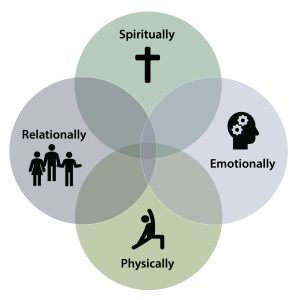
God created human beings with four primary aspects of life: the biological, psychological, relational, and spiritual. It is common for people to either neglect or become consumed with one or more of these areas. Understanding these facets allows us to better steward each area personally and helps us honor the Creator and each other. The concept of stewardship reminds us we are ultimately God’s and are called to take care of what he has given us – neither neglecting nor idolizing it. Considering the four areas of the model holistically is a good first step in healthy stewardship. Brief descriptions and encouragements are below.
Biological/Physical
The Bible calls our bodies the temple of God (1 Corinthians 3:16). God wants us to be good stewards of our bodies and treat them as the place he resides. The biological area deals with doing what is within our control to keep our bodies healthy through exercise, rest, and nutrition. Everyone’s physical makeup, metabolism, genetics, and general health are different. Our health needs may vary greatly from someone else’s needs. Sometimes it is easy to forget about stewarding our bodies when we’re feeling good, and we find ourselves only thinking about our physical health when we are sick. Taking reasonable preventative measures, such as an annual physical exam, are great ways to steward our bodies.
- Get adequate sleep and rest. Our bodies need adequate sleep to think clearly and handle the tasks of each day. Not getting enough rest may make us more susceptible to poor health in other areas. The difference between an adequately rested body and a sleep deprived or chronically stressed body is immense.
- Start small and get started. Let’s say a physician asks a middle-aged man to exercise and lose some weight because of high blood pressure. He may feel unsure of what to do or defeated before he even starts. Other times people make such ambitious health or exercise goals they are unable to sustain them and meet their goals. It is important to be reasonable, start small, and just get started in some way. Don’t be afraid to ask others for assistance and accountability.
Spiritual
Genesis 2:7 says God made human beings “a living soul.” Unbelievers sometimes try to deny or downplay the spiritual aspect of their lives while other times they seek out “spirituality” that is separate from biblical truth. Regardless of how much an unbeliever tries to stay away from God’s laws, there is no rest for his soul anywhere other than Christ. For believers, the spiritual aspect is focused on the process of sanctification and growing in grace and the knowledge of our Lord and Savior Jesus Christ (2 Peter 3:18). This includes staying rooted in God’s Word, worship (personal, family, and corporate), prayer, service, recognizing and dealing thoroughly with sin and living for Christ. The goal is for our whole life to be under the Lordship of Christ.
- Deal with issues directly. Dealing with issues such as pride, inferiority, lack of forgiveness, covetousness/lack of contentment, or poor stewardship will not only help one’s spiritual growth but will positively affect other areas of life as well. For example, perhaps an individual deals with lack of contentment and grows by God’s grace into living a grateful life. They will impact others as they express gratitude and view what they have with thankfulness.
- Focus on God’s promises. All of us have been given “exceeding great and precious promises” by God (2 Peter 1:4). Memorizing and meditating on scriptures that speak to the promises of God will help us have a confident expectation as we stand on promises that are foundational.
Psychological/Emotional
Proverbs 23:7 says, “For as he thinketh in his heart, so is he…”. The psychological domain refers to our patterns of thinking, which directly impact how we behave and handle our emotions. All of us may be familiar with people whose thinking patterns lead to a joyful outlook on life, while others have a critical, worrisome, or doom-and-gloom mindset. Scripture teaches us to train our thinking toward certain things (Philippians 4:8) and away from others (2 Corinthians 10:5). Consider the practical, daily benefit to our lives and those around us when we live out the spiritual truth found in Philippians 4:8, “Finally, brethren, whatsoever things are true, whatsoever things are honest, whatsoever things are just, whatsoever things are pure, whatsoever things are lovely, whatsoever things are of good report; if there be any virtue, and if there be any praise, think on these things.”
- We all experience stress. In this life we all go through times of stress, struggle, and grief. Thankfully, we can take these things to God as well as receive support from one another. Periodically dealing with stressors is a common occurrence for everyone. However, chronically high stress eventually leads to a wearing down of our emotional, spiritual, and physical health.
- At times, more help is needed. When clinical symptoms of depression and anxiety occur, special attention is needed. Satan would like to use shame and embarrassment to keep us isolated during these times yet help, support, and hope are available.
Relational
God made human beings in his image (Genesis 1:27), and being relational is one of the attributes of this image. He already knew in the Garden of Eden that humans needed to connect with him and with one another. He also knew that isolation is not good for us; we grow and heal best in relationships. As James 5:16 says, “Confess your faults one to another, and pray one for another, that ye may be healed. The effectual fervent prayer of a righteous man availeth much.”
- Relationships are blessings. Having good relationships is certainly one of the greatest joys of life. In Romans 12:5 Paul explained that the Body of Christ is made up of individual people who are connected to one another, “so we, being many, are one body in Christ, and every one members one of another.” While life can be hard at times, God knew having supportive relationships would be an encouragement to us. Ecclesiastes 4:9-10 states, “Two are better than one; because they have a good reward for their labour. For if they fall, the one will lift up his fellow: but woe to him that is alone when he falleth; for he hath not another to help him up.”
- Relationships can be painful. Difficulties relating to other people, marital problems, dysfunctional families, etc. can sometimes be the source of great pain. While God expects us to do our part in relationships, we can only control our own behavior. Romans 12:18 says, “If it be possible, as much as lieth in you, live peaceably with all men.” Also, God knows how badly bitterness and anger can harm us. God speaks quite clearly about the need to handle hurts in relationships with forgiveness. The Bible does remind us to forgive as Christ forgave, not based on whether others deserve it. Ephesians 4:32, “And be ye kind one to another, tenderhearted, forgiving one another, even as God for Christ’s sake hath forgiven you.”
Conclusion
It is important to note all the areas above are interconnected. Strengths in one area can serve to bolster other areas, and conversely, problems in one area can impact and cause issues in other areas. For example, an individual was hurt deeply by someone who betrayed them (a relational wound). They then experienced strong emotions of sadness, anger, frustration, and loss (emotional effects). They often had difficulty sleeping as they replayed the situation in their mind and then were less focused at work due to lack of sleep (physical effects). Unfortunately, they didn’t work through those emotions and the hurt moved into deep bitterness and a hard heart (spiritual effects). The bio-psycho-social-spiritual model helps us be aware and lean into the stewardship of our lives. Through greater understanding, we become better stewards of our lives holistically in a God-honoring manner.
Click here for printable document
Click here for document in graphic form
Click here for an animated tour of the graphic document.
Additional Articles

The Story of Mental Health Podcast Episode
May is Mental Health Awareness month. Like most matters that get highlighted with a month’s recognition, there is a story to be told. In this episode of Breaking Bread, Ron Messner and Ted Witzig Jr. join to tell the story. A story that has loving as Jesus loves at its

Understanding ADHD in Adults Podcast Episode
ADHD has been well understood in the classroom. For a long time, ADHD has been well understood in children and treated for optimal growth in their maturing years. What about adults? What does ADHD look like later in life? How should we understand its effect on life and relationships? How

Whole Brain Living Podcast Series
Two halves make a whole. This is true for everything. But it is uniquely true for our brains. Each half, the left and the right, bring a wholeness that without either one, we are much less than half. In this episode of Breaking Bread, Ted Witzig Jr., Brian Sutter, Kaleb
Comments
Leave a Comment