


The Life Curve Podcast Episode
A Needed Conversation from a Father to his Son
We enter life with no ability to control. As we grow, we acquire more and more faculty to control. If our life takes its natural course and we age into the sunset years of life, we gradually lose our ability to control. Finally, we will leave this life having the same capacity to control as when we entered, little to none. Join us as Matt Kaufmann discusses this life curve with his father, Denny Kaufmann.
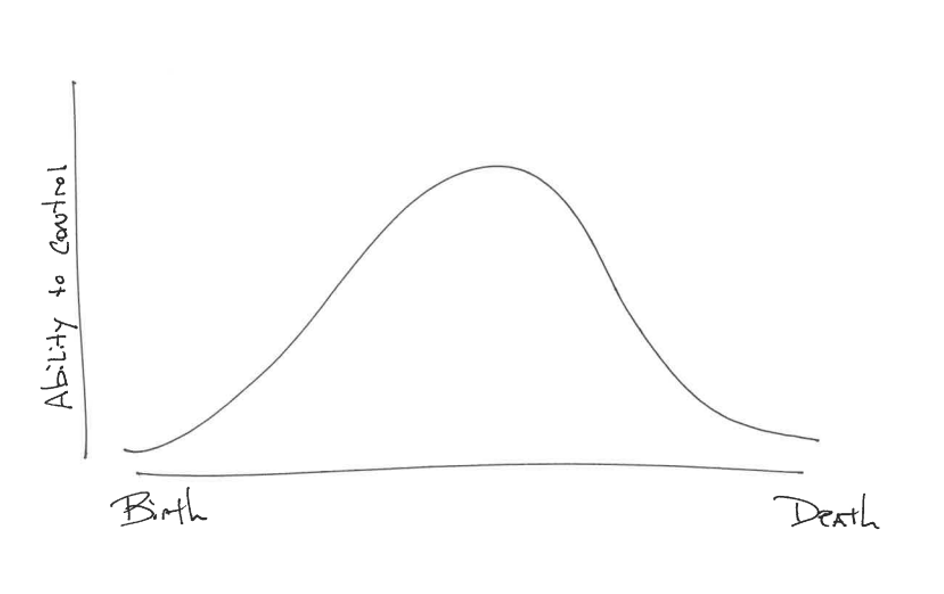
- Control, the ability to rule, make choices, make determination in our surroundings and direct people, transitions over the span of life.
- The transition is a function of release.
- Ease of release is a function of confidence in the predecessor and ability to live with God into the future.
- Release to the predecessor is helped with a view that God is in control and uses people separate from us.
- The ability to live with God into the future is helped by learning to find satisfaction in his presence apart from the satisfaction that the power of control affords.
- Living healthily will require that we know where we are on the life curve and live accordingly.
Transcript:
We get to a point where we see life from a little different perspective and to really trust that God ultimately is going to take this where he wants to take it. And he may ask me to be a part of that, and he may not. It’s not my responsibility. It’s God’s. Yeah.
Well, welcome everyone to Breaking Bread, the podcast brought to you by Apostolic Christian Counseling and Family Services. Excellent as always, to have you along. I may possibly have my favorite guest in the room thus far. Welcome dad. Great to have you in. Thanks, Matt. Glad to be here. So, Dennis Kaufman is my dad and with just a little bit of arm twisting and I think probably a lot of yielding on his part, he has agreed to come in.
Is that true? Am I reading the room Dad? Trepidation here, yeah, but that’s okay. This is new technology for us old folks. Well, I’ve assured him that at the root of all of this technology, there’s just a conversation to be had. And I’m glad to have that with my dad. You know, I want to go back to a conversation that we had previously. And a conversation that meant a lot to me, and I hope it will be an ongoing conversation. I don’t know if it’s my midlife age that prompted this or if it was the raw reality that I can’t control things that I used to be able to control? Kids, for example. They’re kind of their own people.
That’s right. I don’t know why I never knew that before, but life and circumstances present that, right? And then seeing that in other areas of life. And I sketched a graph, an image, a picture on a scrap piece of paper and sent it to you with the phrase, why hasn’t anybody ever told me this before?
Do you remember that? I do. I remember getting that text and thinking, huh, this probably was something I should have talked to Matt about. Well, you know, that is an interesting concept. Why hasn’t anybody ever told me this before? The lessons probably would’ve been lost on me prior to this moment.
So, there’s an immediacy, right? And I think this particular conversation was that. So anyway, do you remember the graph? Do you remember the picture? Yeah, I do. Can you explain it? So, the vertical was control, is that right? Yeah, and the horizontal was age. So, age from birth to death. The vertical then was no control to great control, right? Yeah. And then you had that bell curve. So, you start out with no control and if life goes on, you gain control. And then as life begins to wane, you begin to lose control again. And most of us will probably find ourselves with very little control over what’s going on.
So, the end of life is very similar to the beginning of life in terms of no control. Well, let’s maybe talk about control. What do we mean by control? I think I meant by control this ability to influence, for example the ability to maybe direct circumstances. Right? Make decisions. Maybe directing people could be a part of that. I remember sending this to you and the texting lights started blinking right away. Evidently that caught you in a good place, something must have connected. What was it?
Yeah, it actually made me think of a point in my career. It was towards the latter part of my career, and I remember sitting in a conference room with a bunch of people and we were discussing clients, I believe it was, and a certain client that we had. I was thinking, well, I need to leave this meeting and go do some research on this client. And another person in the room, who was very much younger than I was, pulled out his phone and at the time the phones were really relatively new technology. And he pulled out his phone and he did the research right there and he explained it to the rest of the room.
And I just stood there blinking, thinking, I’ve just been passed by. And perhaps my life is entering a new phase where other people are taking control, and rightfully so. It’s not like I felt like I was being pushed out. It was just a natural order of things. I’m growing older. I felt like I was at the top of your curve there, maybe on the downward slope, where it was time to start giving up control of some things at work and that was in a work context.
So, you saw that and was that your conclusion from that experience? Did you see it with control that element, that variable of control? Yeah, control or influence, whatever you want to call it at that point. And so that started for you a kind of transition. The first word that comes to my mind is to say, release.
I felt good about releasing my responsibilities at that point, to a younger person, a younger generation, perhaps more qualified, doing things in different ways than we’ve done them in the past, but a release and a relief from all that. I really appreciate that. This idea of feeling good, I think, is remarkable. Because I can run a lot of scenarios where it doesn’t feel good to do those things. Yeah. I can probably come up with some too. You mentioned a work scenario, but this happens in a lot of different areas of our lives. Yes, of course.
The first one that comes to mind is kids, and as you guys grew up, we loved to see you take responsibility and make good decisions. Releasing. That was another whole story really. Sure, of releasing your kids to make decisions. There’s a whole curve with family. Right. And that peak happens a little bit earlier. It’s got a different skew than a career. Yeah. Maybe a longer tail on that, but yeah. It applies there too. Absolutely.
How would you coach a person on releasing because that’s a difficult thing to do, especially when we want to hang on to something. There are lots of things that go into that, Matt, the competency of the person to whom you’re releasing to looking ahead and saying, okay, if I release this, now what?
Those are probably the two main things that come to my mind that you have to prepare yourself for. Well, let’s take one of those at a time. This appreciation for this very capable person coming behind you with different knowledge, different technology, different experiences, is likely to make different decisions than you would’ve made. Did you feel a sense of being put out to pasture or offense or discouragement or competition? No, I didn’t feel any of that really. No. Partially that’s my personality, maybe that I’m always looking forward to the next, whatever the next step is. Now if you remember right, you weren’t the only one that weighed in on this conversation, okay?
Do you recall that you replied back to me, said, Matt, let’s talk, and I happened to catch you down with mom in Florida at the time. You had a couple of weeks stay down there with Uncle Mark and Aunt Barbara. Do you remember that? I do. And I found myself on a conference call with all four of you talking about this very thing, it all made sense to all of you. And it was a beautiful moment because they each one weighed with their own perspective of this very concept of release. And I was really blessed by the joyful release that each was able to give testament because I think I was struggling with the release in a variety of areas in my life.
And I’m not where you are, but I recognized that some of that release kind of makes me sad. I was sad to see change. What perspective do you have on life that allows you not to be so sad about change, but to accept it? This brings up another whole issue of who we are and how we’re made, how God has made us, right?
Some people will struggle with transition because of their thought processes and how they think. Perhaps or remember things differently. I have a tendency to look forward and God made me that way, that I look forward to things and I am always willing to drop the current in anticipation of what’s coming next, and that’s where we’re different.
Yeah. I’m more nostalgic, yeah and mom is that way too. And I have a better memory than you do too. Yes, you do. So, forgetfulness is a great thing. Hey, maybe that’s why late in life, you lose your mind and the curve goes fine. I think that’s probably it. We don’t know if there are decisions being made anymore and we don’t really care at that point.
Well give me some insight then what it looks like to look forward. In some ways you find yourself controlled through life, right? So, you find yourself controlled. You’re controlled in the fact that, for instance, you’ve got a family now. You’re pretty controlled. Your decisions are all centered around the family and raising the family and that kind of thing. At work, you’re consumed with work eight hours a day or whatever it would be. I’ve always looked forward to this time when some of those constraints would be lifted, not because they were bad by any stretch of the imagination, but because they were constraining and now those constraints, those kinds of decisions, don’t need to be made anymore.
Now we’re free to pursue some other things that perhaps God has put on our heart. I see. Now that’s fascinating. Now that would be a perspective that I lack simply having not gone through the curve. But what you’ve just said then is that control has a double-edged sword. While you have the ability to control, you’re at the same time controlled by all that you have influence over. Right? Okay.
So, could we use the word freedom? There’s freedom then that comes over your life. Yes. Everybody doesn’t feel that freedom the same way, like you were saying, you like to look back. Yeah. I like to look forward. What to me is freedom, to someone else might be an uncertainty that brings stress. Does that make sense at all? It does make perfect sense. We get back to a point, I think where we become comfortable with who we are and what God is doing in our lives and where we’re going. I’m comfortable that God will present me with doors to open. God will present me with opportunities to continue to feel useful. I don’t need to hold on to the past to feel useful and there’s a freedom in that to say, God’s in control. God’s doing this, so let’s watch God do his work in the present.
Yes. Has it opened your field of vision? The kids, regarding a family, for example, when you are climbing the curve with family, it was consuming, and you had a pretty narrow vision. Work, the same way. A lot of men and women who are in early stages of life are consumed by work. Right. Their field of vision is very narrow, not a lot of capacity to take in a lot of other things.
Right. Same thing with maybe ministry. But now I get this caricature that you’re able to have a wider field of vision about life, about this world, about God. Would you say that’s true? You certainly have more openness, more opportunity for seeing the vision that God’s got for you.
I guess the overriding thought in my mind is freedom does not mean doing nothing. Freedom means pursuing different things. I can remember coming home from work and talking to mom about, well, which hat do I have on right now? Do I have my dad hat on? Do I have my work hat on? Do I have my minister hat on? Do I have my husband hat on? And I would feel very overwhelmed at times with the numbers of hats that I had. As I age, I find the number of hats maybe doesn’t change, but the intensity of wearing those hats has lessened so much. And the relationship you have with that hat, correct?
Correct. How has the relationship you have with a hat changed? There’s no pressure there. So personally, I have a lot of things to do, but none of them need to be done today. And so, there’s a certain amount of freedom in letting go of pressures that we had when we were younger.
Does that make sense? Yeah. Have you had to find satisfaction in a different place? If you had your satisfaction and your hopes for satisfaction pinned on achievements or accolades or audience or power, you’re in for a rude surprise. And something needs to pivot.
Alright. So, you’ve pivoted. Speak of the satisfaction that you seek and find. Yeah. Matt, I find myself closer to God than I ever have before. And perhaps that’s because I have more time to spend in prayer and meditation and in the “quieter” things of life, not driven by deadlines and expectations and things like that.
And so, I guess personally, I do find myself more interested in feeling satisfied when I know that I’m about God’s work and God’s work does not necessarily have to be tangible at my age. It’s not that I’m building a house or I’m doing anything like that. Sometimes it’s just in prayer and in sending simple notes to people that God puts on my heart.
And there’s great satisfaction in knowing we’re playing a different role here in life now. We’re playing the role of encourager, we’re playing the role of listener, and it’s not as tangible as it was before, but it’s still a very valuable satisfaction that we gain. Would you say your relationship with God is sweeter in some senses?
Oh, definitely. Yeah. You mentioned probably because of time and that might be true, but I think it’s deeper than that. I think there is a shift that’s happened in your life that hasn’t necessarily been brought on by more time, but a shift away from things that prop up our relationship with God that now have been kicked out from underneath you.
Oh, it makes sense. Can you give an example of that? Yeah. I can give you an example. Is my relationship with God predicated upon my need to influence or need to or need to grow a family or need to be successful in business. Right? Are those tangible things that I really hang my faith on? But when those things aren’t there to support and prop up faith, you’re left with the person of God by himself. You know what I mean? That’s what I hear. Yeah. I think, well, back to the old adage, we’re not human doings, we’re human beings. Right? Yeah. And to find yourself being with God is a very pleasant place to be. Just being content to sit with a cup of tea in the morning, look out the window and worship him as the creator, God.
And so, there’s a life evaluation that’s different. You evaluated yourself at the end of the day in your 20 somethings very differently than evaluating by number of accomplishments. Yes. That’s not completely gone, Matt. I mean, as human beings, we always have this need to accomplish something or get something done. But I think deeper down, I’ve come to appreciate that God loves me for who I am, not what I do. And I can be comfortable just sitting with him and enjoying his presence in many different ways.
So, there’s been a release, but there’s also been an apprehension as well, right? You have apprehended God in a beautiful way which comes with that release. Let’s talk a little bit about the release. I understand release when you say, I’m releasing this responsibility to the next person who’s coming behind me. Right. That makes sense. But I have to believe that there’s a release of something deeper, A release of even the project that you were working on. Am I right? When you walked away from that committee, maybe at work or retired and you released the things that you really cared about deeply.
Is that true? But just to trust that God’s in control and God’s got this thing and God can work through others just as well as he’s worked through me, is a part of that release process right. Of believing and trusting and having faith in God that God’s got this, you’ve got this. And so, I believe in you. Yeah. And that’s where I’m recycling back this idea of what’s propped us up when you’re in the thick of it and you’re using your brain and brawn. Yeah. We wanted to release everything to God, and we do even in those moments. Yeah. But there’s a different type of release when you’ve got no more influence in the thing. You are in a sense in the back of the bus being driven around. There is a release of another type. Yeah. To be a passenger rather than the driver. Yeah. And that doesn’t come easily, and it doesn’t come with every situation. We all have situations that we find very hard to release.
Right. But I would say overall, Matt, yes, we get to a point where we see life from a little different perspective and to really trust that God ultimately is going to take this where he wants to take it, and he may ask me to be a part of that and he may not. It’s not my responsibility. It’s God’s. Yeah, which again, is this larger field of view, I think.
Yeah. What advice would you have for a person like me where I’m at? I think I could probably say, Dad, that not everybody transitions well. You have, so what do I need to be thinking? Wow, that’s a good question. It really does come down to how secure you are in your relationship with God. And how well do you communicate with him or know him? Right? Because ultimately that’s what it comes down to. God is directing your steps. How well are you listening to him direct your steps?
And how content are you in being in a relationship with just him? Right? And that has to develop in your earlier years, it doesn’t just come on you at the end. But it has to be developed early on in your career. Am I communicating well with God and is God communicating well with me and am I comfortable in him?
Am I comfortable just sitting in a room alone talking to God? That relationship ultimately is what allows us to release later, I think. It’s been my personal experience anyway. I think that’s great advice. It’s important that we understand the life curve so that we live well in our stage.
Would you agree with that? Absolutely. I wouldn’t want those in the first half of life to not be gaining control and growing an influence. Right. But they will live differently. Let’s take a setback, for example. Take a financial setback or a health setback or something.
I mean, they have to pivot, take control of it, heal from it, and climb. But those things are different at the end of life. m. You can’t, you can’t pivot and reclaim gain from a, a financial loss late in life. You don’t have time. Right. You, I mean, it is a different playbook. Right. And we could use other examples that if I don’t know the time of life that I’m living.
I’ll probably make some wrong decisions on what I should be doing in the moment. Right. So, all that to say it’s important for us to know where we’re at in this. Yeah. This is a complex issue, Matt, and you’ve hit a piece of it. The control issue piece.
You make me think about how all these other factors enter into it. My age, my health, my economic status, you could go on and on, right? That change, that graph and a particular subject from being skewed to the left, to being skewed to the right. It may tell me that it doesn’t matter if you’re older or not, you need to retain control here for a little bit.
Or I may be very young and because of the circumstances of life, God may be saying, you know what, you need to release this and let it go. So, it’s huge. Sure, and if I were to summarize it, maybe what you’re here too is be thoughtful. The advice to be thoughtful, about where you are in life, okay? To be thoughtful, is it time for me to give this up? Is it time for me to move on? Is it time for somebody else to take this over? Is it time for me to relinquish control over this specific thing? To be thoughtful about that, I think, is very important.
Dad, this has been meaningful to me in many ways but let me go back to my first text. Why hasn’t anybody ever told me this before? Do you think, as a general rule of thumb, we do well at passing along this type of knowledge? What impresses me is that we all come face to face with this in the solitude of our own lives. Yeah. Wondering, is this normal? I’m curious on your perspective on that.
What role should we be playing as a community of people living life? Right. It’s a hard one. They are conversations, they’re not lessons. Does that make sense? Yeah. Other than the broad-brush control talk. Well, and I think by positioning it as a conversation, which I totally get behind, you then require a community that talks. Yeah. Correct. The communication between generations has to occur of lessons learned and experiences gained. Thanks for coming in and engaging me with this topic, Dad. I really, really appreciate it. And just to our listeners, I know that this topic has to be meaningful to you because it’s so germane to the human experience.
And you will find yourself right now somewhere on this life curve. Maybe it’s the beginning of life, and you are getting jobs, you are pursuing relationships, you are growing in really important ways. You’re taking risks and you should be. Or maybe you’re through the transition side of life and you’re starting to look behind at who we should be passing this off to. You are training people to come behind. Or maybe you are in the latter end of life, finding your place with Jesus to be enough and what a beautiful testimony that is. And encouragement. Dad, I think that’s what you said, encouragement. Yeah. I like that. I think that’s something we can easily remember.
Listen on Spotify – Listen on Apple Podcast
Additional Articles

3 Habits for Our Kids
Parenting has its eye towards producing future adults. One powerful adult forming tool is instilling good habits in our kids. A well parented habit can pay dividends in the long run by building the muscle memory to do what otherwise would not be natural. In this episode of Breaking Bread, Brian Sutter examples this by suggesting three habits

One Tip for Human Growth Podcast Episode
We all have room for growth. Yet sometimes our progress gets stalled, and we get discouraged. This discouragement might be because we are measuring the wrong thing. In this episode of Breaking Bread, Ted Witzig Jr. helps correct this mistake and teaches us to measure from the bottom-up.

Advent: Thy Kingdom Come
In ancient times, Jewish teachers traditionally had prayers unique to their school. The prayer encapsulated the world view of the rabbi. It unified the pupils and gave them identity. It was an extension of the teacher; in fact, the prayer itself taught the disciples what was important and what they
Comments
Leave a Comment