

 in Men, Transitions
The Life Curve
“To everything there is a season, and a time to every purpose under the heaven: A time to be born, and a time to die… A time to get, and a time to lose; a time to keep, and a time to cast away.” Ecclesiastes 3:1,2 & 6
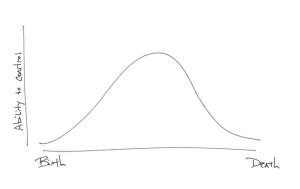
I’m not sure what it was-maybe my age. Halfway to 90 has one pause. Or maybe it was a moment of reckoning, realizing my kids will make their own choices. Whatever the impetus, I picked up a pen and scrap piece of paper and scrawled a hand drawn graph, took a picture and sent it to my Dad with the description, “why hasn’t anyone ever told me this?” The image was in the shape of a bell. The horizontal axis measured time from birth to death. The vertical axis measured one’s ability to control. By control, I simply mean the ability to rule, make choices, make determination in our surroundings, and direct people. The meaning of the graph is simple. We enter life with no ability to control. As we grow, we acquire more and more faculty to control. If our life takes its natural course and we age into the sunset years of life, we gradually lose our ability to control. Finally, we will leave this life having the same capacity to control as when we entered, little to none.
It must have struck a chord with Dad. Shortly his texting dots were blinking. “Call me, let’s talk.” The conversation that ensued was a survey of life. Dad explained the season of growing by acquiring power and the season of waning by letting go of power. He spoke of the tricky transition and how it happens at different times depending on what you are talking about. “You lose control over your kids pretty early” he said. Your career curve may linger longer. Ministry sets a slightly different skew. But in the end, they are all the same. A season of growing and a season of waning. As a man in the middle, experiencing tricky transitions with my kids and seeing upcoming transitions in other life areas, I was getting a real dose of reality. And it made me kind of sad.
Dad and I talked about the importance of understanding the “life curve.” To have a proper view of our season and live into that season well. For example, as young men we should be growing, exploring, and investigating. Practice and honing skills make men ready for gaining increasing control in the form of responsibilities. The early season is marked by finding and committing ourselves to duty. This might be a career, financial investment, buying a house, marrying a wife, or leading a family. It might mean accepting the responsibility to lead others or participate in initiatives for the good of others and God’s glory. Action, initiative, and work ethics are important. And when setbacks come, the right thing to do is get back up, pivot, and keep climbing.
Then there’s this season of transition – Dad’s season. He has raised his kids, retired from his career, and has found his place in the pew rather than in the pulpit. He has handed over control to the next generation, the next workforce, and the future church. And to my surprise, it pleases him to have done so. Paraphrasing his reply, he said “The first season is for the second”. All we do in the first is so we have something to hand off in the next. It struck me, as we spoke, how strength shifts over the course of life. In the early season our strength lies in our brawn and brain. In the later season, our strength lies somewhere deeper. It is a deep-seated humility, a deep-seated faith, and a deep-seated identity.
Humility is required to yield the driver’s seat and take a seat at the back of the bus. Such humility, as Dad pointed out, is most tested when “agreement” is on the line. Sitting in the back when the new driver takes your preferred path is one thing. But when the driver takes the side road you would have avoided, your humility is tested. Yet, this humility is made possible by a deep-seated faith. The faith that says this is God’s bus and control lies with him. Men who transition well have a healthy view of God’s strength. Obviously, they’ve always believed God was strong. They believed it when they were raising kids, building careers, and leading causes. But when they depend on the brawn and brains of others, their view of God is tested. Which leads us to deep-seated identity. Men who transition well into the later seasons have let go of the identities they once held dear. Accountant, CEO, minister, builder, boss, farmer, teacher, doctor were all identities that grounded them and gave them a sense of meaning and belonging. Now, with those identities faded, a surer grounding, a more significant meaning, and an enduring belonging wins the day and that is found in Christ. In a sense, they have an altogether different relationship with the bus they are riding. They have become more suited for an entirely different home.
I drew this graph on the marker board in my office, and it stands as a reminder to live well in my season. It also gives me good perspective as it gives me respect for the men across the span. Young men growing up behind me and gaining power soon to surpass my brawn and brain. These men for whom I will need to pass the torch. Older men ahead of me who have entrusted me with the responsibilities I now carry. And the elderly who have gracefully found purpose in pouring into those who are coming behind while at the same time feeling more and more at home in another place.
To view the PDF, click here.
Additional Articles

The Life Curve Podcast Episode
We enter life with no ability to control. As we grow, we acquire more and more faculty to control. If our life takes its natural course and we age into the sunset years of life, we gradually lose our ability to control. Finally, we will leave this life having the

Beholding the Face of God
The human face has 40 muscles – twenty on each side. These muscles are unique from most of the muscles in the body. The vast majority of muscles in the body connect and power bone movement necessary for life. They allow you to move your arms, extend your legs, and

Four Lessons from Daniel’s Success
When it comes to living life well, not too many men in Scripture score as well as Daniel. The man led in unprecedented circumstances. He braved risk when the stakes were high. He spoke when truth was unpopular and stood when others fell. All of this in a difficult environment,
Comments
Leave a Comment