


Praying Like the Disciples Podcast Episode
Christ knew what he was doing when he gave his disciples what we have come to call “The Lord’s Prayer.” It is beautiful to the ear. Rhythmic to the tongue. Simple to remember and loaded with power. In this episode, Joe Leman highlights this beauty and power and helps us see the hope of human transformation that is instore for any who would take up the prayer and pray it.
Transcript:
Yours is the kingdom and the power and the glory forever and ever. Amen. Welcome everyone to Breaking Bread, the podcast brought to you by Apostolic Christian Counseling and Family Services. Excellent as always, to have you along. I’ve got Joe Leman with me here. I just have more to talk about Joe with the Lord’s Prayer.
Well, it’s a subject that I love, so I’m on board. I knew that. So, for those of you who listened, we had a podcast out in December during Advent, and there I asked you to serve up the Lord’s Prayer to us and we really focused in on thy Kingdom come, thy will be done. Right. We just got started. And so, here’s what I want you to do, and we know the Lord’s Prayer, but I want you to recite it, putting you on the spot here. Okay? Recite the Lord’s Prayer for us. You talked about six big buckets last time that the Lord Prayer has, maybe you can accent those. Sure. And then I’ve got some specific places I want to go to this time because there’s so much here and you know that better than I do.
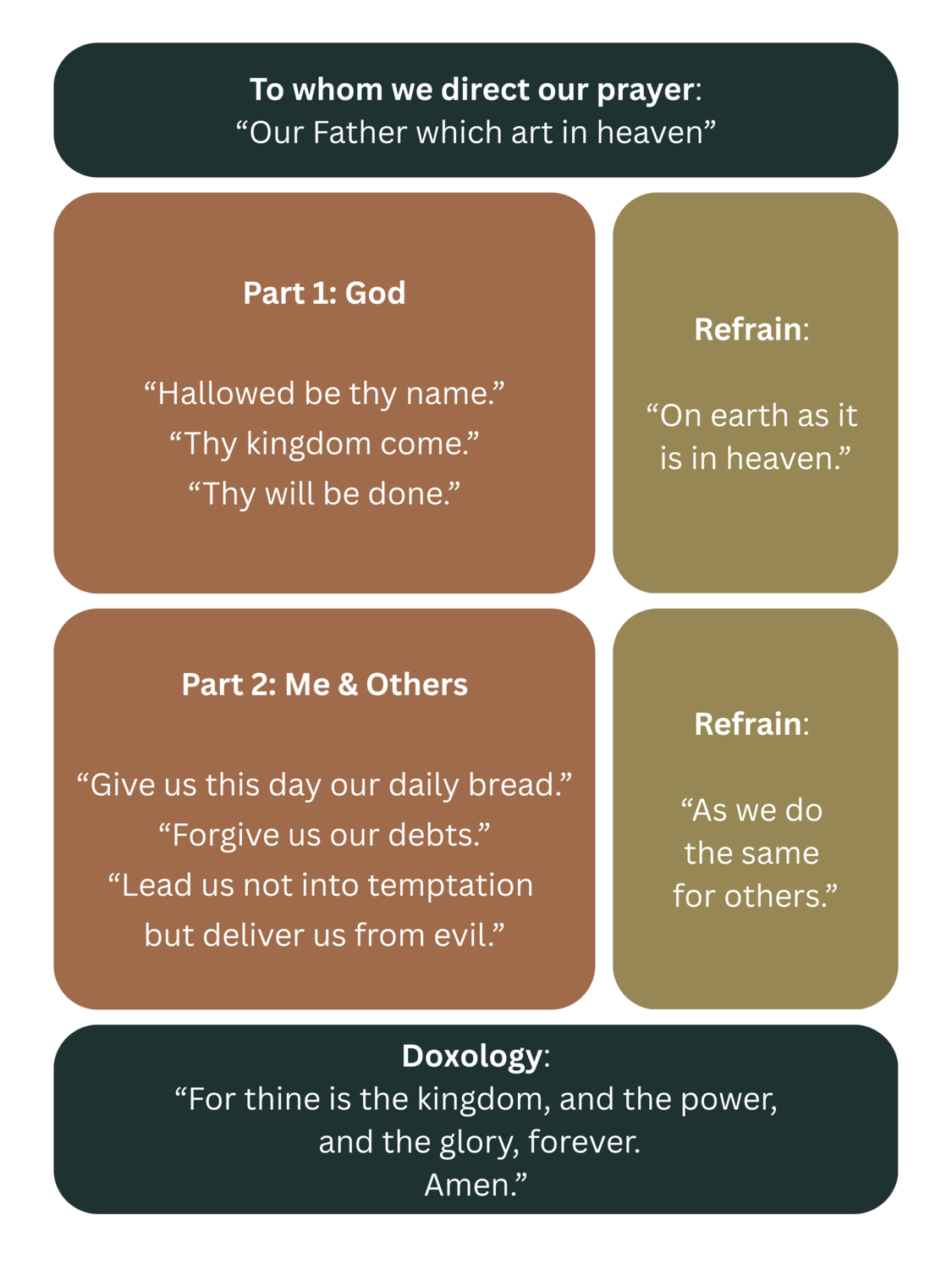
Remind us of what the Lord’s Prayer says. Okay. Yeah. So, we’re approaching this as a poem. A beautiful poem meant to be prayed but also meant to be a template for prayer. So, the poem has three buckets, as you said. We’ll start. It’s going to address our Father which art in heaven, or to look at as our father. The next is hallowed be your Name, turning our eyes to the greatest good. That is God thy kingdom come. This idea that God is working in our time and in our universe to great ends and a submission to his will as better than our own. His intentions for good, better than our own, thy will be done on earth as it is in heaven.
So that on earth as it is in heaven, that’s extra. Hmm. That’s the extra cherry on top after the first half. That’s the refrain. Yes. And I want to get to the refrain, so let’s come back to the refrain. Okay. Yeah. And then the next three buckets or requests have a different tone. It’s more about joining a community of faith and a community that’s dependent on God.
Right. So, give us today our daily bread. It’s not give me today my daily bread, but it’s actually give us. So, you’re joining a community of dependence on God and then there’s, forgive us our debts as we forgive our debtors. There’s that refrain. It’s in a different place. As we forgive our debtors is actually the refrain on this second half of the prayer.
That’s excellent. So, you’ve keyed on two things that I want to talk about. One is the refrain. We’ll do that first and the second is forgive us our debts as we forgive our debtors. In fact, I want to spend the balance of our time on that one. Okay. And then let’s finish with talking about this community piece. Okay, sure. Yeah. Us and we and our. Yeah, absolutely. Alright, finish the poem. So, then the last one is lead us not into temptation but deliver us from evil. And then there’s this beautiful doxology that comes out of Chronicles. I think the early church adapted this out of Chronicles a piece spoken by David for thine is the kingdom and the power and the glory forever and ever. Amen.
Beautiful. It’s a beautiful prayer. And the disciples ask, teach us how to pray. And this is what Christ gave his disciples. You mentioned previously that this would’ve been a prayer that the early church would’ve known and recited rhythmically. Exactly. Yeah.
And that’s clear to us because the early church’s writings instruct disciples to pray in the didactic. And certainly, the prayer itself has evidence of changing from when the disciples used it to when the early church began to use it. Like I said that last piece, the doxology was added afterwards.
That’s beautiful. Go to this refrain part. Highlight these two refrains. Yeah, so the refrain can be applied across the three principal requests in each half. So, I could actually change the refrain or change the poem and say, hallowed be your name on earth as it is in heaven. May your kingdom come on earth as it is in heaven. May your will be done on earth as it is in heaven. So, it’s an echo. Yeah. It’s an echo present in the prayer. And I feel like that refrain, as it is in heaven, pushes my imagination. Try to imagine the reverberation of God’s holy name in heaven. Right. If I’m calling for it here, I have to step into that place.
Sure. Or his kingdom in heaven and what his rule must look like. Oh yeah, that’s well said. Does that make sense? Yeah. Or in his will. Can you imagine his will in heaven? Like what that means? Everything ticks at the will, in the heartbeat of God, we’re imagining it to be in our place.
What would that look like in my family? Yeah. What would it look like in my community, my neighborhood, in my school system? If such a will, such glory, such a hollowed name. Yeah, this is cool. I think you’re teaching me something. So, in responding to our own dissatisfaction, there’s this biblical idea that the law of God and eternity is actually written on the heart of every human. And so even if we are the actors and we’re the victims of sin, we have this notion that it’s wrong and it shouldn’t be, and we can channel through this prayer a desire for what is deeper in our heart. But the antithesis also gives us the desire to look into heaven and imagine what heaven is. Not only having a pulse of what is wrong but having a pulse of what is right.
Yeah. I like that. And that’s what the refrain does in the first part, I think. So, let’s go to the refrain in the second part. Sure. How this has been highlighted to me is it’s hard to forgive other people. Right. And so, there’s a very convicting element there. Forgive us our debts as we forgive our debtors, and that is definitely a hard nut to chew on and meditate on, but it changed gears or it changed octaves a little bit for me when I applied it to the other elements of that second half.
So, I’ll just try and pray in the same way for each request, so we could say, give us today our daily bread as we provide for the needy around us or the dependent. Forgive us our debts as we forgive those around us and lead us not into temptation and we’ll refrain from tempting the weak around us. Protect us as we protect the vulnerable around us. The refrain calls us to responsibility.
Maybe not responsibility, but participation. Right. Okay. I think there is a response. So, in that sense, a response or an ownership of relationship. Right. It helped define our relationship with others, I think. Yeah. And how that’s connected to our relationship with God, because prayer can really get off the skids a little bit every now and then, because I think we tend to put prayer coins into the cosmos. Yeah. So that the cosmos can do well for me.
Jesus warned against being repetitive like the heathen. They think they’re going to be heard because they’ve put enough coins in the machine. And then maybe on the other side we might think that prayer is mostly about looking at oneself. It’s more just the therapeutic or mindfulness, but this idea that prayer is something other than those things. It’s harmonizing with what God’s doing in the universe. So, we see God as a father and so we rightly position ourselves to receive his provision, his condescension, forgiveness, protection, and guidance. He guides us away from temptation that would basically destroy us or eat us up and so we become like sheep.
Right? But then a strange thing happens with that refrain, we suddenly become participatory. Yeah, right. We suddenly become simultaneously the object of God’s grace. The recipient. Yeah. And then also the agent or the channel of God’s grace. So, you can’t really join God’s family without joining in the family business, which is abundant grace into the universe.
This recreated abundant grace. So, I think Jesus’s poem is inviting us into dependence on God’s provision but also not without an enthusiasm to provide for others around us. So, how would you delineate this? I think some could read this as conditions. Right? Forgive me insofar as I forgive because I’ve already forgiven people. Or insofar as I will forgive. Yeah, right. I promise.
Anyway, I’m curious about your reaction to that. How should we be thinking about that in terms of conditions? Well, I think it stayed conditional for me until I learned to apply it across all three of the requests of the second half. Once I understood it outside of just forgiveness and also understood it in the context of provision, protection, and gentleness. Yeah, not tempting people to anger or sadness. And so, I think once it zipped out of that one forgiveness vein, it took on a new character.
So now, let’s shove it back in. When I think about forgiving us our debts as we forgive our debtors, I sometimes just pray, Lord, I’m not what I should be. Forgive me and teach me this melody of grace that you’re showing me so that I can sing that into the world. Because if I can be forgiven by You and also be able to let other people go who have wronged me, then I’ll be in the heaven of your presence.
So maybe that helps and maybe it doesn’t. Yeah, I like that. So, I am not the model of the forgiveness that I’m asking for. You are the model. Conform me against your model as I go out and forgive. See, here’s the brilliance, Joe, that I think Christ had in giving us this prayer.
And I do want to focus on this. Forgive us our debts as we forgive our debtors. Let’s just camp here on this one narrow thing. What’s been brilliant is him bringing my forgiveness, my need for forgiveness, and the need to forgive so close together, right? So close together that when I address my own need I’m quickly looking at where I need to forgive. There’s something really, really powerful in knitting these so closely together. You know what I’m saying? Yeah, and I think in Luke he follows up the prayer saying, you know, if you don’t forgive other people, then how can you accept forgiveness from God?
So, it’s not like God is up there saying, listen, I only forgive forgiving people. Yeah, I’m stingy in that way. Yeah. Sorry, my child. Yeah. But maybe to turn it around and say, well, God has grace for you. God has forgiveness for you, but you’re unable to really access it while you’re holding on to the things. When you’re basically unforgiving, you’ve still got gripes and grudges. You’ve still got things that you’re holding on to, you see, okay, so you can’t really accept forgiveness when you’ve got unforgiveness packed into your heart. That was really helpful to me, Joe, and it does square with my experience.
As we become forgiving people, we become more apt to be forgiven in the sense of being able to accept it. We’re a recipient of that grace in a way that really does its forgiving work on us. Yeah, I think so. And so, it’s almost like a beautiful on ramp into changing us into forgiving people. So, I think I agree with you, but I think too, it’s helpful to apply it maybe to the provision and the protection piece as well. You think about provision, right? God has made some rich people in this world and God has really allowed a lot of poverty in this world, and this idea that maybe receiving abundance from God is impossible if we’re unable to channel that abundance. And so, sometimes it’s maybe God’s grace or our limitation to receive abundance from God because we wouldn’t be in the formation to channel that abundance but just allow abundance to turn into idols. Yeah. Or abundance to turn into toil or burden in our life.
And so, what abundance God would have for us. It isn’t compatible with us unless we become the type of person who can channel abundance wherever we go. And maybe willpower is not a very good model for human relations, but protection requires power. To protect somebody, you have to have power. And so, we’re just iterating this whole idea of can you be the type of person to accept the protection of God if you are not willing to protect others, to bring others into your protection? I love the expansion. Here’s a couple words that you used over and over.
You mentioned formation. You mentioned type of people. Yeah. I think this is a really beautiful key thing here. This prayer produces in us a type of person. Yeah, that’s a good reminder. So, we we’re praying to God because he deserves our worship but we’re also agreeing to be formed by the prayer, right? Yes, we’re participating in it because we have this instinct that if I prayed like this, I might become like this. Yes. That is the good news of the lesson. That’s the good news of the prayer. That’s the good news of this gift Christ gave the disciples. Yeah. Don’t you think?
Yeah, well it certainly has. I’m not done with it yet, but it certainly yielded fruit in my life rather than pulling up my britches and becoming a better Christian. Yeah. I find that participating in the Lord’s Prayer has sort of fattened me up spiritually. Yeah. I grazed on God’s goodness through this prayer and became a woolier sort of sheep in God’s pasture.
It’s done its work. So, let’s finish. I’d love to finish with this. We’ve talked and we’ve used your illustration there. Right. I’ve talked about my experience. But the pronouns you’ve highlighted in this are plural. Our daily bread. Our father, I think it’s fine to pray the prayer with I, me, mine as ourselves in focus and in view, but Christ has given us something else here. And he’s used those plural pronouns intentionally. Yeah. Unpack that a little bit.
Well, the prayer certainly comes from a culture that’s less individualistic than our culture. So, this is an invitation to join a mindset that’s more ancient and less individualistic. That hyper individualism sometimes creeps into our Christianity. But maybe it’s good to distinguish that the Lord’s Prayer was prayed as a daily office of prayer which means you pray it periodically during the day, maybe at a set time, which is over against personal prayer that you would pray for your personal needs. Straight from your heart. You know, a spontaneous prayer that’s original as things arise. Yeah. So, you’re participating in this behavior knowing also that other people in your church, in your community of faith are also doing this. And so even though you might not be with them at that moment, it’s a corporate prayer done individually, right. And so, the requests have a corporate ring that I have needs, but as entering into this office of prayer, I’m not praying just for myself. I’m joining a community of prayer, a community of worship. While we’re supposed to be oriented on God, orientation onto oneself as a god, which was the temptation in the garden is not only antipathetic to your own life and joy but destroys whatever corner view of the universe you inhabit.
And so, joining in a prayer that makes you dependent on God and makes you a participant in whatever he’s doing in the universe, and then also acknowledges, or at least is baked into the DNA of that prayer is that you’re part of a faith community that is doing this thing, that you’re not on your own relating to God. You’re not on your own channeling God into the universe. You’re part of a community that’s doing this and perhaps that is the best medicine for that terrible disease of self-focused, self-obsessed idolatry. That’s really helpful.
And here are a couple of things that rang as you were talking about when we pray collectively, there’s a self-admission that I’m like the rest. We’re all the same. Sure. This is a collective prayer. It’s almost like a collective confession. Even as you said it, I heard humanity’s problem in what you said. Right. And so, it’s almost like a confession that I am normal. I’m like the rest, we’re all the same.
We all have this problem. We need God’s kingdom. We need his will to be done. We need him here like he is there. I need provision, protection, forgiveness, and I need to do all of those things for others. And so, there is a really healthy coming to terms with who we are as people in the prayer. Yeah. You also can inhabit humanity a little bit and it teaches you to separate yourself from destructive patterns. So, I’ll just try and say this without taking up a bunch of time. I really am appalled by abortion. And I’ve found it personally very easy to corner off this pattern of lifestyle that’s created that event as something other than me and something other than the church.
And praying like this has helped me to draw that in and be like, you know, I am Joe Layman and I am part of a community of faith, but I also am a member of humanity that hurts and needs forgiveness. And so, I’m able to join in the church’s communal intercession, lament, and sorrow and take some ownership of something that we hate and want to distance ourselves from.
But we’re people and are included. Exactly. I’m not praying for them and their problems; I’m praying for me. Yeah. I’m trying to absorb the fact that I’m praying for me and then pray for this sorrow and pray for this forgiveness. Yes. So, I think that’s really helpful, Joe, to help us understand what it means to pray we collectively where we see that we are really calling for God to produce a people.
Yes. I am being formed into a type of person, singular, but I’m actually calling by way of this prayer for a people to be formed. Yeah. And that’s well said. That receives the provision of God and provides for others. That receives the forgiveness of God and forgives others. And receives the protection of God and protects others.
Yeah. That’s a huge prayer. Yeah, it’s deeply connected with being made in God’s image. You know, Jesus Christ is calling us into being the objects of his grace but also calling us into participation in the transmission of his grace. That reestablishes the fact that we’ve all been designed to be in God’s image and we’ve all been given that dignity and office and it is a delight.
Yeah. And it connects back to the great commandment that has a similar ring to it, doesn’t it? I think you can connect the first half of the prayer to love the Lord your God. Yeah. You know what I mean? You’re asking God to come to the earth as he is in heaven, and so you’re desiring that the rest of our world begins to love the Lord our God, the way we’ve learned to love him. And then too on the second half, once we do participate in this expression of need for ourselves, for our family, for our church community, for humanity, we begin to love our neighbor as ourselves.
Yeah, I love it. Or we begin to say, I am my neighbor. And my neighbor is me. And we get to unite. I think this prayer is instructive on so many levels, and I do think we see a bit of the heart of God towards us as a providers, forgiveness, and protection. I’m glad that we expanded this conversation to include those to see a fuller picture because I think that’s important. Joe, let’s close this and I want you to recite the Lord’s Prayer for us and we’re going to be able to meditatively do it with you, okay?
Okay. But I want you to include the refrain. Speak the refrain after each one. Does that make sense? Okay. I’ll try. Yeah, let’s do it. Let’s pray together. Our Father, which art in heaven, hallowed be your name here in our place as it is in heaven. May your kingdom come here in our land and in our universe as it is in your heavenly courts.
May your will be done here on earth as it is in heaven. And give us today our daily bread, what we need mentally, physically, emotionally, as we, with joy, provide your abundance to others who are in need around us. Forgive our debts, our faults, failures, our brokenness as we channel your grace and forgiveness towards those who have hurt us and have sinned against us.
Don’t lead us into temptation, God, deliver us from temptation. And deliver us from evil as we deliver others who are captured by evil, enslaved by evil as we protect others from evil, as we protect others from danger. Yours is the kingdom and the power and the glory forever and ever.
Amen. Amen.

Listen on Spotify – Listen on Apple Podcast
Additional Articles

Discipleship in the Middle Years Podcast Episode
Sometimes the Middle Ages can feel like the dark ages. They are long, with seemingly little advancement. Yet Jesus invites us into discipleship in these years also. In this episode of Breaking Bread, Isaac Funk and Arlan Miller highlight the work Christ might be calling us into during these middle years.

Aging with Intention Podcast Episode
To be human is to age. To age well is to transition. To transition well is to adapt. In this episode of Breaking Bread, Ron Messner and Lori Wiegand encourage us to be intentional in the aging process. In so doing, we find abundance of life where scarcity may have been assumed.

Creative Spiritual Disciplines Podcast Episode
God has created us with the ability to connect with him. In fact, we are most satisfied when we do. Yet, at times, our spiritual disciplines may seem dull, flat or tired. It is in times like these that we need to think creatively about the activities we regularly engage in
Comments
Leave a Comment