

Life in the Woods
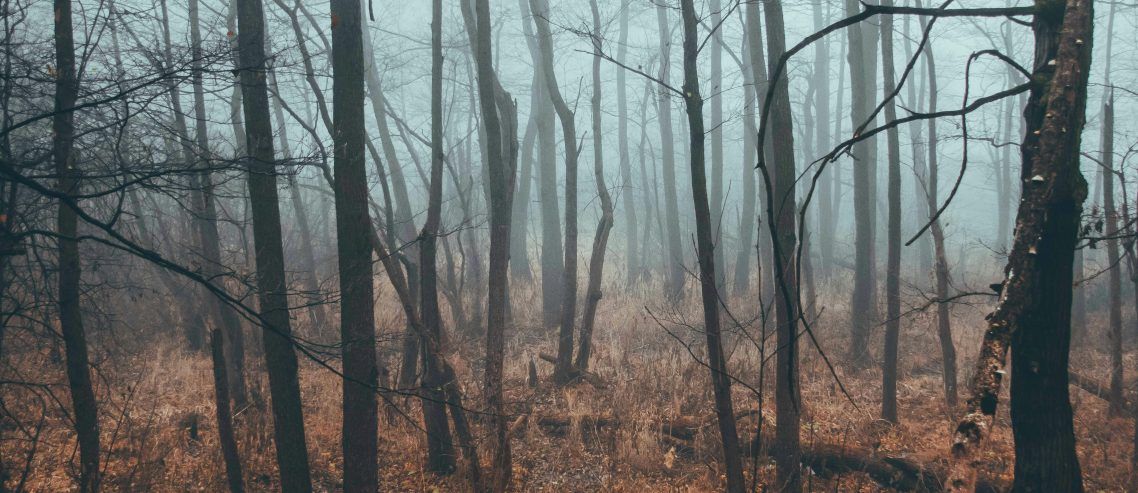
You have to be pretty in-tune with the woods to detect life in February. For most Midwesterners, February in the woods is a bleak picture. It is a scene that is more akin to death than life. Leaves lay decaying on the timber floor. Branches rattle hollow in the wind. Limbs unable to withstand the winter snow and ice load have forfeited their strength and lay splintered all about. The colors are shades of grey. Beauty is a stretch and requires imagination.
Yet, there is movement beyond our field of view. Beneath the bark of the maple, birch, and walnut trees, sap is beginning to flow. Freezing night temperatures and warming sunny days serve as a natural pump, moving minerals and sugars from the roots to the limbs. Nutrients are being consumed in the twig and bud. Life is doing its unseen work, and this is required for the celebrated brilliance of leaf and flower.
On the Friday afternoon of Christ’s crucifixion, Jesus exhaled his final earthly breath. What exactly transpired while Christ lay in repose from Friday afternoon to Sunday morning will be left a mystery to us. But by all accounts, his friends saw it as much like the February woods. Grey, lifeless and a cold shell of what once was and could have been. Yet, beyond their field of view, beneath the surface, a sweet grace began to flow. We now understand that the unseen work in those few dark days was fueling a resurrected life. First Christ’s, and because of his, ours.
The lesson we see first in Christ’s death and resurrection, is illustrated in the February woods and also, is a model for our own lives. When life seems lost, when death seems to have won, resurrection is possible.
It comes as no surprise, that God would use this model of death and resurrection to transform us more into his likeness. Death and resurrection serve as a central shape for the believer’s life. The follower of Christ increasingly is familiar with dying and reviving.
- We die to our will to revive to his will.
- We die to our passions to revive to holy passions.
- We die to our idols to revive to God worship.
- We die to our thinking to revive to the mind of Christ.
- We die to our pride to revive to humility.
The maturing life of the believer is marked by our resemblance to Christ’s death and resurrection. Over the entire lifespan, the believer continues to die to newness of life.
For the woodsmen, February is more than meets the eye. They have found sweet reward in tapping the sap of the maple, birch, and walnut which only flows during this perceived season of death. Candy and syrup are a few of the delights in store for those who collect this flow. Far more delight, however, is in store for the believer who taps into the resurrection flow of Christ. Delight in a hope that springs eternal from death.
Additional Articles
3 Habits for Our Kids
Parenting has its eye towards producing future adults. One powerful adult forming tool is instilling good habits in our kids. A well parented habit can pay dividends in the long run by building the muscle memory to do what otherwise would not be natural. In this episode of Breaking Bread, Brian Sutter examples this by suggesting three habits

One Tip for Human Growth Podcast Episode
We all have room for growth. Yet sometimes our progress gets stalled, and we get discouraged. This discouragement might be because we are measuring the wrong thing. In this episode of Breaking Bread, Ted Witzig Jr. helps correct this mistake and teaches us to measure from the bottom-up.
Advent: Thy Kingdom Come
In ancient times, Jewish teachers traditionally had prayers unique to their school. The prayer encapsulated the world view of the rabbi. It unified the pupils and gave them identity. It was an extension of the teacher; in fact, the prayer itself taught the disciples what was important and what they

Comments
Leave a Comment