


Receiving God’s Blessing Podcast Episode
Flourishing, Abundant Life
God was very thoughtful and intentional about how to bless his people. “Do it like this” he told Aaron. His blessing (captured in Numbers 6) is beautiful poetry. Not only is it beautiful to the ear, but it is also health to the heart and soul. In this episode of Breaking Bread, let’s learn together about how God chooses to bless us, how to receive His blessing and how to bless others with our Father’s words.
Show Notes:
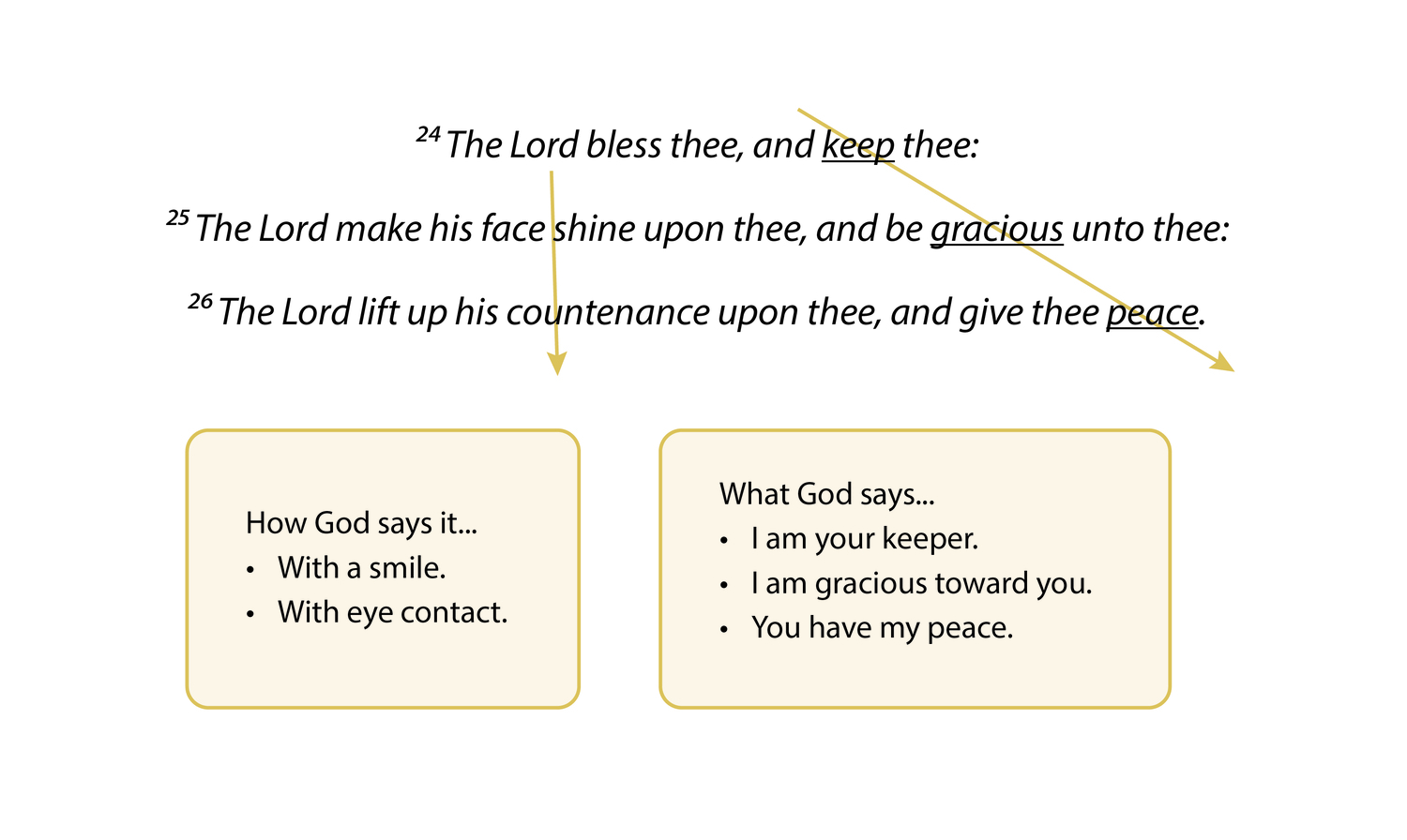
We live in a world of cursing. God knows this, so he has thoughtfully chosen to bless us carefully. And when he does, he confers abundant, flourishing life on us. Receive God’s blessing in Numbers 6:
Transcript:
The Lord bless you and keep you. The Lord with shining face is gracious unto you with lifted up countenance towards you, gives you peace. Welcome everyone to Breaking Bread, the podcast brought to you by Apostolic Christian Counseling and Family Services. Wonderful as always, to have you along Arlan Miller is with me here in the studio.
Great to have you in Arlan. Hey, Matt. It’s good to be back in the studio. Alright, Arlan, we’re going to talk about blessing, and you can’t talk about blessing without talking about cursing. Blessing and cursing. Sounds like stuff that lore and story has made up. We live in a very physical world, very intellectual world.
Blessing and cursing aren’t a thing, but I want to unwind that a little bit. The Bible uses blessing and cursing a lot. The Bible speaks in terms of blessing and cursing. The story the Bible is told in blessing and cursing. Am I right? Am I hitting close to that? Absolutely. It’s a key aspect of the entire narrative of the Scripture, right from the beginning to the end.
You see blessing and cursing interwoven within it, but then even like subplots and it plays out in multiple different ways. And you can take a very simple example where a father bestows his blessing upon his child. And I mean the whole impact of that. The whole drama of Israel.
Jacob versus Esau goes back to a blessing. So, you can go back to Jacob and Esau and think about who’s getting the blessing of Father Isaac, and how that plays out and just the impact that had for generations. So, you see this narrative, God speaks in terms of blessing and cursing and it’s important to him.
The Psalmist writes The Blessed Man. It’s interwoven in that, Job, and others. And then Jesus picks it up in the sermon on the the Mount. Blessed is, you know, the Beatitudes right. Matt, you’ve talked a lot I know about this idea of we see this in numbers with the Israelite people coming into the wilderness and God gives a blessing to Aaron and says, bless the people this way.
Yeah. He’s very articulate. God is very careful and what he says, and not only what he says, but how he says it in terms of this blessing. And I think it’s fantastic that God is very intentional about how it is that his people would be blessed. And I think it stands as an example, but also as a huge gift that we would receive his blessing.
Right. And I don’t think it was meant to be just a one-time thing. This is meant to be an ongoing thing. So, there’s health in just thinking through what that blessing is and what that looks like? Right. Well, and in some ways, it is a counterbalance to the cursing that we find ourselves in.
I mean, you look at Genesis three, the curse enters, and then we’re not going to see the curse done away until into Revelation. So, you could also say that we are living in a time of cursing. So, maybe let’s do some definition. What do we mean by blessing? How can we understand a blessing and how do we understand its counterpart?
A curse, right? Yeah. Could be in a way. Yeah. So, when you think about blessing, you’re talking about blessing someone as to confer or to encourage flourishing or that abundant life upon them. We want you to move to a place of flourishing. Yeah, and this is how I think about you.
I think about you in fullness, in flourishing, with the abundance of God and what he is. I think that word confer is important that you mentioned that there is a conferring or a pronouncement of these things, of flourishing, abundant living. I mean, that’s what blessing is made of.
Right. Which then even brings you back to that kind of the core of God in terms of life, I guess you could say. A curse is the flip of all of those things, right? Instead of abundance, that’s scarcity. Instead of flourishing, its withering instead of life, its death. It certainly has our adversary written all over it.
Right. That’s what Satan has been about since Genesis 3 and onward to today. Yeah. All throughout the story of Scripture which has this element of cursing throughout it. The story of the fall of man until the very end. But even in the midst of that story of cursing, you see God speaking blessing at times.
He enters into the story and speaks blessings as kind of a reminder and encouragement to remember the abundance of who he is. Yeah. The goodness of who he is and the promise of flourishing that comes from following after him. Yes. And that abundance is ours. Yeah. And in a way that blessing then is a reminder that this is true.
This is now true of you, right? So, let’s go to that number six, which we all know it’s beautiful, it’s poetic, but the Lord bless thee and keep thee. The Lord make his face shine upon thee and be gracious unto thee. The Lord lift up his countenance upon thee and give thee peace. So this well-crafted, beautiful vernacular.
God told Moses, tell Aaron to bless the people this way. I think it is profound but might be a dose of pure health for us as humans. Yeah, it makes sense, and it speaks to the idea that you can take it and break apart in the different aspects. It begins with this idea of the Lord keep thee right? So, the Lord is a keeper, it speaks into a little bit of who God’s character is. He is a keeper, he’s a protector. He’s one that’s looking out for things. And I think this is the keeping that Adam was created to do. And he was to keep the garden. For any garden enthusiast, they understand what keeping is.
It’s not just that we put a fence around something and keep it safe. But it is being in and among the elements and nurturing to plant, being present, not being absent. Right. We get a lot from God when he says to us, Arlan, I am your keeper. Yeah. It’s a direct refute to this idea that God just kind of sets things in motions and disappears.
Right, because a keeper is one that’s constantly present, constantly keeping his eye on things, and that speaks to part of what God’s character is. He does not just set us and forget us. He is engaged in every aspect of our life, caring, protecting, looking upon us and desiring flourishing for us.
And then he talks about being gracious unto the right, this idea of grace. This abundant, flourishing, life-giving love. Yeah. And I think this part speaks to God’s heart. If the first part speaks to God’s character, this part speaks to God’s heart and his desire for us.
That he wants to be gracious towards us, that he will be gracious towards us, and that’s at the core of his being in a way that he is for us is a tremendous blessing. Right. Can you imagine, again, that voice of blessing that Aaron was speaking to the people and that has been preserved for us to speak into them and say, in the midst of the cursing, I am here as God and I am your keeper, and I am gracious towards you. My heart is for you. Yeah. That hope and encouragement should start to come. As we take those and we start to receive those words of blessing, and then he concludes that in saying that he is our peace. All of these are just fundamental human desires. I don’t think there’s anybody on the planet who would not perk up and say, really a keeper.
You mean he loves me? You mean he soothes me? Tell me more. Right. And brings you to this place of peace. That’s the result of those two things. Yeah. I have a loving good God who is a keeper of me, and so therefore I can rest in peace. And so, I think there’s this aspect of, okay, what he says, but there’s even the aspect of like how he says it and the imagery that he uses.
As he shares this, he speaks about making his face shine upon you. What a beautiful imagery that we have there with the idea that God is looking at us, smiling upon us. I think a face that shines is a face that is smiling and Arlan, when you say it that way, and then lift up your countenance in this idea of direction and eye contact, God is telling Moses, tell Aaron to remind the people that I am their keeper. I am their lover, and I soothe them and be sure to say it with my smiling face and eye contact, which carries the message, doesn’t it? Right. I mean, it’s the nonverbals. You get how we look at someone as we deliver a message or what our nonverbals are saying has such a huge impact on what that message is.
Yeah. And how we receive that. And here you have the smiling, benevolent, loving, caring father, lifting up his count upon his people. Not just saying it as he’s walking out of the room or whatever, but with the power of, I’m pausing, I’m looking you in the eye. I’m smiling at you and I’m saying these things.
Yeah. I, so not just the what, but the how I think is a really important point, Arlan, that you made there, and again, it carries the message and is a strong dose of health for the human being. Yeah. And we see it as such a small level. Again, I’ll use the example, and any of you who are parents out there and you’ve had engagement with your children, how you say something means so much more than what you say sometimes. Yeah. You know, you can say the right thing but in the wrong way and demeanor. Wrong way. Yes, totally. I mean, I had that incident this morning with one of my children. And I’m like, and I, I flopped it, right? And at the end I look back and I’m like, I totally, I did not have the right demeanor.
And any message I could have said, any words I could have shared were not going to be heard or received until I got the demeanor right. Yeah. And so that’s a critical aspect of blessing and engaging blessings. Number one, just theologically, as we think about and reflect upon Aaron’s blessing. The Aaronic blessing, but then also going forward, how do we bless others? What does that look like? Yeah. I think a neuroscientist would say, oh, you’re hitting on the left and the right-hand brain hemisphere is what you’re doing. Right? That logical brain basically takes in information.
It likes words and reason and rationale. Right. That’s the keeper. That’s the gracious, that’s the peace part, and then the right hemisphere. That’s the feeling imagery story. That’s the smile eye contact. And together, powerful combination. But you really call us Arlan as we talk about how can I be a voice of blessing?
Whether it’s my kids or my spouse, my coworkers, right? My community, my neighborhood, how can I be a voice of blessing? Striking both of those elements, right? The what and the how is really key. God told Aaron to speak this blessing. I think sometimes we just simply die the death of not doing it.
Yeah. Right. God calls us to bless, he calls us to engage. He calls us to actually speak it. I may think of a lot of beautiful things towards my children, again, to use that context. But until I actually look them in the eye and say it, I have not blessed them. I mean, there is something where you have to carry that out.
I think you’ve really spoken about the difficulty of it. Yeah. I actually find this to be difficult to do, even with Rebecca, to look her in the eye and to confer or to relay God’s blessing upon her, which I fully believe with all my heart. It always feels good, but there’s a way that we’re not used to talking to one another this way, you know?
And so, I dare say, as a church of God and as believers who want to carry the blessing of God, there is a little bit of a learning curve for both the giver and the receiver. How do I receive a blessing? Could be another thing we launch into, right? Arlan. We’re not so good at receiving it.
We’re pretty quick to say yeah, but I’m not sure. And question that and to sit and to absorb it and to receive it is our duty or call to that. That’s a critical point, Matt. We can justify a thousand ways as to why that’s not true, or he doesn’t really mean it. Or there’s some other ulterior motive or whatever.
And there is a beautiful thing that happens when we sit and just receive the blessing that someone else shares. You know, there are a few times I think, in life when you have more of the formal type of blessing situations, like my mind goes to a wedding ceremony and often at the end, this blessing will be spoken, which is beautiful and wonderful.
I sometimes wonder if it would be a healthy exercise for us to consider. How do we appropriately share blessings at key milestones in our lives? Or not even just key milestones, just at key moments in our lives. Yeah. And I further love the idea that God has kept it simple. He’s kept it simple that he’s a keeper, that he’s a lover, that he is peace.
I can’t remember much more than that, you know? And for me to be able to, before my feet hit the floor, for example, and to receive God’s blessing, it needs to be that simple to me. And he’s given his blessing in a way and mode for us to remember it. Yeah.
That’s how important it is, and it is a healthy discipline, if I can use that word, to build into our life the reception of that blessing. To remind ourselves of that story and the fullness of that story that he is working out through his creation and that he is looking upon us and interjecting himself into this world of cursing that we are part of and sharing that blessing.
We need to let God counteract the cursing in this world by the graciousness which he wishes to bestow upon us and then continue that cascade on down. Yeah, as we bless others and share his good love with them. I mean, if we finish that blessing out there, number six, that my name might be upon them is how he concludes it.
That is what it looks like when his name is upon his people. And when we repent of our sin and when we come to Christ and when we accept his grace and we follow him as disciples, this is our positioning with him when his name is upon us. He’s our keeper. He’s our lover. He soothes us. And I would say it’s good news.
It’s good news that we can rest in. Yeah. Arlan, I’m just going to finish sharing that blessing. So, wherever you’re at, just allow the blessing of God to settle on your heart. He shares this blessing with you, with a smile, with eye contact, he says. The Lord bless you and keep you. The Lord with shining face is gracious unto you with lifted up countenance towards you, gives you peace.
God bless you each one.

Listen on Spotify – Listen on Apple Podcast
For Further Information
Beholding the Face of God
In a world of cursing, it is important we bask in the blessing of our heavenly Father. We can do this by receiving the Aaronic blessing. Listen to what God is saying and how he says it. Imagine him smiling upon you. Because he is.
Five Ways to Bless Others
Blessing or withholding blessing has a profound impact on those we interact with. We have been blessed by God through Christ, and we are to bless others as we have been blessed. Let us briefly consider five ways to bless others.
Additional Articles

Thy Kingdom Come Podcast Episode
Advent is a season of longing and hope for Christmas – a time when anticipation fills the air. But what does this waiting reveal about the kind of people Christ is shaping us to be? In this episode of Breaking Bread, Joe Leman and Matt Kaufmann explore how the Lord’s prayer stirs a deep desire for Christ’s


Immanuel: Teaching Us What Humility Means
Isaiah prophesied of the coming Christ child and named him Immanuel – God with us. Captured in this announcement is the humility of God. This attribute is knit into the character of God, and by his example at Christmas, we learn what humility means and are taught how to humble
Comments
Leave a Comment