

 in Sexuality, Singleness
Stewarding Your Sexual Desire
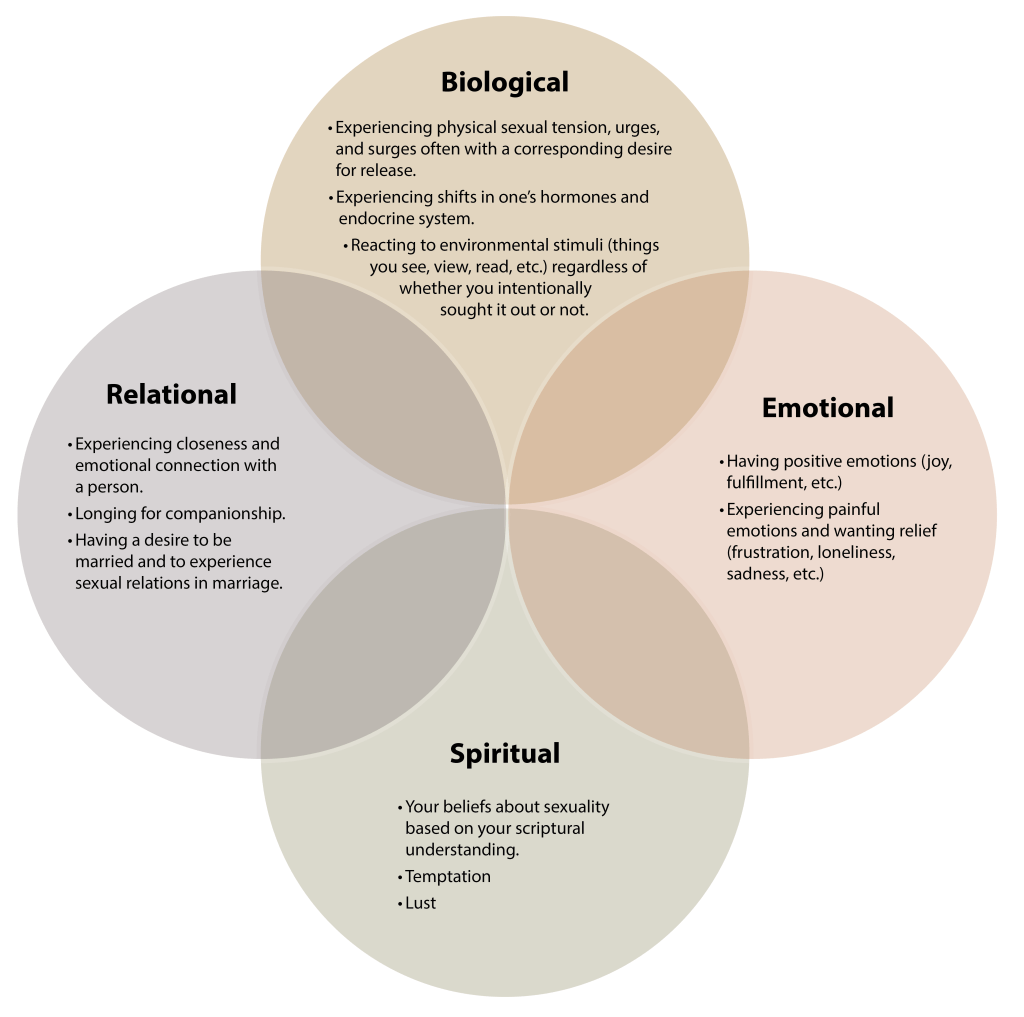
Having sexual thoughts, feelings, and desires are part of the human experience as God has created all of us as sexual beings. An accurate understanding of sexual desire will consider all four aspects of life (biological/physical, emotional/psychological, relational/social, and spiritual) and how they each provide contributions to sexual desire. This knowledge should equip us to steward sexual desiring a God-honoring way.
Lust
Lust can be explained and defined in various ways. When you are battling with lust, seek God, accountability, and counsel (James 5:16). Remember that forgiveness and hope are available to us when we turn away from our lustful thoughts and actions and turn towards Christ (1 John 1:9).
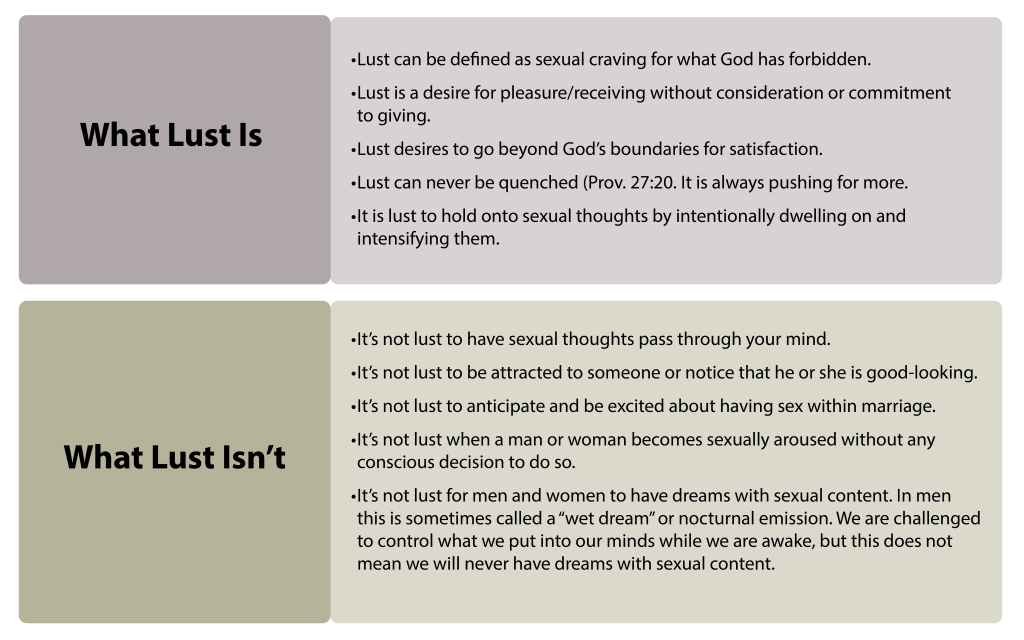
Some individuals automatically interpret sexual thoughts and feelings as being sin, however, that simply isn’t always the case. While being careless or feeding sexual thoughts and feelings leads to error, so does fearing sexual thoughts and feelings and falling into the error of self-condemnation.
Develop a zero-tolerance policy for sinful inputs and accelerants.
In the context of sexuality, inputs and accelerants are anything that stirs, increases, or leads to lust or sin. Zero tolerance policy, simply put, is cutting them off (Matthew 5:29-30). Satan’s stealthy lies and a gradual deterioration of our vigilance can lead to allowing things which should not be tolerated. The following list includes examples of inputs and accelerants that should be cut off:
- Media/technology, in any form, that provides or provokes images or stories that lead to lust.
- Pornography in any form or pictures from any source that stir lust.
- Sexual fantasy and lustful thinking.
- Romance novels and stories with strong sexual content.
- Flirtatiousness and sexually tinged conversations.
- Locations or people that provoke lust or sexual behavior.
With the ease of accessibility of these items today, it is especially important to remain diligent. People can access inputs and accelerants within the privacy of their homes, creating secrecy and a lack of accountability. It is simply never acceptable to allow sinful inputs or accelerants into our lives. (Matthew 18: 8-9).
Masturbation
While the Bible is very clear on warning about the sinfulness of lust (and by extension sexual fantasy and pornography), fornication, adultery, etc., there are no scriptures which specifically mention masturbation. Therefore, biblical principles regarding temptation and sexual purity should be used as guidelines for how to approach this topic in Grace and Truth.
It is sometimes difficult to address the topic of masturbation because its meaning and impact are different across individuals. Let’s start by considering again the following continuum. Please note where you would place yourself along this line as you consider the topic of sexuality.
License—————————-Grace & Truth——————————–Condemnation
- Individuals who tend toward License may minimize that they are letting their flesh set the course of their behavior instead of the Spirit. We have seen the damage left behind by the indulging of the flesh, the lack of accountability, and the absence of overcoming in a life not fully committed to sexual purity.
- Individuals who tend toward Condemnation may feel like completely giving up and being unforgiveable for slips that occur. We have likewise seen the damage left behind by the shame, excessive guilt, and sense of spiritual failure created by those viewing these occasional slips from this viewpoint.
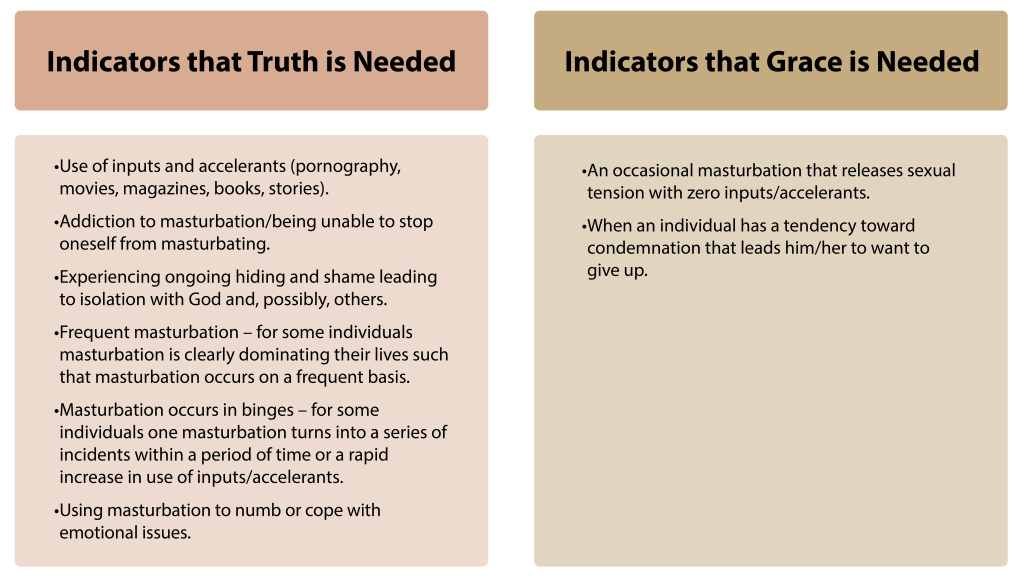
Approaching the topic of masturbation through the lens of Grace and Truth means knowing that masturbation neither condemns completely nor is to be taken lightly. To be clear, there is a difference between continually experiencing sexual tension and continually submitting to sexual tension. This distinction is important and should be recognized as the believer discerns the line between feeling excessive guilt and unwarranted license toward masturbation. Other factors that can influence how serious an issue masturbation is for an individual include:
- The age of the individual (pre-adolescent, teen, adult).
- The marital status of the individual.
- The presence or absence of inputs or accelerants.
- The history of the individual (sexual history, addiction to masturbation, etc.).
- The level of spiritual maturity and accountability of an individual.
Our bodies are given to us as a vessel to steward. People make the argument that masturbation is acceptable as it doesn’t directly sin against another. However, as 1 Corinthians 6:19-20 states, our body is not given to us for our own use but for the Lord’s and we are to glorify him through it. It is essential this truth is kept in mind as this challenging topic is dealt with. Below are some indicators to help determine whether a truth or grace approach to masturbation might need to be undertaken:
Leading an Overcoming Life: Incorporating a Comprehensive Approach
The goal God has for us is that we live an overcoming life. That doesn’t mean that we will have a trouble-free or temptation-free life, nor does it mean we will always overcome in the moment. We are called to “get up again” and continue moving forward (Proverbs 24:16). Consider the following two life-paths you could walk and consider how each is likely to deal with sexual desire, tension, and temptation. It is easy to see there will be a big difference.
We are called as followers of Christ to have a comprehensive approach to dealing with our sexual desires and temptations. This means our plan for resisting sexual temptation should touch all aspects of our life. Too often we believe changing one or two aspects of our life will result in a victory which requires us to be completely aligned with God’s truth by his grace. A few of the specific strategies are discussed below.
Using Scripture to Guide our Thinking
Below are some scriptures and questions you can use to help someone guide their thinking and develop strategies to overcome sexual desire. These verses and questions can help discern how to properly view this struggle. These questions can be used for self-examination or reviewed with an accountability partner or mentor.
- 1 Corinthians 6:12-13
- Is this type of thinking or behavior bringing me under its power? Am I being controlled by it?
- Is this type of thinking or behavior increasing or decreasing the Spiritual fruit of temperance (self-control) in my life?
- Even if this type of thinking or behavior isn’t overtly sinful, is it wise or beneficial for me? (James 1:14-15)
- Colossians 3:5
- Is this type of thinking or behavior increasing my lust? If so, I need to flee.
- Matthew 5:28
- Is this type of thinking or behavior objectifying someone as an object of lust?
- Romans 14:14
- Does this thinking or behavior cause me to feel shameful or isolated from God through the conviction of the Holy Spirit?
- Genesis 2:24
- Is this thinking or behavior leading me away from pursuing a marital relationship which God has called me to?
- Romans 14:13
- Is this thinking or behavior putting a stumbling block in someone else’s way?
- Is this thinking or behavior taking advantage of someone or leading them into sin?
Redirecting and Reframing our Sexual Desire
Our sexual drive is God-given and as with any other drive, we must discipline it to keep safeguards around it. We deal with it appropriately by redirecting our focus and reframing our thoughts. Instead of concentrating on what we cannot have that would seem to satisfy our sexual desire, we concentrate on God and find ways to be drawn closer to him and others in wholesome ways.

Protecting Yourself Against Temptation
It should be no surprise to us that temptation will come. Sexual temptation and frustration over sexual desire are certainly areas he tries to exploit. As 1 Peter 5:8-9 tells us, “Be sober, be vigilant; because your adversary the devil, as a roaring lion, walketh about, seeking whom he may devour: Whom resist stedfast in the faith, knowing that the same afflictions are accomplished in your brethren that are in the world.”
Based on this warning, we need to be aware of the sources of environmental temptation around us. Many temptations come as we passively go through our day and without a diligent plan of protection an “innocent” search on the internet or drive down the street can take a turn toward temptation as we come across something we were not expecting. There are also vulnerabilities inside of us that we need to be aware of and on guard against. Examples include:
Starving our Sources of Temptation
- When facing sexual temptation, take inventory of your life to see what sources of temptation you are aware of that you are allowing in your life. You are encouraged to pray through Psalm 139:23-24, “Search me, O God, and know my heart: try me, and know my thoughts: And see if there be any wicked way in me, and lead me in the way everlasting.”
- We can all find ways to justify things in our lives that quite simply need to be removed and from which we need to flee. There may be certain environmental sources of temptation that you knowingly allow in your life (various forms of media, romance novels, pornography, etc.); or perhaps it is a relationship that consistently provokes unhealthy desires.
- Choosing not to feed the natural desires within us is an important step towards overcoming sexual temptation. This is a matter of enforcing your personal “zero-tolerance” policy on inputs and accelerants.
- For more information, readers are encouraged to go the Dealing with Sexual Temptation section of the ACCFS website.
Remember the Body of Christ
- In the midst of this struggle with sexual desire, it is imperative to remember the invaluable tool which God gives us in the form of his Body of believers.
- We are called to be active and involved members of this Body.
- Within the Body, we should utilize the source of protection accountability partners and mentors can provide (Pr. 27:17).
- Accountability partners are typically people of your same sex around the same age and stage of life as you. Mentors are individuals of the same sex with more experience in life or in some specific area who provide guidance and support.
- For more information, readers can go to the Mentoring section of the ACCFS website.
Managing Technology Effectively
- Technology has increased the ease of accessibility to pornography and sexual images like never before. Personal stewardship and high levels of accountability and integrity are needed to stay away from falling into a trap of isolation and secrecy.
- Remember that our Christian beliefs and behaviors need to go with us online. Nothing is hidden from God. 1 Corinthians 4:5b tells us that God “…will bring to light the hidden things of darkness, and will make manifest the counsels of the hearts: and then shall every man have praise of God.”
- Viewing pornography or graphic sexual images on the television or the computer can create a mental catalog of images to be recalled during future struggles. As sexual temptation is heightened, sinful fantasies increase and can result in masturbation to satisfy desires instead of seeking to fulfill deeper needs of connection in line with God’s truth.
- Through continually viewing and fantasizing, a person’s relationships with others and overall view of reality can become distorted. Women become objectified, diminishing a man’s ability to see her worth in Christ as a human being. She instead becomes viewed only as an object of desire or fulfillment and standards are created which can never, even in marriage, be righteously filled.
- For more information, readers are encouraged to go the Technology section of the ACCFS website.
Fulfillment and empowerment through Christ
Our goal must be to have pure desires: desiring God’s gift of sex to be honored and undefiled. In the spirit of Colossians 3, we must continually “put off” or “mortify” the natural lusts and “seek those things which are above” in order to “put on the new man” (Colossians 3:1-11).
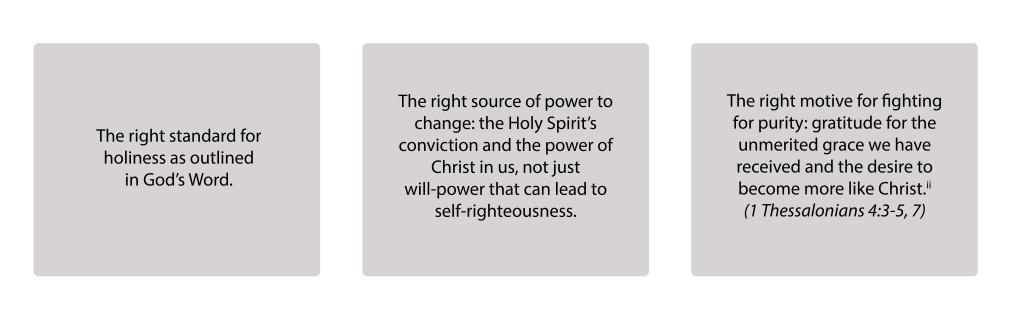
As we continue this pursuit of sanctification, we become transformed and conformed to the image of Christ and fulfill his calling to us (Romans 8:29, Romans 12:2). God’s call to us is based in his unending love for us. When he calls us to defeat temptation, He does so knowing that he has something far better for us than the temporary, artificial fulfillment that lustful thoughts and actions attempt to provide. As we seek to defeat lust for the sake of holiness:
- We need to be properly equipped with:
- We need to develop an intimate relationship with God and reflect on his love for you through:

“When people catch a glimpse of something much larger than themselves, something they deeply believe in, seemingly nothing is too difficult for them.” v This is not to say maintaining this purpose will always be easy, but this discipline allows us to strive for and fulfill the heart of Colossians 3.
Conclusion
God wants us to be empowered and to succeed in victorious Christian living. He does not want us to be brought under the power of anything (1 Corinthians. 6:12). Understanding normal sexual desire, focusing on the complete elimination of sinful inputs, and overcoming lust by the grace of God will help each of us to live an overcoming life in Christ.
There are many ineffective ways of dealing with this relevant issue. Redirecting and reframing your sexual desires, developing and maintaining healthy relationships, starving sources of temptation, and gaining victory over lust are ways to properly acknowledge your sexuality and yet not allow it to lead you into sin.
A vibrant, committed spiritual life which maintains healthy communication with God and the body of believers should be viewed as an essential first line of defense. The intimacy we have with our heavenly Father and the opportunity to experience it through prayer is powerful and fulfilling.
- Pray for the presence of Christ and the desire for God’s will in your life, whether it includes marriage or not.
- Pray for yourself to be growing into the person Christ wants you to be.
- Pray for the purity and integrity of the men and women you know.
- Pray to be able to honor God as part of the Body of Christ.
Discussion Questions
- How have you been able to turn towards Christ when struggling with sexual tension and urges? If this idea is new to you, what can you do to draw nearer to God when these feelings arise?
- How is the definition of lust in this section similar or different from how you have defined it? What other Scripture verses guide your understanding of and defense against lust?
- Do you have a zero-tolerance policy on input and accelerants? Ask the Holy Spirit to help you do an inventory of your life and see if there is anything that needs to be “cut off.”
- In what ways does your sexual desire seek to be played out in ungodly ways? Some are tempted in more overt ways such as porn while others are tempted in more subtle ways such as developing private emotional relationships. Where are your weak points?
- What specific activities can you do in order to “redirect” the tension that comes from sexual desire? How can you specifically “reframe” your sexual desires into a greater perspective?
- What are your vulnerabilities? Are there any social or environmental sources of temptation that need to be removed from your life?
- Who are you accountable to for maintaining your sexual purity?
- How can appropriate boundaries be set to maintain integrity and accountability when using technology?
To view the PDF, click here.
References
Referencing of these materials is not meant to imply an endorsement by the Apostolic Christian Church of America of the author, publisher, or organization that created the materials.
i http://changingminds.org/techniques/general/reframing.htm
ii Ibid., 98
Additional Articles

Am I Living a Healthy, Balanced Life?
“…I am come that they might have life, and that they might have it more abundantly.” John 10:10 God’s desire for us is that we can live a full and abundant life in relationship to him. Yet, life is full of situations and transitions which can shape and affect our

The Church & Singleness
“But as many as received him, to them gave he power to become the sons of God, even to them that believe on his name: Which were born, not of blood, nor of the will of the flesh, nor of the will of man, but of God.” (John 1:12-13) For

God’s Design for Sexuality
Genesis 1:27; 31a, “So God created man in his own image, in the image of God created he him; male and female created he them…And God saw every thing that he had made, and, behold, it was very good.” Before the Fall of mankind into sin, God created our world
Comments
Leave a Comment