
Paul reminds us that the church, similar to your own family, is one type of dynamic relationship system – “For as the body is one, and hath many members, and all the members of that one body, being many, are one body: so also is Christ” (1 Corinthians 12:1). Each member is distinct in his or her gifting and talents and all work together for the glorification of God. The dynamics of a family, whether church or biological/adoptive, are influenced by the flexibility and connectedness of each of the members. Paul uses the human body as a metaphor in 1 Corinthians 12 to convey the reality that individual body parts impact the entire body, and the body impacts the individual parts. We are reminded throughout scripture of this truth – when one member weeps, all members weep (Romans 12:15) and to love our brother/neighbor is to love our Lord and follow his commands (John 13:13-15; 1 John 4:7-8).
Your family of origin is an individual, dynamic, relational system designed by God to carry out the teaching and modeling of his Word in daily life for the growth and nurturing of its members and the glorification of God. The family structure is associated with the establishment of “rules” for family interactions as well as roles and responsibilities of each family member. Some of these rules, roles, and responsibilities are clearly spoken whereas others are unspoken. For example, if parents don’t model appropriate sharing of vulnerabilities/imperfections and give only negativity or distance toward “failures”, it may lead to children believing it is not okay to be vulnerable or talk about imperfections. Your family of origin often provides a “blueprint” for how you communicate, engage in relationships, set priorities, and more. It can influence you even after you leave home. God himself reminded the people of Israel their choices had an impact on future generations (Numbers 14:18). Thus, some beliefs and behaviors are often formed by and inseparable from the functioning of one’s family of origin.
Types of Family Dynamics
There are several dynamics occurring within families which influence how family members relate to each other and the individual roles within the family system. These dynamics affect how a family transitions through various normal life stages as well as unexpected events that occur in life.
Family Adaptability
The first of these dynamics relates to adaptability, as shown through the continuum below:
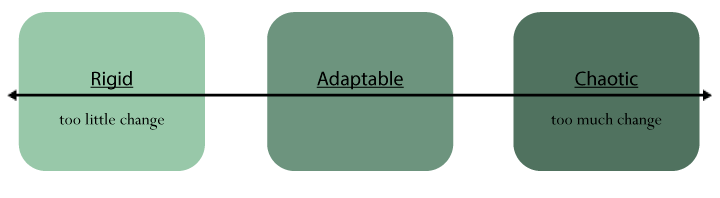
The dynamic of a rigid family functions inflexibly and the family system seldom changes. Rigid family systems tend to have an authoritarian leadership style while enforcing strict and stern discipline. They may attempt to provide protection (with desire to keep the bad out) through control over members which can inhibit learning through failures and reduce the healthy expression of affection/physical touch. This can lead to unrealistically high standards being internalized; when unmet this can foster shame and the development of perfectionism to seek acceptance. Chaotic family dynamics, on the other hand, tend to lack clear leadership and enforce discipline in an erratic manner, if at all. Often this chaos leads to excessive and uncontrolled expressions of emotions, confusion, uncertainty and difficulty with deciding or committing to decisions due to lack of healthy guidance. Family members may struggle responding well to a “no” in adulthood. Healthy, adaptable families adjust well to the change which is inevitable in life and have clearly defined boundaries or structures. An adaptable family handles problems as a unit rather than placing issues on a particular person/s. Adaptability in a family allows members to deal directly and respectfully with one another while encouraging healthy expression of emotions, vulnerability and exploration.
Family Connectedness
The next family dynamic relates to the connectedness of family members.

A disconnected family tends to be highly independent. It places high value on being able to be self-sufficient, with low levels of need from the family and limited emotional connection between members. This leads to feeling emotional distance and disconnection among family members. An enmeshed family tends to be overly dependent on each other, demands loyalty to family, and implies guilt when family members seek support outside the family system. Normal differences among members can feel threatening to an enmeshed family system. An attached family balances time apart from each other while also spending quality time together. An attached family values loyalty, while not demanding it. Finally, an attached family understands the importance of strong emotional connection among members and that such connection flows out of a healthy expression and acceptance of differences.
Family Dynamics in the Life of King David
Let’s consider an example of a well-known family in scripture. King David became a man after God’s own heart, yet his immediate family seemed very dysfunctional. The story of David and Bathsheba and subsequent murder of Uriah is well known. This incident happened when Amnon, Tamar, and Absalom were teenagers. These children saw their father model behavior that was manipulative and treacherous. The children were likely influenced by their father David’s behavior to hide or keep secrets, avoid issues, and ignore the hurt that grew out of one’s own actions. Just in this introduction, we can gather that this family appeared to have disconnected & chaotic family dynamics.
One of the tragedies of David’s family appears when David seemed to ignore, rather than face and deal with, the incest between Amnon and Tamar (chaotic – lack of family leadership). Two years later, Absalom chose to take things into his own hands (chaotic – due to what appeared to be David’s lack of leadership within his family) and moved into the place of authority and “disciplined” Ammon in an unbiblical manner (chaotic – child taking on parental responsibilities due to lack of guidance). After the sheering of sheep was complete, Absalom invited his family and Amnon over to his house for a party. After Amnon had heavily drunk, Absalom murdered his brother Amnon to avenge Tamar (chaotic – excessive expression of emotions and disconnected). Absalom seemed to take pride in the murder, feeling justice had been served. Absalom eventually flees to avoid the consequences of the murder (chaotic & disconnected). Absalom was in exile from his family for three years (disconnected).
Pause for a moment and consider who in David’s family is often considered the “bad guy.” Likely, Absalom after the death of Amnon. The reality is, however, that David’s whole family needed to deal with several issues. At times, it is easy to dump all the problems and responsibilities of a family on a single member or “scapegoat.” Yet, there is no such thing as a scapegoat in David’s family. Absalom was not the only one in David’s family that needed help; he simply was “acting out” in obvious ways. Each of David’s family members had hurt and wounds; each family member needed help. For some reason, it appears David was unable to take the appropriate steps to deal with Amnon and address the emotional damage done to Tamar. The pain of Amnon’s violation likely devastated Tamar’s whole life.
Multigenerational Dynamics
As previously mentioned, the Bible communicates clearly that the dynamics of one generation are passed down to the next generation (Exodus 20:4-6). These verses speak of “visiting the iniquity of the fathers upon the children unto the third and fourth generation.” We see generational brokenness and dysfunction passed down in David’s family as well as exemplified in the kings who reigned in Israel and many who reigned in Judah. Both realities of individual sin and generational sin often make it difficult to fully understand the effect of actions. However, scripture calls us to embrace both. We also need to remember that even if family dynamics are broken and dysfunctional, generational faith and blessings can be passed down. History does not determine destiny when God’s grace, love and ability to transform life are involved. For Exodus 20:6 remind us that God shows “mercy unto thousands (of generations) of them that love me and keep my commandments.”
Final Thoughts
Considering a family’s dynamics and the role of each family member is important as you illustrate the Gospel of truth and grace. It is important to note that several family dynamics are not biblically wrong or right. For example, it does not say in scripture there is only one right way to express emotions or there is only one right way for the process of decision making in families. We need to apply biblical concepts to each family process. As you reflect on your own family experiences, it is helpful to remember the limits and freedoms operating within your family dynamics. Reflecting on these limits and freedoms can greatly shape your environment (both internal and external) and influence the roles of each individual within the family unit. This reflection process is not about blaming your parents or family. It is likely your parents did the best they knew how. It is, however, about having a mature understanding of the influence your family of origin had on you as a child and perhaps even certain behaviors you engage in today. It is with this deeper understanding that we make sense of our experiences – both leading to a deeper appreciation for whom God created us to be and sharing our hurts with him so he can bring continual healing and transformation in our lives and families.
Appendix
Experiences and dynamics from our childhood can shape our behaviors and beliefs. For example, when we were young and events or people hurt us, we used certain strategies to protect ourselves from those painful experiences. Along the way, we may have learned to play a particular role in the family to lessen tensions. Over time, those roles become a part of who we are, and often operate without our awareness.
Children can begin playing roles in family to gain attention, conform to parental expectations, reduce conflict, or meet the needs of a parent. Look through the list below and see if any of these roles feel familiar to you:
- Good Kid: I made sure not to burden my parents.
- Clown: I used humor to reduce conflict and stress.
- Invisible One: I tried to avoid conflict and stress by hiding.
- Perfectionist: I attempted to avoid criticism or disapproval by doing things perfectly.
- Hero: I accomplished great things so my parents would be proud of me.
- Confronter: I was passionate about the truth no matter the consequences.
- Scapegoat: I took the blame for everything and everyone.
- Surrogate Parent: I had to take care of situations that were beyond my ability to manage well.
- Black Sheep: I was labeled as the bad kid for acting out and doing my own thing.
As children, we initial fill such roles to support smooth dynamics in the family. However, these roles inhibit healthy development, often requiring us to give up important aspects of our personality or temperament. As adults, these roles can continue to operate stagnating our emotional and even spiritual growth.
Consider reflecting on the questions below:
- Identify which role(s) from the list above you played growing up in your family and explain what need it met in your family. What did that role do for you? How did it increase or decrease your anxiety? Closeness or sense of separation from the family?
- Do you see any evidence that you still play this role in adult relationships in your life? In what ways does this hinder intimacy in relationships? What do you think would happen in these relationships if you stopped playing this role?
- If you are engaged or married, consider asking your partner what role they see you playing in relationships with others.
*Appendix was adapted from How We Love Workbook, Expanded Edition: Making Deeper Connections in Marriage, Milan & Kay Yerkovich.
To view the complete PDF, click here.
For Further Information
Family Dynamics Podcast Episode
Families are a system. A set of dynamic moving parts that affect and influence each other. Over time they form up our norms for family life. In this episode of Breaking Bread, Kaleb Beyer exposes the nuances of family systems and helps us notice where adjustments can be made.