


Telling Myself the Truth Course
Self-talk is the internal chatter we are constantly speaking to ourselves. It is an inward narrative, a continual live commentary from ourselves to ourselves. Sometimes this narrative can be false. When misbeliefs color our inward commentary, the results are always unhealthy. This course attempts to help participants learn how to recognize, evaluate and correct unhealthy self-talk. It is designed for a participant to walk with a mentor through skills that will teach a participant how to speak truth to themselves.
Four applications this course focuses on are anger, anxiety, depression and perfectionism.
Required Resources:
This course will be using the workbook "Learning to Tell Myself The Truth" by William Backus as a resource guide. (Link to Amazon Purchase)
- A mentor is recommended. A mentor should be a mature believer willing to read the workbook and comment on lesson submissions. The mentor should purchase the workbook at the link above as well.
Time Commitment:
Participants can expect to spend 1- 2.5 hours per lesson and rate of completion is flexible. Upon sign up, the schedule is as follows:
Lesson Content:
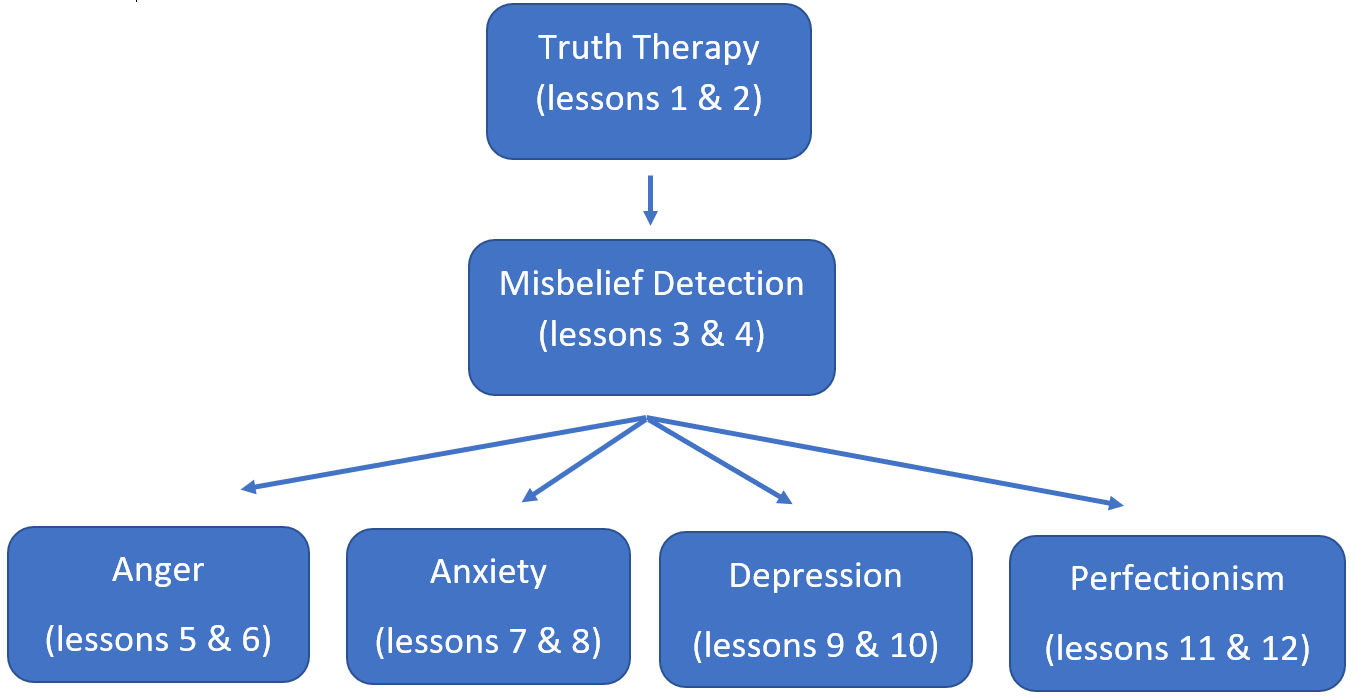
Lessons 1&2: Truth Therapy
Lessons 3&4: Misbelief Detection
Applications:
Lessons 5&6: Anger
Lessons 7&8: Anxiety
Lessons 9&10: Depression
Lessons 11&12: Perfectionism
It is important to note that the applications are useful to every participant, but each is not necessarily required. That is, if an application (anger, anxiety, depression, perfectionism) is more relevant than another, participants can choose which lessons to complete. Consider the flow chart below.
What you can expect from each lesson:
- Motivation: Participants will be motivated with clear goals.
- Information: This section will incorporate new content to learn from assigned readings.
- Internalization: Key concepts from the lesson will be summarized for you to internalize.
- Reflection: The section will allow personal reflection on the content.
- Participant and Mentor Interaction: Participants and mentors should respond to reflection prompts. Online interaction or in-person communication is vital.
Relationship with Mentor:
This course is designed to be completed with a mentor. The mentor is a person who is willing to read the material, review your course responses and respond to your contributions in the course platform. Learn more about the expectations of the mentor here.
Relationship with Instructor:
This course is taught virtually through video and workbook readings and activities. Course entries will be private to you and your mentor.
Sign up below by choosing how you will be participating in the course.
Additional Articles

Are We Too Fragile in Life? Podcast Episode
There is a lot of offense these days. Probably not more offending than normal as people have acted badly for a long time. But it seems people are quicker to call foul when they are hurt by others. “Trauma”, “emotional hurt”, “abuse”, “bullying” are household terms and sometimes we drop

The Prince of Peace
Isaiah 9:6, “For unto us a child is born, unto us a son is given: and the government shall be upon his shoulder: and his name shall be called Wonderful, Counsellor, The mighty God, The everlasting Father, The Prince of Peace.” The world is crying out for peace. It seems

Women: Created in God’s Image
“And God said, Let us make man in our image, after our likeness: and let them have dominion over the fish of the sea, and over the fowl of the air, and over the cattle, and over all the earth, and over every creeping thing that creepeth upon the earth.
Comments
Leave a Comment