


Roles & Decision Making In Marriage
Listen to the audio version of this article.
View the full PDF version of this document.
BIBLICAL PRINCIPLES
Jesus Christ gave us the perfect example
In thinking about your role in marriage, consider the example Jesus provided. He fully exemplified servant leadership, balancing headship of the body of believers and submission to God (Matt. 20:26-27, Phil. 2:5-8).
Scripture provides us with direction for God’s design for marriage
Society’s standards for marriage and the roles of husbands and wives are ever-changing and often do not align with Scripture. Couples must regularly consult the Bible for guidance as it reveals God’s design for marriage and helps identify & correct unbiblical thinking (2 Tim. 3:16-17, Heb. 4:12).
Marriage is a joint effort requiring mutual submission
Living out your roles in marriage, agreeing on and fulfilling responsibilities, and making decisions for your family should be a joint process characterized by mutual submission. Your actions and decisions should be consistent with your love for the Lord rather than selfish ambition (Col. 3:23).
Seek wise counsel
As decisions are faced in marriage, it is often helpful to seek guidance from wise individuals. Getting another perspective can reveal your blind spots and help you learn from the experiences of others (Prov. 19:20).
Prayer must be a vital part in making decisions
Fervent prayer is a key for every individual and couple seeking to make decisions. God is a loving, trustworthy heavenly Father who wants the best for his children and works his plans and purposes for their good. Therefore, while submitting your will to God can be difficult, it also can provide you with peace and comfort, even when your circumstances are uncertain (Matt. 7:7-11).
ROLES IN MARRIAGE
Equal in value, yet distinct in role
God designed an order to be followed in marriage and family (1 Cor. 11:3). God’s intent is for marriage to reflect the relationship and oneness of the Trinity (see how Jesus referred to his oneness with the Father in John 17:21-23). Each person of the Trinity is distinct, yet intimately connected with the other. The Father, Son, and Holy Spirit are each equal in value, yet distinct in role. Similarly, husbands and wives are equal in value, yet distinct in role. God’s image is revealed in both the husband and the wife.
Complementary roles
The scripture contains general and specific teachings concerning both the roles of husbands and wives. God designed these roles to complement one another, and one role is incomplete without the other. Ephesians 5:21-33 provides some very important insights into God’s design for marriage. Two important principles can be distilled from these verses: women feel loved when they are cherished, and men feel loved when they are respected. Without love, women can feel insecure and unimportant. Without respect, men can feel devalued and criticized.
Mutual respect, honor, and submission
Through the Word, God reveals several important principles about his design for relationships. The importance of mutual respect, honor, and submission is one of these themes. For example, he affirms the need for these principles between parents and children (Ephesians 6:2), servants and masters (1 Timothy 6:1), citizens and governmental authorities (1 Peter 2:17), and church members and church leadership (1 Timothy 5:17).
Mutual respect, honor, and submission are also vital in marital relationships (1 Cor. 7:3, Eph. 5:21). Their presence helps relationships flow more smoothly through the ups and downs of life. Their absence leads to emotional hurt, disconnection, and conflict. It is easy to critique how well you feel your spouse is doing at showing respect, honor, and love to you. However, each husband and wife should really focus on assessing how he or she is doing personally by looking into the mirror of the Word.
Specific teachings for husbands & wives
While most scriptural principles and teachings apply to both spouses, the Scriptures below call out individual principles for each spouse. God encourages husbands and wives to meet their spouse’s deepest needs. It is our privilege to help each other develop into Christ’s likeness and reflect God’s glory.
“Husbands, love your wives.”
Husbands are called to assume the role of a Christ-like servant leader who will watch for and guide the course of the family. This role includes loving in a self-sacrificing way that does what is necessary to make his wife feel nourished and cherished (Eph. 5:25-30, Col. 3:19). Husbands must remember that while they have been given the role as the spiritual leader of the home, it does not give them authorization to “rule” in an authoritative way. Being domineering, controlling, or disrespectful to one’s wife is sinful. Likewise, not fulfilling one’s duty to attend to the spiritual needs of the family due to absence, passivity, apathy, or neglect is sin. The husband is to be intentional about understanding and being sensitive to his wife. Not doing so will hinder the husband’s spiritual life (1 Peter 3:7).
“Wives, respect your husbands.”
Wives are called to respect and be submissive to their husbands. This involves a willingness to assume the role of a wife that is Christ-like, encouraging, respectful, and helpful to their husbands (Gen. 2:18, Eph. 5:22-24, 33). Respecting one’s husband does not indicate the wife is of lesser value than the husband. Rather, it involves being his partner in a way that is designed to bring out the best in him. God’s design for a wife’s role in marriage does not include being domineering nor being a doormat. Either extreme will promote an unbiblical marital relationship and needs to be corrected (1 Peter 3:1-2 ).
ROLES AND RESPONSIBILITIES
In marriage, it is helpful for each spouse to have a role that is recognized and valued with certain responsibilities to which he or she is held accountable. Deciding these roles should be a process whereby both the husband and wife mutually agree on assigning these responsibilities. In this way, each spouse makes a commitment to take care of something and is accountable to the other spouse for following through.
While having both spouses involved in various responsibilities is beneficial, one still needs to take ownership. Responsibility involves action, follow through, and accountability. Defining roles and responsibilities is beneficial because it reduces the possibility for misunderstandings (“I thought you were going take care of that”), blame (“I did my part, but you didn’t”), and criticism (“Why did you do it that way?”). A clear assignment and definition of responsibilities reduces the opportunity for conflict and allows you to form healthy boundaries in your marriage. Boundaries help determine who is responsible for what. If you understand who owns [is responsible for] what, you then know who must take responsibility for it.
Responsibilities in marriage are largely determined by a spouse’s preferences, skills, interests, abilities, and time availability. Because of these variables, the definition of responsibilities will differ from couple to couple. While deciding on responsibilities is helpful, spouses should not be overly rigid about who does the tasks. If your spouse is overwhelmed and needs help taking care of his/her responsibilities, you should help bear one another’s burdens (Galatians 6:2) while still attending to your own personal responsibilities (Galatians 6:5). When spouses feel support from each other during stressful times, trust and closeness are fostered. Spouses who work cooperatively, empower one another, help each other feel needed, and sometimes accomplish tasks more quickly (Ecclesiastes. 4:9).
Problems can easily arise if the roles are not clearly defined, are too rigid, or if one or both spouses aren’t being accountable for taking care of his/her responsibilities. For example, if one spouse makes all the decisions and has complete control, the marriage will be unbalanced. Conversely, if one spouse avoids responsibilities, procrastinates, or does not follow through on completing tasks, the marriage will be just as imbalanced. To avoid problems in these areas, remember to “check-in” with your spouse and discuss how each of you feels about the arrangement of responsibilities in the marriage. It is especially important to have “check-in’s” during life transitions (i.e., parenthood, job changes, etc.) as roles and responsibilities may need to shift. Clear, proactive communication can help you deal with these issues when they arise.
DECISION MAKING
The foundation for making good decisions is a prayerful attitude that is submissive to the Word of God and the Holy Spirit. Proactively discuss your expectations for how decisions will be made and how you will manage decision making gridlock.
Questions to consider may include:
- What types of decisions require a discussion between the two of you?
- What types of decisions can you each make without consulting the other? For example, making purchases of
- small items for the house may not need a discussion between the spouses. However, a decision about larger purchases will likely require a consensus.
- What will you do and who will you contact when you cannot agree on a decision?
Particularly in the beginning of a marital relationship, making decisions can be a difficult process. Each spouse may be used to making decisions on his/her own without having to consider another person or decisions in the past were always made with the help of parents. In marriage, part of “leaving and cleaving” involves mutual decision making. Some individuals may need to shift away from a situation in which parents or roommates had primary influence on decisions. Instead, decisions are now made considering one’s spouse first. It is important to realize compromise and flexibility are often required for many decisions (i.e., holidays and in-laws, financial expectations, etc.), and ultimately, each couple must come to their own decision about what to do. Below are a few principles to think about regarding decision making.
Instructions for both husbands and wives.
A number of roles and responsibilities apply equally to both spouses. The listing of verses below is not exhaustive; rather, it serves as a starting point for your own study of the Word on this topic.
- Have a servant’s heart (John 13:12-17).
- Raise your children to know the Lord (Prov. 22:6).
- Respect church leadership (Heb. 13:17).
- Respect governmental authority (1 Peter 2:13-16).
Common sense, logic, and signs can all be a part of decision making
In decision making, you need to avoid both the error of the Jews (over-focus on supernatural signs) and the Greeks (over-focus on earthy wisdom). Both ways hinder a true understanding of God’s ways (1 Cor. 1:22-24). Like the Greeks, some people over-focus on learning, earthly wisdom, and logic. Because of this, many of them find faith to be an illogical and foreign concept. However, sometimes scriptural principles are not learned solely from common sense. Rather, these spiritual principles and matters of faith go against what is natural. In the context of biblical decision making, this means you must not make decisions solely upon what “everyone’s doing” or what appears to be the most natural or easiest solution. Rather, your primary allegiance in decision making must be to biblical teaching and principles.
Conversely, like the Jews, some people seek decision making by looking only for signs or feelings that indicate a direction. For example, if something happens easily or goes smoothly, it can be interpreted automatically as a sign of God’s favor. On the other hand, if something is difficult or filled with setbacks, it can be interpreted as a sign that God thinks something is bad. While the ease or difficulty of working through something may be an indicator of God’s direction, these factors should not be the only evidence used to determine God’s direction. God can speak in any way he chooses; however, we have to be careful we don’t read into things based on our biases and interpretations.
Seek counsel
Proverbs 13:10 says, “Only by pride cometh contention: but with the well advised is wisdom.” You may seek out different individuals for each topic area, or you may choose to consult an individual about more than one area. Remember to seek counsel from individuals who are wise in the Lord and who will have the ability to advise you even if the advice isn’t what you want to hear.
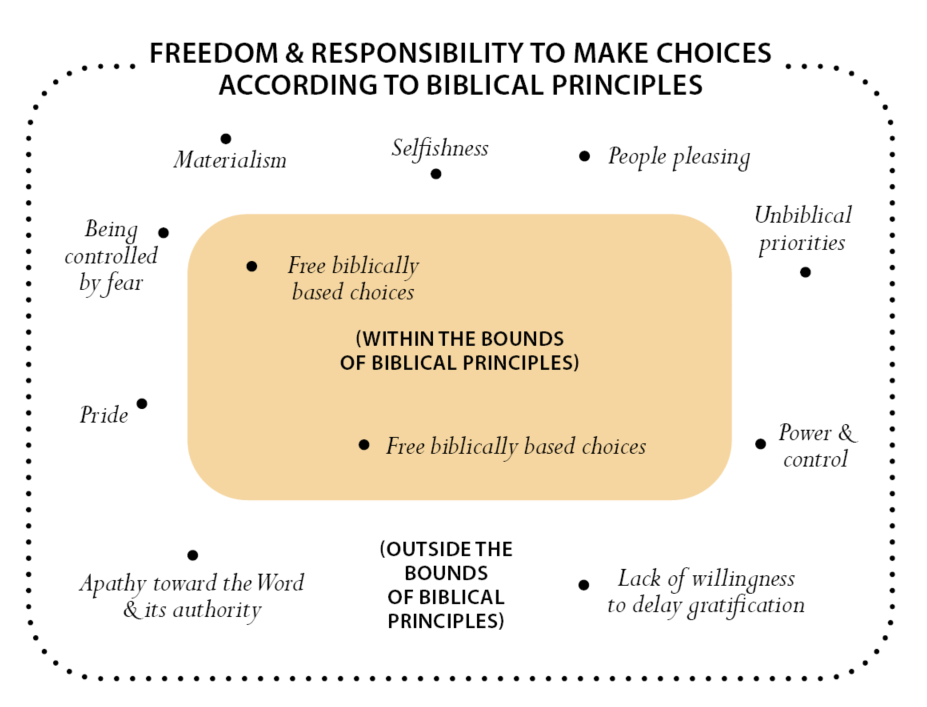
We have freedom & responsibility in decision making
In scripture, God has set out guidelines for what his children need to do and what they need to avoid. He didn’t design his children to be robots without any freedom nor did he design them to be moral free agents that can do whatever they want. When you have taken care to live within the boundaries of the teachings of God’s Word, you can have confidence he will honor your requests made with a humble heart.
Understanding preferences, house rules, organizational norms, and absolutes
The figure below helps outline the different levels of decisions you will face in your marriage. Often difficulties may arise when the two of you see the issue on different levels of the pyramid. Before coming to a decision as a couple, you both need to agree on the underlying level of importance of the decision.
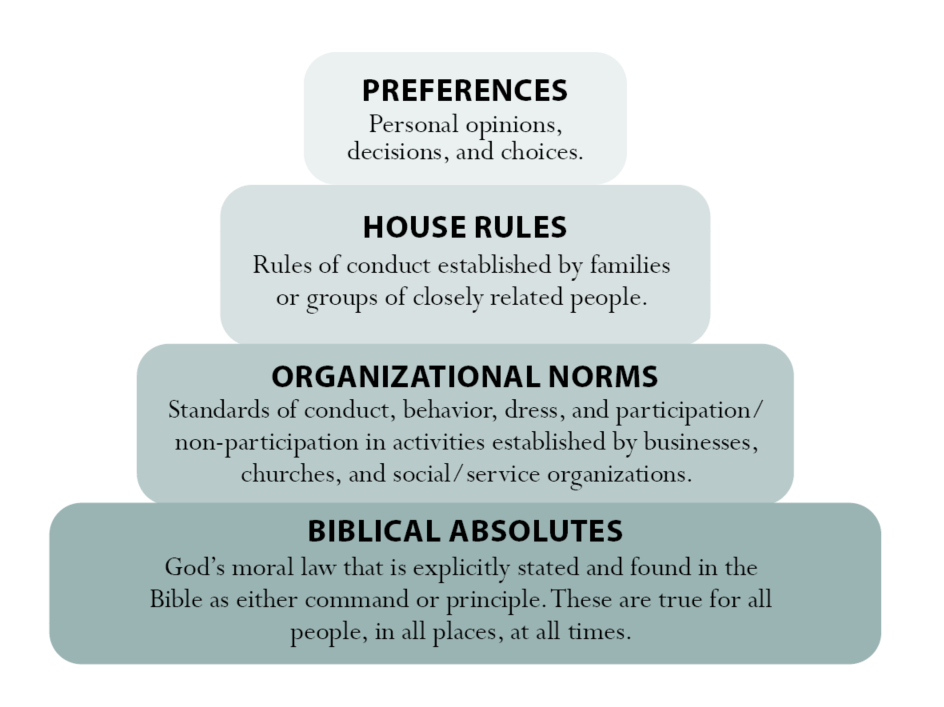
Below are descriptions of each level:
- Preferences are personal opinions, decisions, and choices. For example, your favorite restaurant or model of car are all preferences. Two individuals may agree or disagree about each other’s preferences, but neither is wrong.
- House Rules are rules of conduct established by families or groups of closely related people. For example, parents have the privilege and responsibility to create and maintain the house rules for their own home. Two sets of parents may agree or disagree about these rules; however, they each must determine what they believe is best for their own family and abide by it (i.e., one family may set curfew at 9:30 pm and another at 10:00 pm).
- Organizational Norms are standards of conduct, behavior, and participation/non-participation in activities established by businesses, churches, and social/service organizations. This level is where many church traditions and practices are found.
- Biblical Absolutes are God’s moral laws that are explicitly stated in the Bible as either commands or principles. These are true for all people, in all places, at all times. For example, “Thou shalt not commit adultery” (Exodus 20:14) is a biblical absolute.
As an example, this chart is considered in deciding how to school children.
Always Start With Biblical Absolutes
Ask yourselves, “What does the Bible say about the education of children?” A few of the verses that speak to raising children include Deut. 6:4-7 and Proverbs 22:6. Clearly, there is a biblical mandate to raise children to know God’s ways. However, the biblical instruction does not specifically address how children should be taught. Therefore, at the Biblical Absolutes level we have been given a clear teaching about the spiritual nurturance of children; however, it does not provide a command about other aspects of education.
Identify Organizational Norms
Ask yourselves, “Has the church given direction on the education of children?” The Elder Body has affirmed the biblical truth that children are to be brought up in the nurture and admonition of the Lord. The elders have concluded that the education of children is a decision parents must make thoughtfully and prayerfully; they acknowledge parents of one household may come to different conclusions about what is best for their children (public, private, or home schooling) than parents of another household. Therefore, the organizational norm has affirmed the biblical absolute and has given guidance that parents should prayerfully consider the options, choose what best fits their family, and respect those that choose differently.
Create House Rules
Ask yourselves, “What do we, as a couple, believe about the education of children?” House rules are accepted and/or created by a couple. Many house rules develop by default without much thought. Other times, house rules simply develop out of what the parents grew up with in their own families of origin. Conversely, some house rules are the result of a deliberate process of information gathering, prayer, discussion, and counsel.
A couple may find that they have very similar or dissimilar views on the education of children. However, as they pray, discuss, and gather information, they can come together to make a decision. Ultimately, the parents must decide for their own children and family, not anyone else’s. It is okay for them to choose an education option that is different from another couple. However, it is not okay for the couple to judge another couple’s decision. Once the couple has decided on what type of education they would like their children to have, the decision-making process is complete, and they must work toward implementing their decision.
Biblical decision-making principles and steps
Below are some steps to consider when working through a decision-making process:
- Identify and clarify the decision that needs to be made. Humbly seek God’s guidance through prayer.
- Study the Word to determine if the decision involves biblical absolutes. If so, follow the scriptural principles laid out in the Bible.
- If the decision does not involve biblical absolutes or if the Bible has no explicit command or principle about the decision, see if the church provides teaching or guidance on how to proceed.
- Seek the counsel of a mentor(s) you know and trust.
- Realize some decisions have multiple options, any of which may be acceptable to God. In these cases, you can use biblical wisdom principles to decide:
- Identify the needs of those who will be affected by the decision.
- Consider the short-term and long-term impacts of each option.
- Evaluate pros and cons of the various aspects of the decision.
- Remember just because something happens easily or smoothly doesn’t necessarily mean it is good, and just because something is difficult doesn’t necessarily mean it is bad.
- Implement your choice.
- Re-evaluate the actual implications of your choice.
For further information, including couple questions, exercises and references, please see the full document.
For Further Information:
Biblical Headship And Submission
Today’s world is filled with distorted messages of what true headship and submission means. This is not a recent challenge. The struggle has been present since the fall of man. This document explores the purpose and intent of God’s original design.
A L asting Promise: The Christian Guide to Fighting for Your Marriage (2nd Edition)
Authors: Scott Stanley, Daniel Trathen, Savanna McCain, Milton Bryan
This 352-page book teaches practical communication, conflict resolution, and problem-solving skills within a Christian framework. The 2nd edition is filled with teaching from scripture, couple exercises at the end of each chapter, as well as the latest research on marriage. This book can be helpful to young couples just starting their relationship and for married couples who are having marital conflict.
Additional Articles

The Journey to a Healthy Marriage
In many ways, all of life can be viewed as a process of growth – from one stage to the next. The apostle Paul shares in Colossians 2:6-7 “As ye have therefore received Christ Jesus the Lord, so walk ye in him: Rooted and built up in him, and stablished

Solid Foundations: Building a Love that Lasts Podcast Episode
A lot goes into a thriving marriage. In this episode of Breaking Bread, Kaleb Beyer uses the research of Dr. John Gottman to place his finger on the components of a marriage that not only lasts, but flourishes.

Three Ingredients for Cherishing Your Spouse
We often talk about the importance of love and deep commitment in marriage – foundational aspects for marriage. Yet how often have you considered we are also called to cherish our spouse? In Ephesians 5:29-30, Paul writes, “For no man ever yet hated his own flesh; but nourisheth and cherisheth
Comments
2 Comments
Wonderful article !
Filled with Godly wisdom!
Thank you!
Sound teaching on marriage
Awesome
Leave a Comment