


Parenting Styles Podcast Episodes
Part 1
Parenting is hard. Should we scold? Punish? Praise? Or ignore? In this episode of Breaking Bread, Brian and Alison Sutter walk us through the dense undergrowth of parenting kids. To discern the path, they give us two lenses: grace and truth. Together these lenses will help us parent our children wisely. Yet if we fail to use either one or both, we’ll surely lose our way.
Content contained in this episode:
- Good parenting requires a growth mindset. Determine to learn and grow as a parent.
- Jesus was “full” of grace and truth. Healthy parenting is “full” of grace and truth.
- Grace is love that springs from mercy.
- Truth is love that springs from boundaries and regulation.
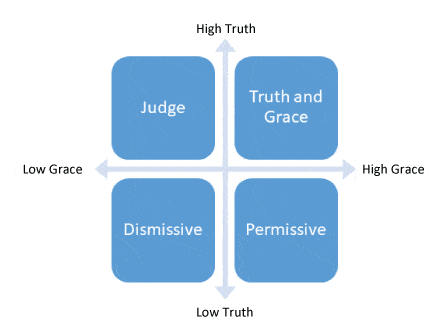
- Four parenting styles immerge when we vary grace and truth.
- Low grace and low truth yield a dismissive parenting style.
- Characterized by apathy, hesitation and separation.
- Low grace and high truth yield a judging parenting style.
- Characterized by rules, authoritarianism and a focus on behavior.
- High grace and low truth yield a permissive parenting style.
- Characterized by avoidance of pain and indulgence.
- High grace and high truth yield a “truth and grace” parenting style.
- Characterized by a willingness to be influenced while also have clearly communicated expectations.
- Through parenting God intends to shape parents more into his likeness.
- Low grace and low truth yield a dismissive parenting style.
Transcript:
And the reality is, as we interact with these young souls, whether they’re really young or they’re moving into adulthood, it’s also exposing our own heart and it’s exposing the things in us that get in the way, whether it’s how I want my kids to look in public or I just want them to avoid pain.
Welcome everyone to Breaking Bread, the podcast brought to you by Apostolic Christian Counseling and Family Services. It’s wonderful to be with you. Today in the studio, we’ve got Brian and Alison Sutter. Welcome both of you. Alison is the wife of Brian. So, it’s great to have her here. And the topic warrants that because we shouldn’t let you talk about parenting too long without your partner in crime weighing in on things.
Kind of a dangerous proposition though. She knows all the dirty secrets. What we’re really going to share is on parenting styles. And I’d like you to take off with that. I know this is something that you’ve spoken to and spoken about and all of us with children are very thoughtful. Oh yeah, I’ve got a style.
Do tell me. Yeah. And I think that’s Alison’s and my heart in this is just being able to recognize our own tendency as far as how we approach parenting or approach topics that come up and then trying to be quick to work together and help each other move towards what style we think is most beneficial when we know individually, we can tend to drift down a path that isn’t.
Let me capture something that I think is very helpful. What you’re saying here is there’s an introspection piece to say, all right, this is where I’m at, but you also have inputted a growth piece that says we should have a growth mindset about our parenting. We should be thoughtful about it and realize that, hey, we should be getting better at this, right? Or learning in some way. I’m not sure it reduces to how you measure better, but at least growing. Exactly. Just thinking about what that looks like to move towards a goal rather than just letting things unfold, but purposely saying, okay, this is what I want to do.
And I, in and of myself, won’t get there, but working with my spouse, you know, the Spirit working in me and being refined, hopefully that moves towards a goal. And we’re not just drifting into whatever happens. Yes. Reactionary. Right. And I think so often we think that this should come more naturally than it does and that we should know what to do in specific situations.
And so just recognizing that this is something we’re all working on and that we all have tendencies to go in ways and paths that aren’t healthy and just to recognize that in each other and in ourselves, but not to stay there. Yeah. I mean, you think of the training, Brian, that you’ve had to counsel and to work with people and help people. And then the lack of training we’ve had when it comes to that bundle we bring home. Oh, it’s amazing. It’s like, you know. Yeah. Did I get a certificate somewhere? Yes.
You’d think there should be some more qualifications, but there aren’t. And I think in some ways it’s scary and in some ways it’s exciting to think about how God’s made kids so resilient. And even in what you’re talking about there too, Alison, that there’s not necessarily specific how tos and that’s not necessarily what we have in view here today. But just from a general standpoint, what’s a general approach towards our kids and towards each other’s spouses and we’ll trust that in the midst of the specifics, they’ll sort out and by God’s grace, things will work out in a way that’s helpful.
I want you to lay the landscape a little bit about parenting styles. So, there’s four different styles that we talk about specifically. So, in 1 John, Jesus is described as being full of grace and truth. He never separated those two. When God came with the law to the people, he said, his heart was always full of grace towards his people.
When Jesus came with grace and forgiveness for sins, he never lost sight of the truth. And we as humans tend to separate those two. So, what these four styles do is recognize our tendency to lean one way or the other. But it’s super important to recognize that biblically, those two concepts are inseparable.
You know what I hear when you say that, Alison? This concept that in us, grace and truth compete with one another. Absolutely. More of one means less of the other. But in that verse, he is full of both overflowing with both in equal measure. Yeah. That’s pretty inspiring. Oh, it’s so inspiring. Yeah. And I think it begins to break down our categories of what is good and bad parenting and to this place that says it’s really hard to know in the specifics, but really it’s the motive behind it is our heart and what’s driving us in those moments and seeking to be motivated like Christ was by a fullness of grace and truth.
And that’s going to look very different from situation to situation. And I think that’s very inspiring. Let’s tease out a bit of a definition. Brian, take each one separately. Grace, this is what we mean. Yes, this is what we mean from this perspective that we’re looking at today. We’re seeing grace is like this unmerited favor that we give towards our children.
So, when we are merciful in our parenting, we’re playing to that grace side of the continuum. Yeah. And I think defining grace as something that even goes beyond mercy. Mercy is something that is like letting them off the hook and that’s appropriate. And we certainly see that as something God gives, but even beyond that grace is something that not only let’s go of the debt, but it’s been paid for too.
And that takes it even a step further. But yeah, that’s exactly right. That’s the grace side of things. And then the truth side of things, we would say more is just like the righteousness or what is right, having rules or expectations in a relationship with our child and that would be authoritative?
Yeah, having some authority and direction providing in that relationship. I think that’s helpful. I think we can taste a little bit and say, okay, this is what we’re talking about here with parenting styles. So, it happens when you lose sight of one or the other is when you are focused more on grace, it tends to come out as letting things slide without any rules or boundaries. So, you just want to avoid pain with your children or avoid something uncomfortable. And in the same way with the truth, if you come with only boundaries and only rules, and your heart for your child is only behavior modification, and you’re not looking to transform their hearts to be more like Jesus, you can lose sight of the grace and transformation piece and it’s only about their behavior.
And so, I think, as Alison’s describing that frames up the four different parenting styles we’re thinking about. So, if you look at grace and truth on a continuum and being either high or low on each of them, then that’s going to give you four parenting styles.
So almost as if each was on an axis. So, if we have maybe grace on the x axis or the horizontal axes, we’re going to have low grace and high grace. And then maybe on a vertical axis, we have low truth and high truth. Defining four different places or tendencies. Low grace, low truth. low grace, high truth, that type of thing.
Exactly. So, if we just step into one of those, we could start with high truth, low grace, and that would be what we would call the judge, the person that’s very quick to have rules and expectations. This brings this sense of authority, but there’s not much view of the relationship and a willingness to consider the situation, consider the child and consider relationship.
It’s just about what is right. It can be kind of unilateral. Yeah. Maybe that would be a tendency. I can be really unilateral. How has that gone for you? Unilateral with your kids. That’s a tough thing for us, right? This tends to be because they pointed out like, wait a minute my consequence was this.
And you’re telling me they are consequences. Yeah, and it turns into everything being what they would call fair. And then it just breaks down. Or, in my own parenting, this would be the style that I can lean towards when I get stressed or frustrated or in general.
And it’s just like this is the way we do it. And there’s no discussion around this. And I lose the, the real heart behind those rules a lot of times. And it really is a good way to frustrate your kids, which is exactly, in Ephesians we’re told not to do that. So that would be maybe something to watch for?
Yeah. Frustration. If you were just constantly saying no, or they appear like there’s no room for a wiggle, and they’re always being discouraged and there’s no room for discussion and negotiation. You know, I’ve been called a no daddy. Exactly. That probably means I’m high truth and low grace.
Thanks for that. Wow, this is really going to be good today. This will be off to a great start here. Okay. So, strike one. How many strikes do I get? Oh, yeah. Three. Yeah, I think it’s three, yeah. The judge can just tend to be focused on behavior and with all of these styles, the motive behind it is generally good, but it loses focus if that’s the only thing.
So, we want our kids to behave in certain ways, right? We want them to do certain things. We want them to follow our instruction. That’s a good desire. But if that’s the only focus, then you turn into the no dad. And then the relationship dissolves over time because there’s no interaction. It’s just what we do.
I want them to do right and not do wrong. Above that, I just want them to have a conscience for right and wrong, a knowing of it. And that’s where the truth part comes in. But let’s go necessarily you’ve got to be perfect. Yeah. So, the next parenting style would be what we would call truth and grace, which is what we’re all aiming for, which is the high grace, high truth.
And I think the only way you really wrap your head around a biblical definition of grace and truth is through the power of the Word. I wish it could be through a really simple 20-minute podcast, but it’s being face-to-face in the Word of God and recognizing that these definitions don’t come naturally out of our hearts or our simple definitions of grace and truth, but it’s the heart of God.
Yeah. And if I can distill what you’re saying, which is really critical, Alison, is that we want to be parents who parent in truth and grace. And there’s really no shortcut ways to do that and to have that mindset, but simply to be face-to-face with God’s heart which comes through his Word largely is a terrific way to do that.
So, we’re encouraged now to go back to him, which is Christ’s masterful work in so many areas that he brings us back to himself. Doesn’t he? So, while we think the child is the project, maybe not. Exactly. And I think that’s one of the things that we as parents would acknowledge, but it’s so easy to lose focus of that.
And the reality is as we interact with these young souls, whether they’re really young or they’re moving into adulthood, it’s also exposing our own heart and it’s exposing the things in us whether it’s, I want my kids to look this way in public or I just want them to avoid pain. Or ultimately the goal, I think, like you had mentioned earlier, Matt, just that they would have a conscience, a sense of what is right and wrong and that would be developing in them.
But that’s going to have to start with the Spirit working in me and developing that in my own heart so that I can look back and say, you know what? I made a fuss out of something that I didn’t need to make a fuss of. I can place my finger on some of my motives and they’re selfish, right? They are what makes my life easier or what makes my reputation glow the brighter.
You know what I’m saying? Right. And to think, then, as, you know, Alison, you said going back to Christ, going back to the Word of God and narrative of the Scriptures, God seems to be willing for the good of his children to wait for it, to be patient for it, to go through all manner of mire and muck for that glorified end that he sees.
It’s inspiring, I think. For those of us who like efficiency, it can be a painful process because it seems slow and tedious, and it seems like there should be a quicker solution. And maybe that’s a tendency of the high truth, right? It’s pretty effective. It’s pretty clear. It answers questions right away.
It maybe oversimplifies situations. And you may even get the behavior that you desire. And again, in one sense, that’s very helpful. And in another sense, if it’s not developing long-term, like a heart for understanding what is right and wrong, and not just the specific rule, if it’s not moving towards recognizing that, they just need grace.
It’s not just something that shows up and that’s helpful when I mess up. I need grace all the time. So let me ask you this question. I think your point there raises an interesting element in parenting and that is how do I steward my obedient child? What role do I have with my obedient one?
I mean there are a lot of books out there about the strong willed one. There are a lot of podcasts about what we do with the prodigal and the wayward. Right. I’m not sure I’ve ever heard about how we care for the obedient. It’s something we’ve actually talked a lot about because we do have a child who has a very sensitive heart. He is quick to obey. He doesn’t want to be in pain or uncomfortable. He doesn’t want you to be in pain or uncomfortable. He’s very empathetic naturally versus another child who’s very strong willed. Her sin has come out multiple times. She’s very aware that she’s a sinner. And my concern for our sensitive child is that he doesn’t recognize his sin because on the surface he seems to be moral, but I know that it’s not coming out of a place of recognition of sin and the Spirit. It’s just he wants to avoid pain. He wants to avoid anyone else being in pain, and so his tendency is to obey. It’s tough to know how to show a six-year-old that they’re a sinner, yeah, when they are quick to obey.
And how different that looks from one child to another child. With one, it’s fairly obvious. And for the other one to expose their need for something outside of themselves is really hard to grasp when they’re so good at following the rules and doing what you want and, you know, those sorts of things.
It does present a really tricky balance. Well, let me give you this question then. So, that child really pleases you because they did the hard thing, they made the hard choice, they obeyed in a really neat way. Okay. Help us follow that up. How might we engage with that child and stroke them in all the ways that they need to be praised or cared for in a way that steers them in the right direction, according to their hearts?
Do you understand my question? Yeah, that’s a good question. I may pass the ball off. He’s looking to Alison. Alison has the question. Something we try to do in all conversations about behavior is to always say that we need Jesus to make good choices. So, my tendency as a mom is to say, this isn’t hard.
You should be able to do this. I tend to just expect my children to behave like normal people. Right? So, in the frustrating moments where it’s, this is not hard, that’s a red flag for me. If I’m telling my child, you can do this. This isn’t hard to say, I recognize this is difficult.
You need Jesus. And then when they do behave well to recognize, I see Jesus working in your heart. Because you made that good choice that shows me that Jesus is at work in your life. So, it is important to quote unquote praise your children’s good behavior, but to always point that back to power really coming from the Spirit and from Jesus and from his good work rather than you. And so, Alison, what I hear you saying is, it’s not saying, you are such a good boy, but you are saying, Jesus is so good in you.
Those are different messages. Yes. Right. And it’s so easy, especially when you have two drastically different children and their behaviors, that you don’t say, you are so bad at listening. You are so good at listening. But to say, this is something you struggle with. And you’re going to need Jesus to change your heart in this.
Yeah. And I think an important key here is just being able to recognize the differences in our kids and that they’re going to have different strengths and weaknesses and that we can’t pit one child’s strength against the other one’s weakness. But really, what we want to do is help expose both of their hearts to their need for a Savior, and that’s going to manifest itself in different ways.
And in the questions we ask, the things that we interact with them, that we’re trying to shoot for what’s going on in their hearts and bringing that to the surface. And again, that’s going to look very different from child to child, but the purpose there is just fullness of grace and truth and not just truth and behavior, if you will.
Amen. Yeah, it makes me think of a recent interaction that you had with Kennedy, and I don’t know if you’d want to share that story. Sure. So, it happened of course, like the 4:30 hour when we all make really good parenting choices when I’m trying to cook dinner. I know Brian’s going to be home in the next hour.
And Kennedy is our seven-year-old. She’d been acting very cruel, unusually cruel that day in a snarky way. And I had sent her to her room because I just was getting really sick of her attitude. But I felt the Spirit say, you need to go talk to her now. And I thought, okay, but dinner, right? Because of priorities. And I felt the Spirit say, no, you need to go talk to her now. So, I left dinner on the stove, and I went, and she had a cold heart and cold stare at me at first. And I just sat on her bed, and I just asked her what had been going on. And I asked some questions about her behavior, but mostly that I knew what was going on.
Her behavior was coming from somewhere. So, I knew her behavior was coming from something that was going on in her heart and she started tearing up. I can count on one hand the amount of time she’s cried. She’s not a crier. And so, when the tears started coming, I thought, oh boy. And I sat there for probably 25 minutes before she said anything. And, at this point, dinner was gone. I knew it was a lost cause. But I just kept hearing the Spirit say, just wait it out. Just wait it out. And pretty soon through tears and sobs, she admitted that she didn’t like our family. And the judge in me almost came to the surface at that point and I thought that’s ridiculous.
We’re so fun, right? We have a great family, and I wanted to tell her how wrong she was, and she said we have too many rules and I wanted to list all the people I knew who had more rules than us, right? We don’t have that. I don’t demand very much out of you. And I wanted to tell her why she was wrong. And I’m so thankful that the Spirit stopped my tongue and said, just listen to her heart because there’s more here and I could tell something else was eating at her and she admitted that she had lied to her classmates all year long that she lived on a farm. We do not live on a farm. We live in town. She had wanted to live on a farm, so she just made up this whole story. So, her whole class thought that we lived on a farm and had all these animals, and the breakdown happened when a classmate wanted to buy one of our chickens and she didn’t know what to do and she felt horrible.
She was just sobbing, and I was able to walk her through the consequences of sin in a way that I could never have done had the judge taken over. Because they were real to her. It had eaten her up inside. I was so thankful this was the problem. You know, like I have answers to this, right?
In my heart, I wish that she would have just listened to me from the beginning. Don’t lie. Just don’t lie. But I also was really thankful that I could, look her in the eyes and say, Kennedy, I am so thankful that Jesus is showing you the consequences of sin and that he is changing your heart. This is what repentance is, right?
You are sorry for sinning. against God. And that’s a great thing. And I think she’ll remember that for a long time. And I want to accent, I love that story. And I want to accent something else here, Alison, and raise it to both of you, Brian. I understand that there is a place and a time for sending kids away for discipline, you know, they need to go sort things out. They need space. They need distance. I totally get it. And I think there’s a place for that. But you went in, was with her in that moment. And that had to happen with her. And sometimes I wonder in our acts of discipline, we send kids away when they actually need to be very close. You know what I’m saying?
Does God send us away in discipline saying, you know what, you and I, we’re not on good terms, why don’t you just go over there? And when you’re ready, why don’t you come back to me? Or does he pursue us? I see in that moment, Alison, you pursued her, and you allowed her in that space to bring all of that out.
And I don’t know, I’m convicted because I think sometimes in discipline moments, I’m more or less disciplining for my own peace of mind that says, why don’t you just get out of my face for a while? Yeah. Which is very selfish as opposed to saying, all right, well, it looks like dinner will be burnt today because I need to be present with my child. Does that make sense? Yeah, it does, and I think what you’re articulating there Matt I think that’s really important for us to gain awareness into our own heart and our motive of what we’re doing and why we’re doing it as we interact with our kids. If we’re sending them away because we don’t like them or we’re just sick of their behavior, which all makes sense, you know, for us to be working on that in our own hearts, or there are times I just need some space or I’m going to do something I’ll regret.
Well, that makes sense that we would, but ultimately, I think healing, understanding, and growth come through relationships and primarily relationship with the Lord, obviously, but then also in the context of relationship, you know, parent, child, husband, wife, those sorts of things. And so, relationship has to be part of the journey here.
I think that story captures so well the parenting style of a high truth and high grace viewpoint. We’ve spoken of high truth and low grace being a judge. And there are two more parenting styles to address, and we’re going to do that next time. Thanks for being along with us. And, in the next episode, we’re going to look at a larger view as well, a Godward view of parenting.
And we look forward to that. Thanks everyone for being here.
Part 2
Parenting kids can tee up disagreement between parents. Why? Parenting styles differ. However, it doesn’t have to drive a wedge in a family. In fact, by working together couples might just get parenting right. In this episode Brian and Alison Sutter finish addressing the four basic parenting styles and expose God’s overarching purposes.
Transcript:
In my heart, I wish that she would have just listened to me from the beginning. Don’t lie. Just don’t lie. But I also was really thankful that I could look her in the eyes and say, I am so thankful that Jesus is showing you the consequences of sin. Welcome back everyone to Breaking Bread, the podcast brought to you by Apostolic Christian Counseling and Family Services.
Wonderful to have you along today. We’re going to continue the second part of the conversation I had with Brian and Alison Sutter on the topic of parenting styles. Thanks for being here. All right. So, let’s go back to this continuum. We’ve talked about high truth and low grace. We’ve briefly mentioned high truth and high grace, which I see that story really articulating that well.
Yeah. All right. Let’s choose another one. Yeah. Maybe it’s low grace, low truth. What would that look like? So, the label that we’ve put on that one is uninvolved and that one, like all of these, no parent wakes up, thinking oh, I’ll be uninvolved. You know, I’m just not going to do my responsibilities. But rather it’s one that often comes from good motives, but it leads to stepping out of the role of parenting.
So, for example, the dad who says, you know what, I’m going to provide for my family and work really hard. A great motive. But then what accidentally happens is that becomes the only focus. And then they’re always gone, whether it’s at work or travel or when they are home, they’re so overwhelmed with other things that they’re not actually present.
And so, a good desire to provide leads to being uninvolved in parenting would be an example. And I think other examples might be someone who has a heart for other people, maybe a really strong faith, they want to serve and again, a great desire, but then all of their energy goes into serving outside of the ministry.
Exactly. Yeah, and a wonderful thing, but then neglecting the home and the responsibility that the Lord’s put there. And again, these are hard things. It’s not like you’re choosing between a bad thing and a good thing. It’s two good things but needing to make sure that parenting in the home is one of those good things you say yes to.
And that might mean that you can’t do something in the ministry, or you can’t serve at the food pantry or whatever that might be. Yeah. And sometimes I wonder too, uninvolved, I think that there’s a certain amount of defeatist mentality that says, I don’t have the skillset. Speak to that mindset.
And I think even in Allison and me, we’ve talked about this. It’s the reason why we even hesitate to share one of those good stories, like she just articulated with Kennedy, like that’s not every day, right? There’s like a bright spot where we’re like, yes, we did it right.
I think I did it right. But yeah, when you’re discouraged and you hear a story like that, or you hear about your friend who’s reading this book, or this is going on. It can be so discouraging. And I think I would just encourage that parent to say, yeah, you may not be an A plus parent, but God’s equipped you and given you the privilege of stewarding these young souls and you may not be very good at it. But by God’s grace, you can grow and learn, and they’ll teach you a lot. You know, you’ll learn that they’ll learn a lot from you and just try to step into that journey, even though it’s uncomfortable, which again, that’s hard, but I think it’s important.
As a stay-at-home mom, I see social media being really influential in how we view ourselves as moms. And when you look at all the highlights going on in other people’s lives. You can feel like you are a hot mess really quickly. And I see moms just wilt under the pressure to be that perfect mom that they see on their screen every day. And so, I think that can also push us back into, I can’t do it that well. And so, I’m not even going to try and that can be really dangerous.
And it’s so important to recognize that God gave you these children specifically in your family, and he has given you what you need through his grace to raise them. And it can feel like other people are doing it so much better than you are on such a different level. And your kids would just be better if they had another, a different, better mom. It can be such cruel thoughts to think to yourself and to take those captive and to say, I recognize that I’m not perfect, but this is the role that I’ve been given by a divine Creator who knows me and knows my strengths and weaknesses knows my kids and he thought this was a good idea. So, I’m going to lean into that. Yes. There are things that I can do better. And yet there is grace and there’s patience and there’s growth that’s expected to be part of it.
And if we can speak that into our own hearts then that can flow out into our kids and that could be something that we teach them through our imperfect parenting. Like what a gift if they see that modeled in how we interact with ourselves and our own heart, as well as we interact with them, admitting our imperfections, but seeking to grow. Wow. That’s good.
So, let’s go now look at the high grace, low truth. What does that look like? Yeah. So that would be more in the permissive lens and just your comments you had Allison with the uninvolved made me think of it too, that I think social media can certainly play a role there. So, the permissive is one who maybe is going to be quick to give grace, maybe show mercy, let things pass. There aren’t going to be many rules or expectations. And a lot of times I think that can come from not wanting your kids to experience any pain or, I think in our current culture, the definition of what it means to be a good dad, or a good mom is to help your kids avoid all pain.
And that leads us down the road of being permissive. There are some of us who tend towards being permissive, high grace, low truth, right? Our hearts are bleeding for the difficulty that our child has endured. Right. Okay. So come along and coach us. What needs to be included in that encounter to help bring truth into the picture?
Well, I think one thing that comes to mind and some of what you guys are articulating is just the need to help the child also view more than just their pain. So, for example, what else is going on? What are some of the circumstances and how can they engage this? So, let’s say Johnny goes to school and his friend is mean to him. We want to hurt with him about that. And also, we want him to think about, okay, what was your interaction with Johnny like, and how can you engage that interaction in a way that is honoring and is wise and not just us thinking about what’s wrong with Johnny and why did he do that? And Johnny shouldn’t have done that, but also okay, what can you do?
And what is your interaction with Johnny next time look like, if that makes sense. You engage that issue, and maybe not cast it as a misfortune, that you are at the end of a lot of misfortune, which is really hard, but you are at the end of a broken world that afflicts all of us.
Yeah. I think it’s really a view of trying to help them move away from just seeing their circumstances to being able to see more than that. I mean, I think it’s probably not an uncommon experience to have spouses on different continuum emphases, right? Maybe one tending towards truth, one tending towards grace.
Right. When you hear the disciplinary action of your spouse, you wag your head and you’re like, oh no. And the other of you, no, they’re not seeing something, they tend to be way too lenient. Right. So then can I ask you, what’s your tendency when you see the opposite side come out, what is your natural tendency?
Well, what I have found to be challenging is now we’ve got in that moment, another layer of issue to resolve. And I’m not sure it all needs to be resolved in that moment. We’ve got the disciplinary action with the child and then the disagreement between the two of us, right? Maybe I’ll say what I’ve noticed doesn’t work well is to compensate in that moment in the direction that I think it needs to be because it belittles the actions of the other.
Does that make sense? Which is now an offense towards the spouse. Yeah. And I think that’s such an important point there, Matt, that’s the natural tendency. When you have different styles or opposing styles and you see your spouse going towards, let’s say truth, but you’re more of the grace one that you tend to try to overcompensate.
And what happens is parents are moving away from each other towards trying to balance this thing. And what we really want to do is say, wait, how do we both move towards each other, towards a goal of being full of both rather than trying to compensate for each other, which is the most natural.
And one major indicator is the child itself. Well, I’m going to go talk to mom about this. That’s right. It’s a pretty good indicator that they’re expecting a different jury outcome with mom than me. And then all of a sudden you’ve got mom and dad against each other. And you know, the kids are smart.
They figure that out pretty quick and parenting is hard enough when you’re working together and when you’re taking opposite positions, it’s just difficult. And so, I think that’s where just being aware of that can be helpful and saying, okay, wait, yeah, this is really uncomfortable because I see them doing something outside of my comfort zone and I want to jump in and do what’s natural to me.
But in reality, there’s probably wisdom in what they’re doing and there’s wisdom in what I’m maybe doing and how, after this interaction, we can move towards each other and support each other. And then over time, maybe being able to trust some feedback in the moment of, hey, would you be open to have a discussion around this, or I think it’s time for a consequence now that we could trust each other.
And if I can maybe distill a few things. Okay. So, with this continuum here, we’ve talked about we can be a judge, or we could be permissive, or we could be neglecting, right? Right. But we want to become more like Christ to be both truth and grace. That’s the sweet spot. That’s the goal. Yep.
And even in our differences and spouses, this might be God’s tool to bring us to that good place. That’s right. Right. One spouse sees it more truth oriented. One sees it more grace oriented. If we can properly learn from one another and help each other see through this lens, then we’re probably more apt to get to that good spot.
If you can recognize the value in that, it can feel like a real sore spot or a real place of contention because you are so different. But if you can recognize the value that between the two of you, there is a more complete picture that can be really helpful. And being able in that to just learn from each other and I think what Satan loves to do is to begin to paint these pictures of the other one about, you know, how they’re ridiculous one way or the other, or how they don’t care if it’s more of the uninvolved.
And to be able, again, to recognize those stories that are going on in our hearts and saying, okay, what does it look like for me to move towards Christ and invite my spouse to move towards him as well? And if we can do that together by God’s grace, hopefully we can both be refined. Or even if one spouse maybe tends towards the truth to use the other spouse who tends towards grace and to really allow them to minister and say, you know what?
We need to discipline Johnny. And you need to be a part of that discipline because this is the way I see it. And I need you there to provide that. Yeah. Does that make sense? Yeah. What a team effort, right? Yeah. That is again, moving towards each other. Yeah. Amid the differences. That’s totally acknowledging differences. Right. But towards each other. Yeah. And to acknowledge that’s going to be really difficult. If you’re the judge, your mind’s going to be going down that, well, if I let this slide, then it’s going to be the next thing. And then it’s going to be the next thing. And how can I do that? I mean, this is my child’s soul.
That’s where your heart’s going to go. And to be able to say, wait a second. Okay, maybe I need to slow down and trust the wisdom and vice versa, the one that’s full of grace, that’s more permissive. Oh no, if we do this, maybe they’ll rebel, and you’ve got your own story of why you do what you do.
And they’re both true, but you’re going to have to get outside of your comfort zone and be influenced by each other. Otherwise you’re just going to move away from each other. Yeah. So recognizing that you see a partial picture of the whole. Yeah. And then I think the other thing that can happen to you in these styles is if you have similar styles, then the difficulty there is you probably have the similar blind spots and there’s nobody to help check it exactly.
So in those situations, if you guys can just both be aware of it and say, okay, wait a second, are there other things we need to be considering? And maybe even inviting like a mentor couple or a mom you really respect who’s maybe good at it. Yep, a place that’s hard for you that can minister into those things and just help check that.
You know, it’s something that I’m finding out more and more as my children get older is how I’m leaning on the church community to raise them. Yeah. To allow other people to speak into their life. And really what that does is it just opens that up to say, yes, talk to so and so. Yeah. It’s not actually an easy spot to be in.
Right? It’s uncomfortable. Because, because of some harried messes that happen at home. Right. Where I acknowledge that probably I did that wrong. And then giving the child permission to be cared for by other people. Yeah. You know what I mean? Oh, man, I mean, I shudder to think of what they share about dad.
Right? Right. Yeah. But that’s fine. What a beautiful picture of the body of Christ to invite people into, to reckon. Yeah. I mean, we’re talked so much more about in Scripture as a body than individuals. And I think so often we see ourselves so much more as individuals. And my tendency is I can think I’m responsible for these kids.
It’s my fault they’re here to begin with. And so I have to pick up the pieces when things fall apart. And man, what a messy place that gets us into because it makes our view of our role really unhealthy where we’re responsible for all the mess and it shuts people off. To show up and really give a picture of the body and community and how we need other people.
It’s something that occurred to me when I taught in the high school setting. I felt like I was pretty good with discipline with other people’s children. And I realized that I wasn’t as good with my own. And I further realized why. And that was because I cared for my own in such a unique and special way that I was afraid of getting it wrong. So I probably got it wrong. Does that make sense? I was so afraid of what they would turn out to be if I don’t get it right. So in that amped up setting with that pressure and fear. I probably didn’t get it right, but I was able with more objectivity in a classroom. I don’t know if that makes sense, but I think there’s just so much at stake with our own children that other perspective from others is, I think, life giving.
Maybe a good question for us to be just chewing on, whether it’s thinking about reaching out for the community or thinking about our own interaction with our kids and parenting to just be contemplating, what am I afraid of? What am I fearful of? Am I fearful of this person, their feedback, am I fearful of what’s going to happen with my child in the future or what’s going to happen today? And just how are those fears, whatever they are, influencing how I’m interacting with people, how I’m engaging the world.
And is that something that needs to shift or not? Because, you know, maybe some of those things are helpful and appropriate, but many times fear just drives us down a road of pulling back from community, pulling back from those moments with our kids that we need to engage and isn’t helpful.
Yeah. This has been excellent. And I think all of us who are parents in different points here in this podcast of like, yes, I can smell that, I can taste that, I can see that in myself. I can see that in my spouse. I can even see how I would like to become and grow. And you started Brian that this is a growth thing.
Sometimes I shake my head at my older children thinking, I’m sorry. Listen, I’m just sorry. You know what I mean? Right. Yeah. But maybe I shouldn’t be so arrogant to think I’ll do any better with the younger ones. But there is a growth thing here, right? It’s like, yeah, we learned from that.
I want you to speak now as we conclude about God’s overarching Fatherhood with our children. The buck doesn’t stop with us wonderfully. Yeah. And as you mentioned, nobody’s perfect and we’ll fail in some major ways. Right. But there’s even hope in that scenario. Yeah. And I think the hope is if we can acknowledge that and even just engage that, and then again, use that to continue to point our own hearts, as well as our kids’ hearts, towards the perfect Father, the perfect place where there is always hope.
And it’s not a matter of we get perfect and then we’re accepted. It’s a matter of we are accepted and then we get to enjoy that. 2 Corinthians 3:18 says, and we all with unveiled face, beholding the glory of the Lord are being transformed into the same image from one degree of glory to another, recognizing that we have an important role, but the power of transformation in our kids’ lives comes straight from the glory of the Lord. It’s not the going out, the getting it right, the check list, right? It’s sitting face to face with the glory. That’s what’s going to transform us. And I think that’s why sometimes it’s so hard for us to pull those two definitions of grace and truth together, because we want to have more of an influence, right?
We want to be able to do more to make things right to do things well. And God says, my heart is way bigger than you making day to day decisions with your kids. My heart is that you both through this would be transformed. I’m so thankful that my Father cares way more about the big picture than how I respond to my kids.
When I’m really frustrated, or how I respond to them when they come home from school that there’s so much forgiveness there, but there’s so much hope that we can be transformed from the inside out by his power and by the glory that comes from the Word of God. I love that, Allison. That’s, I think, a terrific way to conclude our time together, to see the heart of the Father and his work in all of our lives and our children’s lives as well. His heart is for them. And to see them changed again, like you said, not by a string of right decisions, but by the result of one right decision. And that is just to behold him, to be facing him, to be open towards him. Yeah. And there’s a lot I can’t do, but I think I can do that one.
Which is pretty exciting. I think it is. So, thanks everyone for being along with us for this time together as we consider and think and be introspective about our parenting and see maybe a larger landscape for it. We’re always anxious and happy to hear comments or perhaps suggestions or questions.
Feel free to email us at [email protected] if you’d like and with that, have a great day.

Listen on Spotify – Listen on Apple Podcast
Additional Articles

3 Habits for Our Kids
Parenting has its eye towards producing future adults. One powerful adult forming tool is instilling good habits in our kids. A well parented habit can pay dividends in the long run by building the muscle memory to do what otherwise would not be natural. In this episode of Breaking Bread, Brian Sutter examples this by suggesting three habits

Helping Children Develop Healthy Self Talk
Just like a ship’s rudder is the unseen mechanism that largely determines a ship’s direction, self-talk is often our unseen director. While all of us have an ongoing internal dialogue, many of us are unaware of this dialogue or the impact it is having on us. Our mind is constantly

Three Healthy Habits for our Children Webinar
As parents, it seems there is so much we desire to teach our children in the short time we have with them. How do we know where to start? This webinar looks at three important habits which, if encouraged in our children, can have long-reaching impacts.
Comments
Leave a Comment