

 in Sexuality, Singleness
God’s Design for Sexuality
Genesis 1:27; 31a, “So God created man in his own image, in the image of God created he him; male and female created he them…And God saw every thing that he had made, and, behold, it was very good.”
Before the Fall of mankind into sin, God created our world in just the way it was supposed to be. Two genders, both reflecting the image of God, were created to be distinct and unique, yet equal in value. He also designed them to connect and relate within a covenant relationship that reflects the close-knit relationship of the Father, Son, and Holy Spirit within the Trinity.
Physical differences are the most obvious distinctions between males and females. God knew that sexuality would be a powerful, intense drive, and as with the rest of creation God looked at it and called it “very good”. We as humankind can and should see the beauty in and celebrate all aspects of God’s design for us, including sexuality.
We must define sexuality in its broadest sense by recognizing that all humans are sexual beings, whether single or married. Sexuality, broadly defined, is lived out by all people in four aspects of life: biological/physical, emotional/psychological, relational/social, and spiritual.
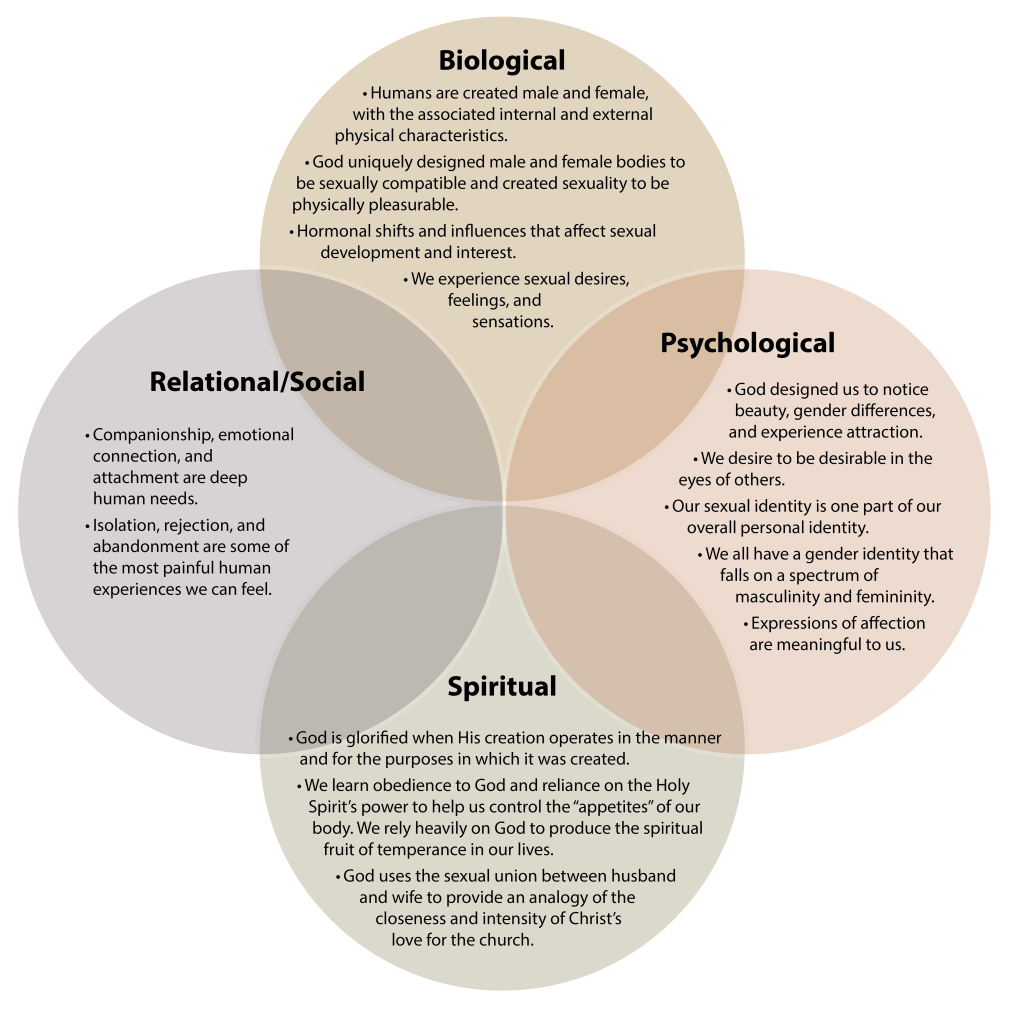
Our Responsibility
We each have a responsibility to maintain our sexual integrity. God expects us all to live in obedience and keep our bodies and desires under control (Hebrews 13:4, 1 Thessalonians 4:3, 2 Timothy 2:22) Effectively dealing with our sexuality is much bigger than just holding to a set of behaviors. Rather, sexuality is a God-ordained aspect of humanity that we are seeking to steward well.
In addressing healthy sexuality, we must remember our primary source of strength and guidance comes from knowing Christ.
- Single or married, some of the greatest dangers are believing that you are either “above” temptation and invulnerable to it or that you are helpless and there is no use trying to fight it. Pursuing sanctification and holiness is a full-time responsibility for all believers.
- As our heart is continually transformed by our relationship with him, our thinking, our behavior, and our relationships with others will be significantly impacted.
- God gives us grace to overcome, and he desires that we use it when facing temptation. 1 Corinthians 10:13: “There hath no temptation taken you but such as is common to man: but God is faithful, who will not suffer you to be tempted above that ye are able; but will with the temptation also make a way to escape, that ye may be able to bear it.”
Finding godly, effective ways of dealing with sexual temptation is crucial rather than waiting for the temptation to go away.
- Sexual temptation does not go away once you are married. Learning to manage sexual temptation now will help you to remain faithful in the future whether you marry or remain single.
- If we overestimate the strength of our will, set weak boundaries, or rationalize our thoughts and behaviors, we will likely fall prey to temptation. The balance is found when we accept our sexual nature and allow God, through his Holy Spirit, to direct our behavior.
- The Scripture notes that sexual sins violate something deep within us and carry consequences. (1 Corinthians 6:18-19, Proverbs 6:24-28) However, this does not mean that sexual sins are unforgiveable or that all sexual feelings are sin. Christ’s shed blood provides cleansing and forgiveness. (1 John 1:9)
Desire for Intimate Emotional Connection
Sexual desires, feelings, tension, and temptation are all made up of a complex mixture of longings. These longings include the desire to be known and accepted physically, mentally, emotionally, relationally, and spiritually. Ultimately, God wants us to seek him to fulfill our deepest needs, for he is the only One who can fulfill those longings. Isaiah 54:5a states, “For thy Maker is thine husband; the Lord of hosts is his name.”
- Our sexual desire reminds us that we were created for relationship, to be intimately known and to know intimately.
- Contentment, joy, emotional connection, purpose and meaning, close relationships, and wholeness are all available to single people and are necessary to experience an abundant life as a single person.
- One of the reasons our sexual drive was given is to draw us closer to God in addition to drawing us closer to other individuals. So, without a spouse, we draw nearer to God when these feelings become intense. One author noted,
“Your sexual ache was purposefully designed by God to motivate you (body, soul, and spirit) toward an intimate connection with God, an intimate connection with other members of the body of Christ, and eventually an intimate connection with a future spouse. Even if you never marry, the sexual ache is the divinely created vehicle God uses to give you a longing for intimate connection with himself and with others.” iii
Applying Grace and Truth to Sexuality
Having sexual thoughts and feelings is part of the human experience. Christian singles should not want to define spiritual victory with sexuality as a state of “not having any sexual thoughts or feelings.” That is is not the goal God is asking us to aim for and scripture does not speak to that. stewarding your sexuality in a healthy, God-honoring way within the bounds of scripture which applies to both the single or married. Being spiritually grounded in the word means the person is connected to Christ, lives an overcoming life, the spiritual fruit of temperance is present, and sin does not have dominion over him or her (Romans 6:12-14).
Two overarching aspects of God’s nature are his grace (love) and his truth (holiness). God’s grace is shown by his love, mercy, understanding, and forgiveness. His Truth is shown by His righteousness, perfection, holiness, and commandments. A biblical concept of God contains both Grace and Truth without violating the other as they cannot be separated.
Christ modeled living in Grace and Truth, which is directly referenced in the following verse in Scripture:
- John 1:14, “And the Word was made flesh, and dwelt among us, (and we beheld his glory, the glory as of the only begotten of the Father,) full of grace and truth.”
Grace: God’s unmerited love, favor, mercy, and strength
Truth: God’s holiness, perfection, righteousness, and commandments
As human beings, however, we seem to tend toward one side or the other: either grace OR truth. This may be due to personality, family background, religious training, and other factors. Unfortunately, this takes God’s grand design and distorts it, because:
- Grace without Truth isn’t Grace: It’s license.
- Truth without Grace isn’t Truth: It’s condemnation.
License—————————-Grace & Truth——————————–Condemnation
Heart Focused vs. Behavioral Focused Approach
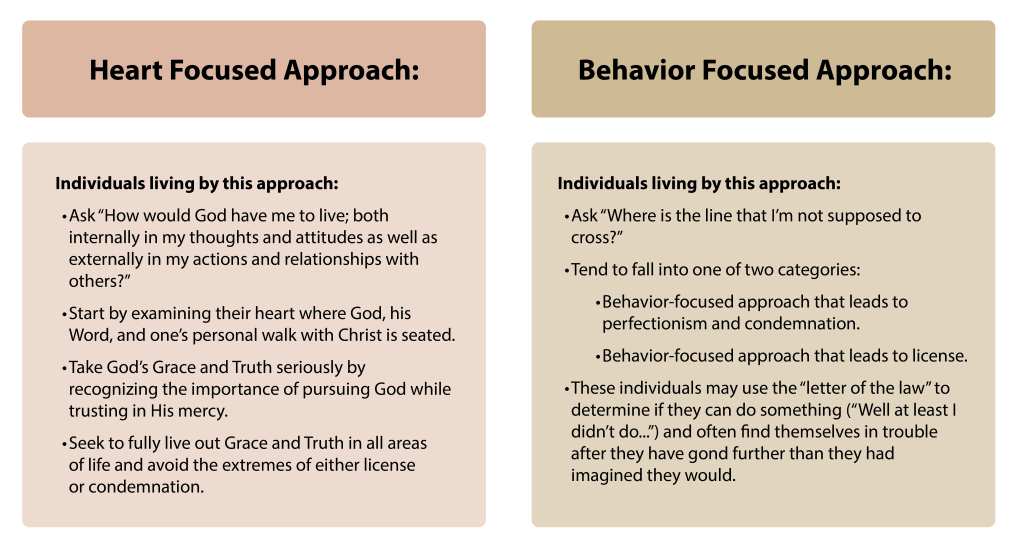
Along with thinking and living in Grace and Truth, we want to encourage readers to use a “heart-focused” method of considering the topic of sexuality instead of a “behavior-focused” approach. We have described each below:
Conclusion
Whether single or married, we have the opportunity to know and relate with God. Consider your relationship with God. How connected to him do you feel? If you think an intimate relationship with the Lord is not possible, consider the traits you love in people or would look for in a mate: gentleness, honesty, tenderness, trustworthiness, warmth, and understanding, to name only a few. God is infinite in all of these characteristics. God created us so we could have a vibrant relationship with him.
Experiencing sexual desire is part of the human experience. By maintaining a perspective of Grace and Truth, we can gain a clearer understanding of our response to sexual desire. Approaching the topic of sexuality out of a heart-focused approach (as opposed to a behavior-focused approach) will lead to heart-change that then creates behavior change. These concepts provide a backdrop by which to scripturally view this struggle.
Discussion Questions
- In what ways do males uniquely reflect the image of God? In what ways do females uniquely reflect the image of God?
- How can an accurate understanding of God’s intent for sexuality aid our ability to manage sexual temptation?
- What does this statement, “all humans are sexual beings” mean to you? How does reading the list of ways God’s design for sexuality is broadly shown (biologically, emotionally, relationally, and spiritually) effect the way you view sexuality?
- It has been said “marriage does not meet all of a person’s needs.” Why is it important for both single and married individuals to keep this in mind?
- What are your thoughts about the statement, “Contentment, joy, emotional connection, purpose and meaning, close relationships, and wholeness are all available to single people; and are necessary in order to experience the abundant life as a single person.”?
- Do you sense that God is real to you and actively involved in your life? If not, what can you do to grow close to him? Who can you talk to about your feelings?
- Consider how sexual desire is described in this paper. Is it similar to how you have seen it or different? Do you agree that it is possible to experience sexual desire without it automatically being lust? Why or why not?
- How would you define the difference between experiencing sexual tension and submitting to sexual tension?
- When considering your sexual desire and how you deal with it, where do you typically fall on the continuum of License —-Grace & Truth —-Condemnation? Which direction do you typically need to shift?
To view the PDF, click here.
References
Referencing of these materials is not meant to imply an endorsement by the Apostolic Christian Church of America of the author, publisher, or organization that created the materials.
i Doug Rosenau and Michael Todd Wilson, Soul Virgins (Grand Rapids: Baker Books, 2006), 138.
Additional Articles

Am I Living a Healthy, Balanced Life?
“…I am come that they might have life, and that they might have it more abundantly.” John 10:10 God’s desire for us is that we can live a full and abundant life in relationship to him. Yet, life is full of situations and transitions which can shape and affect our

The Church & Singleness
“But as many as received him, to them gave he power to become the sons of God, even to them that believe on his name: Which were born, not of blood, nor of the will of the flesh, nor of the will of man, but of God.” (John 1:12-13) For

Refining Through Relationships
Arguably one of the biggest challenges of living life as a single person is learning how to navigate emotional and relational needs. While the intensity of the need varies from person to person, God has instilled a desire for connection within each one of us. In Genesis 2:18, God said,
Comments
Leave a Comment