

 in Elders
Guide to Premarital Counseling
The purpose of premarital counseling is to develop skills and healthy habits in couples while fostering conversation and union in Christ. Premarital counseling is not a quick fix. It is a way of planting seeds that can grow over time and bear fruit for his kingdom. This document will walk you through some things to consider as you work with engaged couples.
Understanding Your Role
As a people helper, your role is to walk alongside this couple, be present, and shepherd them in Godly counsel. No two engaged couples are alike so you will need to prayerfully navigate each couple through the principles and key points below. While you do have the opportunity to guide the process in counseling with a couple, you are not responsible for outcomes. The couple has a role to play in the counseling process that will impact the outcome of their time with you. It is good to remember God transforms hearts–we are called to plant and water.
Approaching Premarital Counseling
- Premarital care is not exhaustive – What you review during your premarital counseling sessions is not meant to be exhaustive – there is simply not enough time to cover all topics that could be beneficial to the couple. You may have time to cover a few topics prior to marriage, but the rest might wait until after the wedding.
- Couple assessments – While there are common focus areas for couples when cultivating a healthy relationship, individual couples have unique strengths and growth areas. Since the engagement period is a limited timeframe, it is often helpful to identify key areas of focus for each couple. Couple assessments (like the PREPARE assessment) can help you get specific information for a couple which can provide guidance on where to focus.
- Coordinated care – Coordinated care among elders is recommended when you have a brother and sister from two different congregations. While there are exceptions to this rule, it is helpful to have the premarital counseling provided by the elder at the church the couple will regularly attend once married. This supports relationship building and integration into the couple’s future home church.
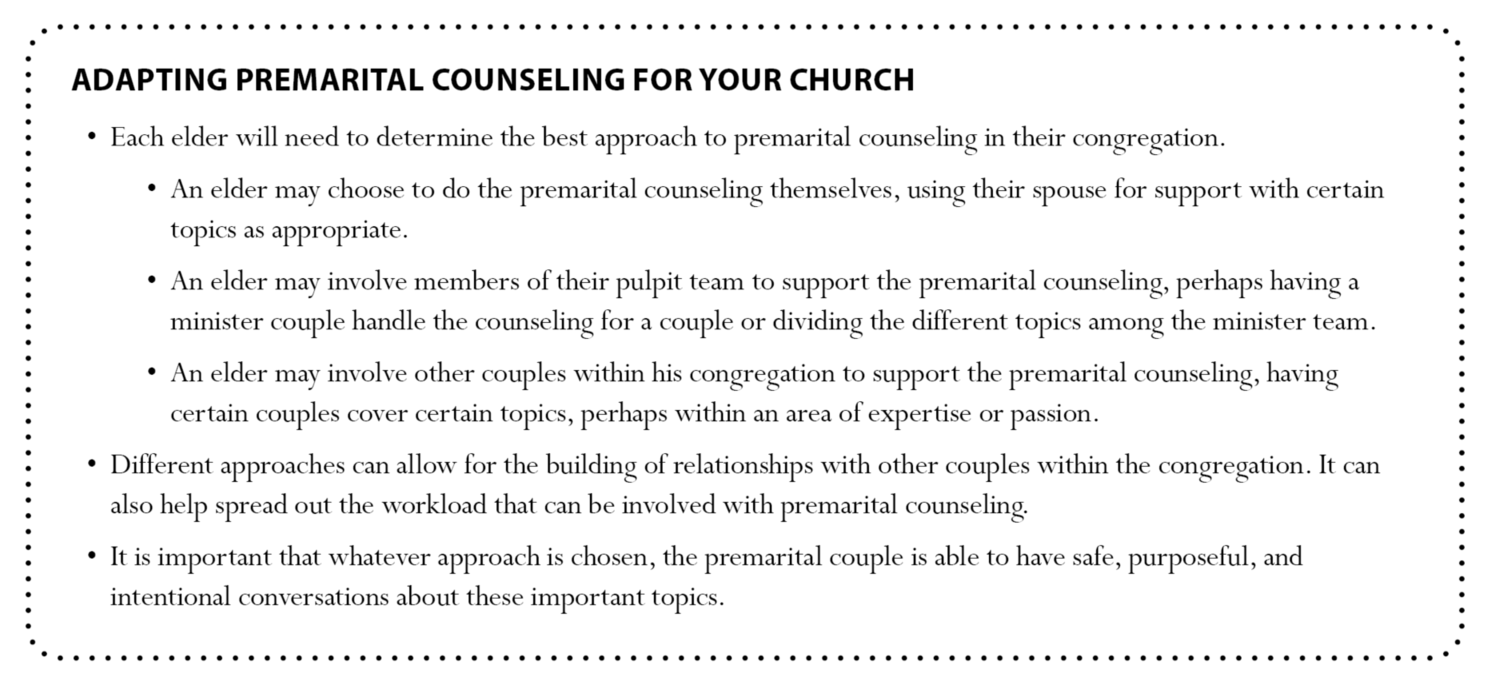
- Meeting individually – Meeting individually with the woman and man getting married has also proven valuable. This can provide you with an opportunity to ensure both are feeling understood in their relationship, growing in healthy manner, and privately check on potential red flags. If a couple is helping with the premarital counseling, it works well to have the women and men meet individually.
- Sharing their past – Engaged couples today are more often more open about past sinful behaviors and struggles than previous generations may have been. Therefore, by the time an engaged couple meets with you they may have already talked in depth about their past. At other times, they may be unaware of each other’s past. Discretion is important in considering what and how much of the past to share – being too vague may hinder a clear understanding of what happened, while sharing too many details can lead to lasting graphic mental images. Openness and transparency are critical for healthy, trust-filled relationships, but this is not the same as graphic details.
Principles to Consider
- Preventative –The engagement period is a time to consider potential red flags related to the individuals, the couple, or their environment. “Factors that Could Potentially Lead to Marital Struggles” (p.255-256) is a helpful resource to guide you in this area. Observing the ongoing interactions of a couple and speaking with their parents can highlight strengths and growth areas. All of us have areas of vulnerabilities in our lives that require intentional engagement. It will be helpful for an engaged couple to know their areas of relational vulnerability as they transition to marriage.
- Proactive – Engagement is a time to develop healthy habits for marriage. Healthy patterns set early on can become helpful rituals of connection practiced over the years to come. Couples should practice healthy physical touch and open communication to support the transition from celibacy to marital sexuality. This involves deepening emotional and relational bond while being accountable for clear boundaries. Open discussions on physical boundaries are recommended. In addition to yourself, it is helpful to ask the couple who will hold them accountable to the agreed upon boundaries.
- Community – Encourage premarital couples early on to select an older mentor couple who can come alongside and support healthy growth and integration into the church body post marriage. This can begin by having dinner or coffee with the engaged couple and asking questions about their history and how God has brought them together. Brief conversations with a mentor couple provide you with another perspective as you support this couple.
See the back of the premarital booklet (p.239-241) for a Potential Premarital Counseling Schedule.
Key Points to Consider
While the following areas are not all inclusive and more topics can be found throughout this Growing a Strong Marriage booklet, they represent common areas which are healthy for couples to consider during their engagement. These key points can be a helpful starting points as you walk through these topics with the engaged couple.
Leaving & Cleaving Key Points (Early Engagement)
- Consider how the relationship with future in-laws is growing and developing. The process of leaving and cleaving is an opportunity for parents to speak into their child’s life (areas they see strength, potential growth areas, etc.) as well as time for the couple and parents to talk about their changing relationship and expectations, how holidays will be handled, potential grandkids, frequency of visits, etc. (Leaving and Cleaving)
- Things to look for during conversations include: Is the couple setting healthy boundaries with family and friends? Are they beginning to turn toward their future spouse before their parents? Are parents honored? Are parents respecting their child’s process of leaving?
- We often bring in unconscious expectations from our family of origin. It is helpful to have the couple talk about their parents and whether mom, dad, or both did a given task in the home. These experiences shape our expectations in our own marriage. (Roles and Decision Making in Marriage)
Communication Key Points (Middle Engagement)
- Healthy communication and conflict management are critical for growing a strong marriage. Commonly, couples don’t have conflict early in their engagement. Some of this may have to do with infatuation, some may have to do with avoidance. All couples have conflict from time to time. It is important to teach healthy principles in these areas and encourage couples to practice cultivating healthy communication, active listening, and conflict management skills.
- Often couples jump too quickly to agree on a particular topic. There needs to be understanding before an agreement. A mindset to embrace is one that lovingly communicates a desire while also taking into consideration the other’s thoughts and reactions. (Communication in Marriage)
- Marriage relationships can be strengthened as couples learn how to move through conflict in a healthy way. These repair conversations create an environment where both individuals can feel understood and grow in the ability to make sense of how conflict occurred. Repair conversations deepen intimacy and help couples step into difficult conversations with the confidence that they will be okay. (Conflict Management Skills in Marriage)
- Stress can tweak the messages we send and receive from each other. Supporting healthy stress management can lead to more effective communication. Additionally, it will be helpful for couples to learn how to support each other through stressful times rather than letting stress drive a wedge between them or taking stress out on the other personally.
- The level of encouragement, affirmation, and gratitude in a marriage impacts the lens through which one views one’s spouse. These factors also directly influence a couple’s ability to work through conflict and dialogue in a healthy manner. (Communication in Marriage)
Intimacy Key Points
- Couples build intimacy in many ways including non-sexual physical intimacy, intellectual intimacy, proximal intimacy, recreational intimacy, spiritual intimacy, emotional intimacy and sexual intimacy. Helping couples to cultivate intimacy at various levels strengthens their relationship, builds resilience, and helps them understand the breadth of intimacy we can experience with God.
Emotional Intimacy (Early Engagement)
-
- Support a deepening level of emotional intimacy among engaged couples. This requires conversations to move from simply facts to the couple beginning to share their own feelings and experiences. As this process continues the couple will naturally desire physical closeness. This is normal and part of God’s design.
- Part of growing into deeper intimacy is more fully understanding each other. Couples should grow in understanding throughout their life together as they navigate inevitable life transitions. One helpful way to start building understanding is through identifying personality characteristics that are similar and different for a given couple. Our personality can impact the way in which we see the world, what we emphasize, or what gives us stress. (Personality & Spiritual Gifts in Marriage)
Sexual Intimacy (Middle Engagement)
-
- Individuals come into marriage with various experiences of their own sexuality. It is important to provide a healthy and biblical vision for sexual intimacy. One of the places this is found in scripture is Ephesians 5:31-32. The marriage relationship, which involves the couple’s sexual relationship, is to reveal and reflect God’s covenantal love to us. Couples are encouraged to invite God into their sexuality so their relationship and experiences may reflect his design and the relationship he desires with us. It may be helpful to talk with engaged couples about the characteristics of covenantal love – it is these same characteristics that should guide their marital sexuality. (Sexuality in Marriage: Foundations)
- For many couples, the transition to sexual intimacy goes okay and they navigate inevitable challenges that may arise. However, there are also couples that struggle with this big transition and could be helped by specific guidance. The reality is without healthy guidance, couples can have painful experiences during the first few weeks or months of their marriage that may have lasting impact for years. Therefore, while it can be an uncomfortable conversation to have, it is important to talk about the honeymoon night and some things to think about and be prepared for as a couple. Often engaged couples welcome such a conversation even though it may be uncomfortable. “Planning for the Wedding Night” is a guide to help you facilitate this conversation or simply share with the couple for their own reading.
Spiritual Union Key Points (Post Wedding)
- Individuals often come into marriage with different approaches to Bible study, prayer, worship, service, tithing etc. Engagement is a time to learn such differences and begin to find ways to support and strengthen the couple’s spiritual union. This may involve a discussion on various spiritual practices such as:
- How can they support each other’s relationship with God?
- What type of practices will they do together and how will they honor their differences? (Developing Spiritual Union: p.117-134)
- What spiritual conversations are happening?
- The Bible clearly values the husband and wife equally while also calling them to distinct roles. Helping couples understand healthy biblical headship and submission is critical for a strong spiritual union. (Biblical Headship & Submission)
- Do you notice any difference in convictions with this couple? Support the discussion and understanding of the difference of biblical absolutes in scripture from what may be practices based on local church norms or certain rules that were established in their own family of origin. While each of these are important, the weight we place on each should be different. (Roles and Decision Making in Marriage)
Ways to Assess Growth
When you meet with a couple, it is important to consider how the couple is growing (or not growing) in their relationship as it moves toward marriage. Clear indicators of a deepening bond and increasing levels of vulnerability between the couple include:
- Increasing openness & active listening in communication.
- Increasing levels of emotional intimacy and desire for physical closeness.
- Willingness and humility to acknowledge areas of growth in self and other.
- Ability to identify and discuss areas of similarities and differences as a couple.
- Ability to identify and discuss areas of strength and challenge as a couple.
In all these areas, it is important to remember growth (not perfection) is the focus. As you meet with the engaged couple, is the couple maturing together in a way that reflects an ongoing growth trajectory spiritually, physically, and emotionally?
Post-Wedding Follow-Up
- What: The transition for a couple post-wedding includes a lot of change and adjustment. Additionally, the engagement period provides only limited time to cover all the important topics related to marriage. It is recommended that you have plans in place to touch base with the couple post-wedding to ensure they are adjusting well and to continue discussion and learning. There are several ways you can approach this follow-up:
- Between three months to one year after the wedding: Consider discussing initial adjustment to marriage and topics that didn’t get covered in premarital counseling.
- Between one and three years after the wedding: Consider discussing their growth, spiritual union, patterns being established, and how they are overcoming hurdles.
- Between three and five years after the wedding: Consider discussing their growth and potential challenges related to children, balancing work / home life, or other life transitions.
- How: Post-marriage meetings may be initiated by you as an elder, through your minister group, or by one or more mentor couple/s in your congregation. The follow-up meetings may involve covering a module in the “Growing A Strong Marriage” booklet, reviewing “Question to Consider When Reflecting on Your Marriage,” or covering other topics you feel are important. Some congregations have found it beneficial to have a group of 5-10 mentor couples who go through specific modules from the “Growing A Strong Marriage” with the newly married couple. This provides the opportunity for ongoing teaching as well as deepening relationships among the body, especially if one spouse is transitioning to a new church.
Additional Articles

Prepare & Enrich
Marriage is a metaphor God uses throughout the Bible – whether in the Old Testament as God relates to his chosen people or the New Testament as Jesus displays love for his bride, the church. This is a glorious truth and one he calls married couples to reflect. There is

A Guide to Marriage Counseling
Marriage is a covenant relationship designed to reflect the relationship between Christ and His Church (Ephesians 5:22-33). This is an aspirational calling for all couples – while no couple will ever perfectly reflect this relationship, we do well to remember that struggling marriages have an impact beyond the couple themselves.

Elders’ Wife Resources
How to be a People Helper Author: Gary R Collins Everyone faces problems, and it is likely that we can help people more than we realize. This book helps people to 1) become more sensitive to the feelings of others. 2) learn how to deal with “people problems” 3) learn
Comments
Leave a Comment