


A Triangular Model Of Love
The above video was taken from the Mentoring Young Couples Webinar and helps explains aspects of the triangular model of love and how it can help us as we consider our marriages.
How do you define love? Is it a feeling or a choice? Both? Love can be hard to describe and define because it has multiple facets and meanings. This handout shows how several aspects of love interact for the purpose of helping you better understand love in marital relationships.
“And we have known and believed the love that God hath to us. God is love; and he that dwelleth in love dwelleth in God, and God in him.” (1 John 4:16)
TRIANGLE 1: GOD – HUSBAND – WIFE

This commonly known diagram shows the relationships between a husband, wife, and God.
- Each line represents a relationship: God – Husband; God – Wife; and Husband – Wife. Both husband and wife have an individual relationship with God as well as a relationship with each other.
- As the spouses grow closer to God in their personal relationship with Christ, they also grow closer to each other.
- When each spouse has a healthy and growing relationship with God, their love for Christ is reflected and lived out in the marriage.
- Spiritual stagnation and/or backsliding in one spouse’s individual relationship with God gradually leads to deterioration of marital and family relationships as well.
- Marriages in which only one spouse is a believer or marriages of two unbelievers lead to unbalanced and misshapen triangles.
TRIANGLE 2: COMMITMENT (1) – EMOTIONAL INTIMACY (2) – PASSION (3)

- Marriages that are healthy and growing will display the following three major aspects of love: Commitment (1), Emotional Intimacy (2), and Passion (3).
- Each aspect of love interacts with the others – they are interrelated.
- If you want your marital love to deepen over time, you can’t simply be strong in one area and ignore the others.
- If love is going to stand the test of time, it must be built upon a good foundation.
- If a couple’s decision to marry (or to stay married) is based on a shallow concept of love, the marriage can become endangered when feelings of love wane.
Commitment (1)
Commitment (1) = Christ-like, self-sacrificial love (Agape)
- The Commitment (1) side of love is a decision/choice that one person makes to sacrificially love another.
- The Greek word “Agape” best describes this Christ-like, self-sacrificial love. Agape love is repeatedly used in the New Testament to describe Christ’s love toward us and what our love should be toward others.
- Agape love is unique in that it focuses on the well-being and good fortune of the other person without requiring or demanding that the other person responds similarly.
- Christ is our example: “But God commendeth his love [agape] toward us, in that, while we were yet sinners, Christ died for us.” Romans 5:8.
- The Commitment (1) side of love is evident when couples make a covenant to marry and stay together for richer, for poorer, for better, or for worse. It is not based on feelings that go up and down due to situational factors or how much love the other person “deserves” at any given time.
- Commitment (1) is the foundation of trust in a marriage.
- With the Commitment (1) side of love solidly in place, couples can freely build the second aspect of love in this model: Emotional Intimacy (2).
Emotional Intimacy (2)
Emotional Intimacy (2) = Affection (Storge) + Friendship (Phileo)
The Emotional Intimacy (2) side of love is the result of blending two important aspects of love.
Affection (Greek = Storge)
- Storge refers to familial affection and care.
- In a marital relationship, this is lived out when one spouse intentionally focuses on expressions of love that are helpful and meaningful to the other spouse.
- It is essential to remember we each tend to express love the way we like to receive love, rather than focusing on what makes our spouse feel loved.
- Affection, as a part of Emotional Intimacy (2), is not about physical intimacy.
- We are truly affectionate when we purposefully and regularly apply the combination of quality time, words of affirmation, gifts, acts of service and physical touch that is meaningful to our spouse.
Friendship (Greek = Phileo)
- Phileo refers to the regular communication of thoughts, feelings, hopes and disappointments, etc. between spouses.
- Friendship grows as couples spend time together and develop a collection of memories & experiences unique or special to them as a couple.
- In the emotional/relational sense it is the experience of “knowing and being known.”
Emotional Intimacy (2) allows couples to share their hearts and feel they are “best friends.”
Due to the safety and trust of Commitment (1) and the emotional connection and expression of Emotional Intimacy (2), couples have the opportunity to experience Passion (3).
Passion (3)
Passion (3) = Romantic & sexual love that encompasses heart, soul, mind, and body (Eros)
- The Passionate (3) side of love is the exciting and exhilarating part of love that creates the feeling of “being in love.”
- Healthy romance often occurs as an expression of focused Emotional Intimacy (2). Romance is the bridge between Emotional Intimacy (2) and Passion (3). Romance allows couples to experience times of being very close, emotionally and relationally, in a way that rekindles their Passionate (3) love.
- True Passion (3) connects deeply with the heart, mind, body, and soul of your spouse.
- The foundation of Commitment (1) and Emotional Intimacy (2) allows a couple’s Passionate (3) feelings and sexual relationship to draw them closer together.
- It is important to remember that while Passion (3) is an intense and exciting expression of love, it is only experienced periodically (versus continuously) and is heavily dependent upon the health of Commitment (1) and Emotional Intimacy (2).
HOW THE TYPES OF LOVE WORK TOGETHER
Let’s consider each of the sides of love in the following, simplified way:
Commitment (1) = Self-Sacrifice
Emotional Intimacy (2) = Friendship
Passion (3) = Excitement
- Every couple’s triangle is constantly changing shape and size.
- While, theoretically, having all sides of the triangle balanced is the goal, life simply does not allow it to stay that way for very long.
- Conflict, hurt, and/or damage to any side of the triangle will affect the other sides.
Example One: Commitment Pulls Us Through – During a time when the husband is sick with flu, the Commitment (1) side of love must be the strongest. During times like these the Emotional Intimacy (2) side of love may be gently nurtured while the Passionate (3) side is put “on hold.” Under the circumstances, this “imbalance” is necessary and will hopefully change as soon as the husband’s health returns. It is important to note that when the Passionate (3) side is waning during the illness, the Commitment (1) and Emotional Intimacy (2) sides must make up the balance.
Example Two: Danger Ahead! – Low commitment with high “pseudo-intimacy” and high “pseudo-passion”.
- When the commitment side of love is weak, a couple may be in a serious crisis because the foundation of the marriage is weak.
- The triangle on the next page shows the unbalanced shape of “counterfeit love” – high “pseudo-intimacy” and “pseudo-passion,” countered with very little commitment. This shape is common in situations such as extramarital affairs.

Example Three: Crack in the Foundation – If the Commitment (1) and trust between husband and wife has been damaged by hurtful choices and actions, both Emotional Intimacy (2) and Passion (3) will suffer greatly. Likewise, it is very important for trust, safety, affection, and friendship to be built first before the openness of the Passionate (3) side of the relationship can be experienced as God designed it.
Example Four: Dry and Burned-Out Marriages – Low Intimacy and Low Passion with High Commitment (1).
- An unfortunately common triangle arrangement is one in which Commitment (1) is high, but Emotional Intimacy (2) and Passion (3) are low.
- These couples may have been together for years but may barely know how to have a conversation together about their relationship.
- They are married out of “duty”, and they stay married because of Commitment (1).
- Even though they are committed to staying married, they are missing much of what God designed their marriage to be.

TRIANGLE 3: AN INTEGRATED CHRISTIAN MODEL OF LOVE
Triangle three is a composite showing Triangles 1 and 2 superimposed onto each other.
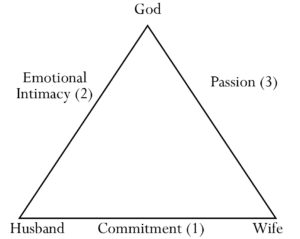
- This model shows that a husband and wife who share Commitment (1) for each other (and who are growing together towards God) will be able to experience Emotional Intimacy (2) and Passion (3) for each other (and for God).
- In a relational sense, they have (1) deepening commitment and trust with each other, (2) a growing friendship and show affection to each other, and (3) they experience excitement and desire for each other.
- In a spiritual sense, they have (1) deepening commitment and maturity of their faith, (2) a growing relationship with Christ, and (3) a feeling of excitement about what God has done for them.
To view complete PDF, click here.
For Further Information:
 The Five Love Languages: How to Express Heartfelt Commitment to Your Mate
Author: Gary Chapman
Publisher: Moody Publishers
This book is a very helpful in teaching couples how to best communicate and express love to each other. The author describes five primary “love languages” and shows how people tend to both give and receive love in different ways.
God’s Design for Sex
This series of articles provides a healthy and biblical view of sexuality for marriage and challenges many conflicting messages we hear from our culture today. [Focus on the Family]
Additional Articles

The Journey to a Healthy Marriage
In many ways, all of life can be viewed as a process of growth – from one stage to the next. The apostle Paul shares in Colossians 2:6-7 “As ye have therefore received Christ Jesus the Lord, so walk ye in him: Rooted and built up in him, and stablished

Solid Foundations: Building a Love that Lasts Podcast Episode
A lot goes into a thriving marriage. In this episode of Breaking Bread, Kaleb Beyer uses the research of Dr. John Gottman to place his finger on the components of a marriage that not only lasts, but flourishes.

Three Ingredients for Cherishing Your Spouse
We often talk about the importance of love and deep commitment in marriage – foundational aspects for marriage. Yet how often have you considered we are also called to cherish our spouse? In Ephesians 5:29-30, Paul writes, “For no man ever yet hated his own flesh; but nourisheth and cherisheth
Comments
Leave a Comment